Robohub.org
The feeling of what it is like to be a robot

Philosopher Thomas Nagel famously characterised subjective experience as “something that it is like to be…” and suggested that for a bat, for instance, there must be something that it is like to be a bat [1]. Nagel also argued that, since we humans differ so much from bats in the way we perceive and interact with the world, then it is impossible for us to know what it is like for a bat to be a bat. I am fascinated, intrigued and perplexed by Nagel’s ideas in equal measure. And, since I think about robots, I have assumed that if a robot were ever to have conscious subjective experience then there must be something that it is like to be a robot that – even though we had designed that robot – we could not know.
But I now believe it may eventually be just possible for a human to experience something approaching what it is like to be a robot. To do this would require two advances: one in immersive robot tele-operation, the other in the neuroscience of body self-image manipulation.
Consider first, tele-operation. Tele-operated robots are, basically, remotely controlled robots. They are the unloved poor relations of intelligent autonomous robots. Neither intelligent nor autonomous, they are nevertheless successful and important first wave robots; think of remotely operated vehicles (ROVs) engaged in undersea exploration or oil-well repair and maintenance. Think also of off-world exploration: the Mars rovers are hugely successful; the rock-stars of tele-operated robots.
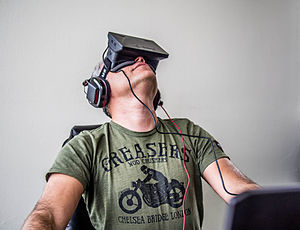
Sergey Orlovskiy using the first version of the Oculus Rift development kit (with separate headphones). Source: Wikipedia.
Roboticists are good at appropriating technologies or devices developed for other applications and putting them to good use in robots: examples are WiFi, mobile phone cameras and the Microsoft Kinnect. With the high profile launch of the Oculus Rift headset, and their acquisition by Facebook, and with competing devices from Sony and others, there are encouraging signs that immersive Virtual Reality (VR) is on the verge of becoming a practical, workable proposition. Of course VR’s big market is video games – but VR can and, I believe, will revolutionise tele-operated robotics.
Imagine a tele-operated robot with a camera linked to the remote operator’s VR headset, so that every time she moves her head to look in a new direction the robot’s camera moves in sync; so she sees and hears what the robot sees and hears in immersive high definition stereo. Of course the reality experienced by the robot’s operator is real, not virtual, but the head mounted VR technology is the key to making it work. Add haptic gloves for control and the robot’s operator has an intuitive and immersive interface with the robot.
Now consider body self-image modification. Using mirror visual feedback researchers have discovered that it is surprisingly easy to (temporarily) modify anyone’s body self-image. In the famous rubber hand illusion a small screen is positioned to hide a subject’s real hand. A rubber hand is positioned where her hand could be, in full view, then a researcher simultaneously strokes both the real and rubber hands with a soft brush. Within a minute or so she begins to feel the rubber hand is hers, and flinches when the researcher suddenly tries to hit it with a hammer.
Remarkably H.H. Ehrsson and his colleagues extended the technique to the whole body, in a study called ‘If I Were You: Perceptual Illusion of Body Swapping’ [2]. Here the human subject wears a headset and looks down at his own body. However, what he actually sees is a mannequin, viewed from a camera mounted on the mannequin’s head. Simultaneous tactile and visual feedback triggers the illusion that the mannequin’s body is his own. It seems to me that if this technique works for mannequins then it should also work for robots. Of course it would need to be developed to the point that elaborate illusions involving mirrors, cameras and other researchers providing tactile feedback are not needed.
Now imagine such a body self-image modification technology combined with fully immersive robot tele-operation based on advanced Virtual Reality technology. I think this might lead to the robot’s human operator experiencing the illusion of being one with the robot, complete with a body self-image that matches the robot’s possibly non-humanoid body. This experience may be so convincing that the robot’s operator experiences, at least partially, something like what it is to be a robot. Philosophers of mind would disagree – and rightly so; after all, this robot has no independent subjective experience of the world, so there is no something that is it like to be. The human operator could not experience what it is like to think like a robot, but she could experience what it is like to sense and act in the world like a robot.
The experience may be so compelling that humans become addicted to the feeling of being a robot fish, or robot dragon or some other fantasy creature, that they prefer this to the quotidian experience of their own bodies.
[1] Nagel, Thomas. What is it like to be a bat?, Mortal Questions, Cambridge University Press, 1979.
[2] Petkova VI, Ehrsson HH (2008) If I Were You: Perceptual Illusion of Body Swapping. PLoS ONE 3(12): e3832. doi:10.1371/journal.pone.0003832
tags: Alan Winfield, EU perspectives