Robohub.org
 

Tree cavity inspection using drones

by and
13 October 2016


share this:
aerial-image-drone

The importance of conserving biodiversity in forest ecosystems is widely recognized. Tree cavities are home to many animal species, such as birds, mammals and beetles, for shelter, nesting or larval development. However trees with low economic interest, often those with cavities or prone to cavity formation, are routinely removed. Consequently, these cavity-dependent species are now endangered. We need better conservation methods to prevent endangering even more cavity-dependent species.

Effective conservation requires better understanding of tree cavities. However, large-scale studies are rare, and detailed data is costly to collect.

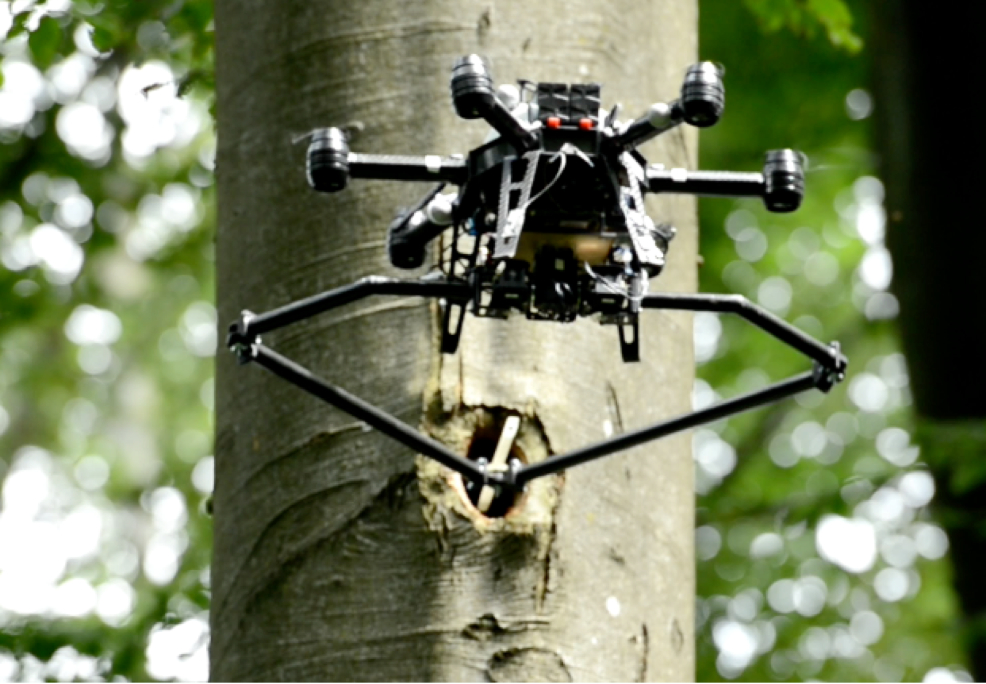
In this work, we focus on woodpeckers’ cavities which are the most common type of cavities. These cavities have an opening of 3-12 cm and a deep hollow inside the tree. We present a system based on Micro Aerial Vehicle (MAV) equipped with a manipulator to perform inspection and 3D reconstruction of tree cavities. The MAV is equipped with a visual-inertial sensor, a depth camera, and a parallel manipulator with an actuated micro-stereo camera at the end-effector, as shown in Figure 1.
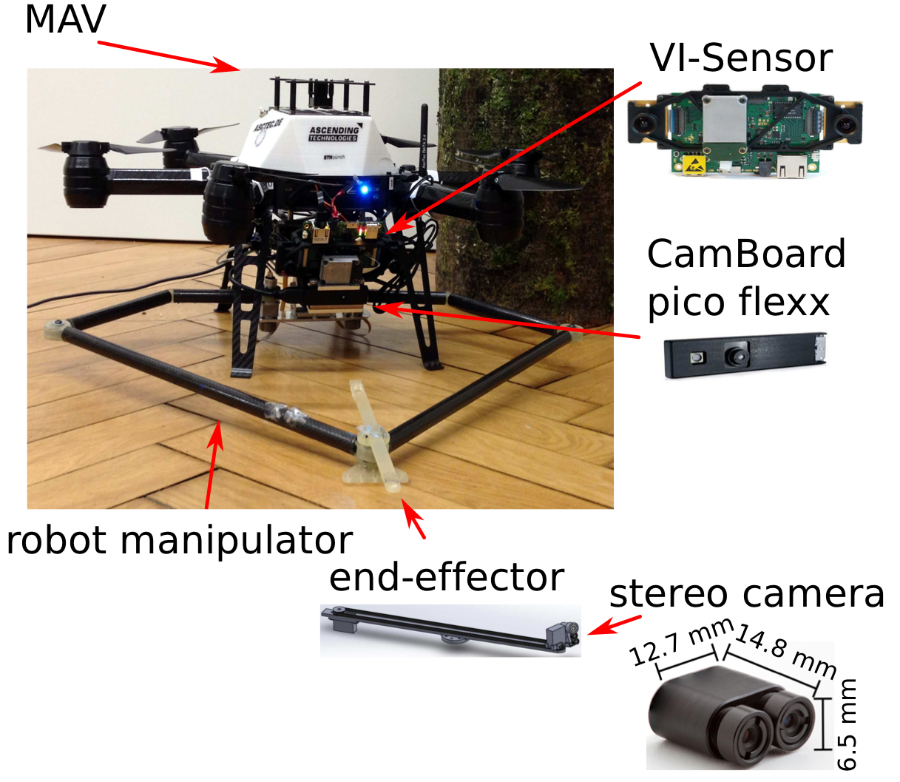
Figure 1: System hardware

Figure 1: System hardware

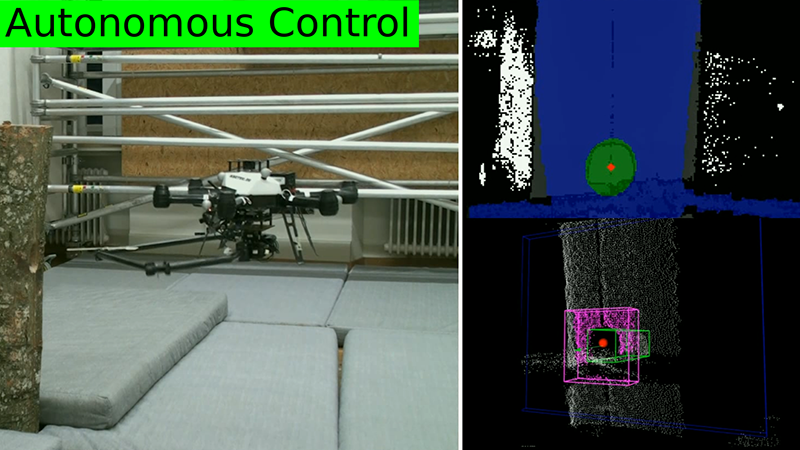
With limited intervention from the user, the system can detect and track a tree cavity. Upon confirmation by the user through a Graphical User Interface (GUI), the inspection process starts.

The proposed approach has been tested in a lab environment as well as outdoors in real tree cavities.
autonomous-control-drone

More details for this approach can be found in our paper: K. Steich, M. Kamel, P. Beardsley,  M. K. Obrist, R. Siegwart  and T. Lachat, “Tree Cavity Inspection Using Aerial Robots.” (The 2016 IEEE/RSJ International Conference on Intelligent Robots and Systems)

Researchers:

Kelly Steich, Mina Kamel, Paul Beardsley, Martin Obrist, Roland Siegwart and Thibault Lachat.


tags:


Mina Kamel is currently a PhD candidate at the Autonomous Systems Lab at ETH Zurich.

Kelly Steich worked for Disney Research and the Autonomous Systems Lab at ETH Zurich


Related posts :


Robot Talk Episode 140 – Robot balance and agility, with Amir Patel

  16 Jan 2026
In the latest episode of the Robot Talk podcast, Claire chatted to Amir Patel from University College London about designing robots with the agility and manoeuvrability of a cheetah.

Taking humanoid soccer to the next level: An interview with RoboCup trustee Alessandra Rossi

and   14 Jan 2026
Find out more about the forthcoming changes to the RoboCup soccer leagues.

Robots to navigate hiking trails

  12 Jan 2026
Find out more about work presented at IROS 2025 on autonomous hiking trail navigation via semantic segmentation and geometric analysis.

Robot Talk Episode 139 – Advanced robot hearing, with Christine Evers

  09 Jan 2026
In the latest episode of the Robot Talk podcast, Claire chatted to Christine Evers from University of Southampton about helping robots understand the world around them through sound.

Meet the AI-powered robotic dog ready to help with emergency response

  07 Jan 2026
Built by Texas A&M engineering students, this four-legged robot could be a powerful ally in search-and-rescue missions.

MIT engineers design an aerial microrobot that can fly as fast as a bumblebee

  31 Dec 2025
With insect-like speed and agility, the tiny robot could someday aid in search-and-rescue missions.

Robohub highlights 2025

  29 Dec 2025
We take a look back at some of the interesting blog posts, interviews and podcasts that we've published over the course of the year.

The science of human touch – and why it’s so hard to replicate in robots

  24 Dec 2025
Trying to give robots a sense of touch forces us to confront just how astonishingly sophisticated human touch really is.


Robohub is supported by:


Would you like to learn how to tell impactful stories about your robot or AI system?


scicomm
training the next generation of science communicators in robotics & AI


©2025.05 - Association for the Understanding of Artificial Intelligence