Robohub.org
US feds propose $4B investment in robocars, seek unified regulatory policy
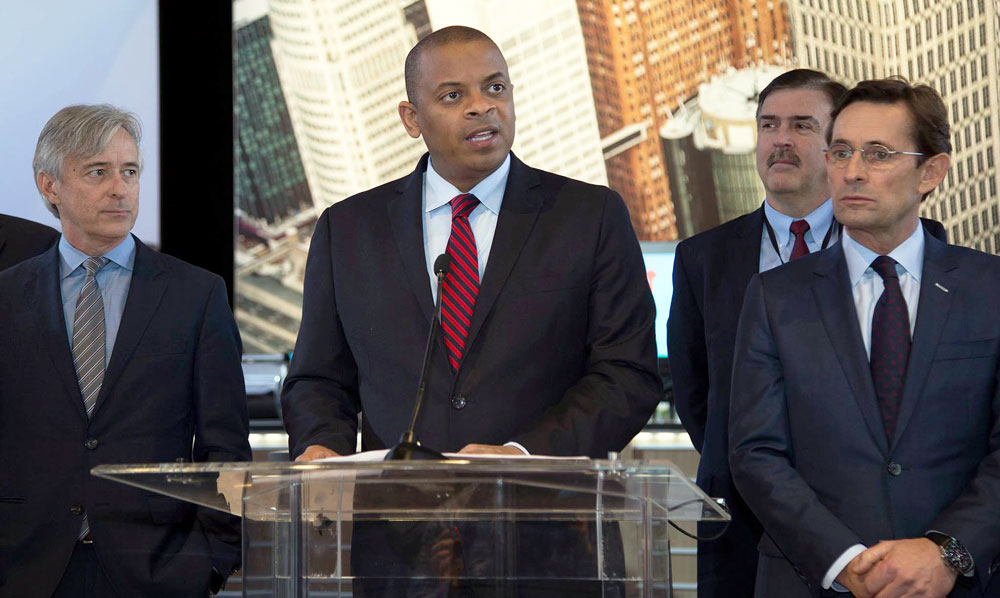
The big news out of the North American International Auto Show last week was U.S. Department of Transportation announcement of The White House $4 billion proposal to expedite deployment of automated vehicle technologies. Source: US Department of Transportation.
NHTSA, the federal car safety agency, has been talking about getting into the robocar game for a while, and now declares it wants more involvement with two important details:
- Unlike California, they are keen on making sure full robocars (able to run unmanned) are part of the regulations, and
- Their regulations might supersede those of states like California.
In the next six months, the DoT will work with states and others on a unified policy. There are some other details here.
(California, by the way, will have hearings in the next couple of weeks on their regulations. I will be out of the state, unfortunately.)
On top of this there is a $4 billion (over 10 years) proposal in the new Obama budget to support and accelerate robocars and (sadly) connected cars.
Perhaps most heartening is a plan to offer reduced regulation for up to 2,500 early deployment vehicles — a way to get companies out there in the field without shackling them first. Public attitudes on robocars have pushed regulators to a rather radical approach to regulation, namely attempting to define regulations before a product is actually on the market, with California even thinking of banning unmanned cars before they arrive. In the normal history of car safety regulation, technologies are built and deployed by vendors and are usually on the road for decades before they get regulated, but people are so afraid of robots that this normal approach may not happen here.
GM Delays super-cruise again
There was a fair bit of excitement when Cadillac announced “super-cruise” — a product similar to what you see in the Tesla autopilot, for the 2014 model year, or so we thought. It was the first effort from a big car company at developing some level of self-driving, even if minimal. Since then, they’ve kept delaying it, while Mercedes, Tesla and others have released such products. Now they have said it won’t show until at least 2017. GM is quickly dropping in the ranks of active Robocar companies, leaving the US mantle to Tesla and Ford. Chrysler has never announced anything, and even ran anti-self-driving-car ads at the Superbowl a few years ago.
Tesla releases “summon” and hints at more
The latest Tesla firmware release offers a “summon” function, so you can train your car to park and come back to you (with a range of 39 feet.) Primary use is to have your car go park itself in the garage, or at a robotic charging station. This didn’t stop Elon Musk from promising we are not very far away from being able to summon the car from very far away.
They have also detailed that those sorts of functions, and other autonomy, will require more sensors than they put in the model S, and that this sensor suite is a few years away, perhaps in time for the model 3.
But wait, there’s more…
The pace of news is getting fast. Even I’m having trouble keeping up with everything even though it’s part of my job. This blog will continue to be a place for the news that actually makes a difference, with analysis.
Here are some other items you might find of interest:
- A Tour of Google’s car garage and driving in their 3rd gen prototypes
- A new news web site from Continental, one of the Tier 1 suppliers building self-driving systems. This is general news, not directly about Continental.
- Ford is testing in snow up in Michigan. Localizing on snow is not hard with LIDAR if there are lots of poles, signs and other objects that stick up above the snow. Driving a freshly covered road with no landmarks will be harder. Another issue is deciding what to do when other cars have chosen to “make a lane” in the wrong place, when you know where the lanes really are.
This post originally appeared on robocars.com.
tags: Automotive, autonomous driving, robocars