
Robohub.org
Walking assistive devices for the elderly
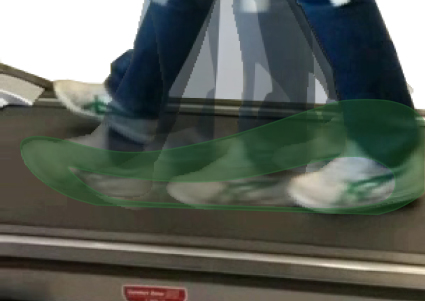
Working out the mechanics of walking is a major step towards creating assistive technologies.
When thinking about robots that can be used to care for the elderly, most people imagine humanoid robots that are meant to help with cooking, cleaning and socializing. But what if robots could be used to keep elderly people from needing help in the first place? Walking assistive devices could be just the tool.
A key element of life quality for the ageing population is preservation of mobility. Being able to walk unassisted is essential for independent living and a crucial driver in maintaining quality of life and self-autonomy. In elderly populations, a wide variety of medical issues lead to loss of mobility, from stroke (CVA) to poorly healed fractures and general loss of muscle mass. Loss of mobility is therefore a key driver in the commonly reported issue of loneliness in elderly people – it makes sense that if it is a struggle to leave your house, you will do so less.
The first requirement for free walking is sufficient muscle strength, not just for walking but also for the associated tasks of day to day life, such as sitting-to-standing motions (and visa-versa) and ascending and descending stairs. For various reasons, the elderly population is subject to weakening muscular power and this is a larger driver in the difficulties that this population begins to face with such tasks.
LSRO (EPFL) in association with NCCR Robotics, propose an assistive device targeted for exactly this situation. Based on an exoskeleton, it is being designed to be usable at home, without permanent human assistance. It should allow normal walking without any impediment. It should provide assistive muscular power only when needed and without any specific command action other than natural motion of the legs.
For a first prototype, the focus has been on the hip joint, a key joint for walking assistance, and an assumption has been made that ankles and knees can still perform their normal functions. “Partial devices” such as those proposed by the Swiss team may offer promising solutions to issues faced by the elderly, who may experience excessive weakness in one joint (here, the hips), by providing a lighter weight and less invasive solution to full exoskeletons. Translating these needs into engineering specifications leads to the following requirements: A single motorised degree of freedom (pivoting of the femur in the sagittal plane), preserving the full mobility of the remaining degrees-of-freedom, high power and low weight, “transparency” for normal walking, no specific control action (such as a “joystick” command) of any kind.
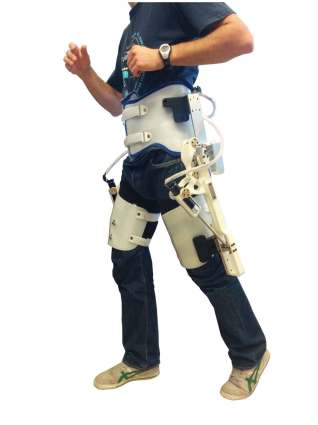
The exoskeleton is designed to be easy to wear, without impeding movement.
The kinematic design of our device is such that torque is intrinsically high around the horizontal position of the femur (typical for sitting-to-standing, stair climbing) and is backdrivable in standing or walking posture (high compliance, “transparence”), thus allowing effortless and swift walking motion. The transmission ratio between motor and end-effector is thus intrinsically, by design, continuously adapted at an optimal value.
Our new types of actuators have been developed so as to fit the requirements of common activities of daily life. For instance, a variable reduction using a ball-screw and bar mechanism to assist different activities such as standing up from a sitting position or standard walking has been evaluated. A high torque is required during the sit-to-stand transitions when the flexion angle of the hip is around 70° from vertical. During walking, less torque is required but higher dynamics is needed. A smaller reduction ratio is therefore better adapted when the flexion angle is less important (i.e. in the walking range of motion). In order to create this specific transmission a ball-screw with an excavator-like mechanism was implemented.
The influence on gait of this kind of robotic hip orthoses are now being assembled and tested in a collaboration between LSRO at EPFL, SMS Lab at ETH Zurich and several clinical centres of elderly care. As the users are able to move on their own, it is very important that the exoskeletons do not. Indeed the added limitations imposed by a sub-optimally designed device may overshadow the benefits that it is intended to provide. The influence of different design parameters such as kinematic configuration, overall mass or user interface are therefore evaluated in collaboration with the Sensory-Motor Systems Lab (SMS) at ETH Zurich.
If you liked this article, you may also be interested in:
- 3 exoskeleton companies go public
- Exoskeleton with haptic sensors helps paralysed man to kick off World Cup
- Rehab robots, smart prostheses and exoskeletons to reach $1.8 billion by 2020
See all the latest robotics news on Robohub, or sign up for our weekly newsletter.
tags: c-Research-Innovation, cx-Health-Medicine, EPFL, ETH Zurich, exoskeleton, human-robot interaction, robots for eldercare, Switzerland

AUAI is supported by:









