Robohub.org
 

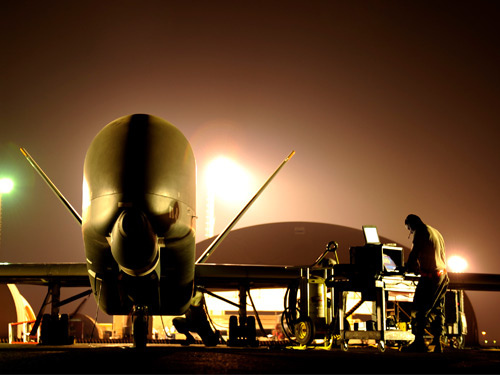
Global Hawks in the crowded Mediterranean airspace

by
24 March 2011


share this:
5554809862_41c6240a8f

The use of UAVs has skyrocketed, a wide variety of systems ranging from extremely small flying bots to large airframes like the Predators or Global Hawk drones is currently in use, mostly from armed forces around the world. Despite this growth, UAVs in civil airspace is a very rare sight with a lot of bureaucracy and strange ramifications.

During the Libya crisis many people who monitor aerial traffic as a hobby, report what is going on from their twitter accounts (like @FMCNL from The Netherlands). One of the most exotic planes for radio plane-spotters is the RQ-4 Global Hawks based in southern Italy that operates in a very crowded region. As David Cenciotti describes in his blog they use special corridors and dedicated climb/descent areas for proper deconfliction with other traffic while specific notifications are also given to other aircrafts. The Global Hawk as a system has two separate ground segments a Launch and Recovery Element (LRE), and a Mission Control Element (MCE). When they are beyond line of sight they are piloted via satellite link. However they carry radio equipment that enable pilots working at the ground station to talk as if they were on the aircraft. Air Traffic controllers communicate with the virtual pilots in a similar way to the ones in human piloted aircraft. The use of large UAVs (military and of course civilian) inevitably will increase and they will communicate routinely like that or in a more advanced stage they may be able to transmit messages on their own.


tags: , , , , , ,


Ioannis K. Erripis joined the ROBOTS association in early 2011 as a news reporter and now leads all technical aspects of the Robohub project, including website design, implementation and branding.


Related posts :


Bio-hybrid robots turn food waste into functional machines

  22 Dec 2025
EPFL scientists have integrated discarded crustacean shells into robotic devices, leveraging the strength and flexibility of natural materials for robotic applications.

Robot Talk Episode 138 – Robots in the environment, with Stefano Mintchev

  19 Dec 2025
In the latest episode of the Robot Talk podcast, Claire chatted to Stefano Mintchev from ETH Zürich about robots to explore and monitor the natural environment.

Artificial tendons give muscle-powered robots a boost

  18 Dec 2025
The new design from MIT engineers could pump up many biohybrid builds.

Robot Talk Episode 137 – Getting two-legged robots moving, with Oluwami Dosunmu-Ogunbi

  12 Dec 2025
In the latest episode of the Robot Talk podcast, Claire chatted to Oluwami Dosunmu-Ogunbi from Ohio Northern University about bipedal robots that can walk and even climb stairs.

Radboud chemists are working with companies and robots on the transition from oil-based to bio-based materials

  10 Dec 2025
The search for new materials can be accelerated by using robots and AI models.

Robot Talk Episode 136 – Making driverless vehicles smarter, with Shimon Whiteson

  05 Dec 2025
In the latest episode of the Robot Talk podcast, Claire chatted to Shimon Whiteson from Waymo about machine learning for autonomous vehicles.


Robohub is supported by:


Would you like to learn how to tell impactful stories about your robot or AI system?


scicomm
training the next generation of science communicators in robotics & AI


©2025.05 - Association for the Understanding of Artificial Intelligence