
Robohub.org
DNA testing chip delivers results in one hour, paves way for personalized drug treatments
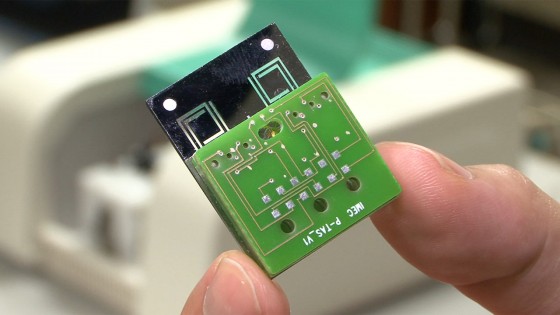
Panasonic, together with the Belgium-based research institution IMEC, has developed a DNA testing chip that automates all stages of obtaining genetic information, including preprocessing.
This development is expected to enable personalized, tailor-made therapy to become widespread.
“This is the chip we’ve actually developed. As you can see, it’s less than half the size of a business card. It contains everything needed for testing DNA. Once a drop of blood is inserted, the chip completes the entire process, up to SNP detection.”
SNPs are variations in a single DNA base among individuals.
Detecting SNPs makes it possible to check whether genetically transmitted diseases are present, evaluate future risks, and identify genes related to illness.
“By investigating SNPs, we can determine that this drug will work for this person, or this drug will have severe side-effects on that person. Investigating SNPs enables tailor-made therapy. But with the current method, it has to be done in a specialized lab, so it actually takes three to four days. In the worst case, it takes a week from sending the sample to getting the result. Our equipment can determine a patient’s SNPs in just an hour after receiving the blood.”
Testing is done simply by injecting the blood and a chemical into the chip, and setting it in the testing system.
First of all, the blood and chemical are mixed. DNA is then extracted from the mixed solution. The regions containing SNPs are then cut out and amplified. DNA amplification uses technology called PCR, which cuts out the desired sections by varying the temperature. With the conventional method, this process took two hours.
“Through careful attention to thermal separation design, we’ve achieved high-speed PCR, where 30 temperature cycles are completed in nine minutes. We think this is one of the fastest PCR systems in the world.”
The amplified DNA is then sent through a micropump to a DNA filter. Here, the DNA is separated for each section length. Then, a newly developed electrochemical sensor identifies SNPs while the DNA is dissolved in the chemical.
“To implement this system on one chip, and make detection easy, the first thing we focused on was the actuators. This system requires a very small, powerful pump. In our case, we used a conductive polymer for the actuators. A feature of these actuators is they’re powerful, yet extremely compact. They can exert a pressure of up to 30MPa.”
“Ultimately, we’d like to make this system battery-powered. We think that would enable genetically modified foods to be tested while still in the warehouse.”
tags: c-Health-Medicine, cx-Research-Innovation

AUAI is supported by:









