Robohub.org
 

Draw precise freehand circles and copy paste drawings with the dePENd table

by
29 November 2012


share this:
12-0215-r

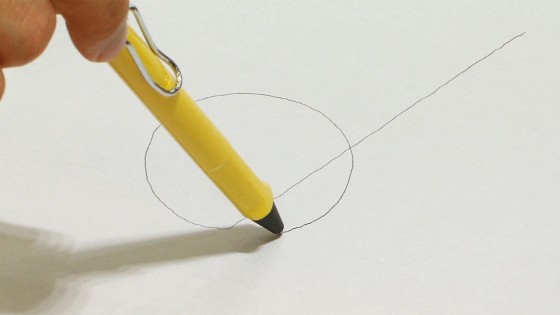
This table helps you to draw precise freehand circles and lines. It is under development by a group in the Yasuaki Kakehi Lab at Keio University.

By using a computer to control the XY position of a magnet under the surface of the table, it implements, on paper, drawing methods utilized in computer graphics.

“I’ll place an ordinary ballpoint pen on the table. Now, I can semi-automatically draw a precise circle, or a straight line, or an illustration prepared in advance. In other words, while I draw with the pen, this system lets me switch to accurate rendering like in computer graphics, such as drawing a precise circle, by assisting me with the pen.”

When drawing, you can use a regular ballpoint pen with a metal tip, or a digital pen. If you use a ballpoint pen, the position where you start drawing has to correspond with the origin on the XY grid, but if you use a digital pen, the system recognizes its location and you can start drawing from any position.

“The digital pen understands the coordinates of the pen position. So, you can start from where you want, and also save and copy the picture you’ve drawn. This means you can copy and paste your original drawing repeatedly.”

“Apart from drawing figures that require precision, we think this system will have various applications. For example, in distance education, students could learn to draw by feeling the sensation of how a teacher draws.”

“Rather than limiting ourselves to pens, we’d like to extend this project to other items used with paper, such as scissors and compasses. We hope to bring in digital technology to assist users with those, too.”


tags:


DigInfo TV is a Tokyo-based online video news platform dedicated to producing original coverage of cutting edge technology, research and products from Japan.

            AUAI is supported by:


Subscribe to Robohub newsletter on substack


Related posts :

Could robots help tackle loneliness? BBC’s Ann Droid raises questions about the future of care

  07 Sep 2026
While the series exaggerates what robots can currently do, some of the technology it depicts is already being tested.

Exploring the Moon will require rovers that can think for themselves – an upcoming NASA mission will test whether they can

  04 Sep 2026
NASA is planning to send three small rovers to the Moon to autonomously compute how to best explore a patch of ground.

Surviving the paper deluge: Notes from an ICRA panel on publishing, LLMs, and the future of peer review

Experts discuss peer-review challenges and possibilities for reshaping the process.

When expressive humanoid robots are awkward, people become wary – new brain study

  31 Aug 2026
People become more suspicious of a humanoid robot that makes errors, especially when the robot is an expressive conversation partner.

First 11 vs 11 humanoid soccer game played at RoboCup 2026

  28 Aug 2026
Watch highlights from this historic match.

How green is your robot? And other awkward questions

Robots clean rivers and sort waste, monitor ecosystems, and inspect renewable-energy infrastructure. But even the greenest robot has an environmental footprint.

These tiny drones are powered by sound

  24 Aug 2026
EPFL engineers have designed acoustic cavities that convert sound waves into thrust, propelling small robots and ultralight aerial vehicles without on-board actuators or electronics.

#AAMAS2026 blue sky award winner: Foundation world models for agents in changing environments

and   21 Aug 2026
Hear from the AAMAS 2026 Best Blue Sky Paper Award winner.


AUAI is supported by:


Subscribe to Robohub newsletter on substack


©2026.05 - Association for the Understanding of Artificial Intelligence