
Robohub.org
Toyota Partner Robot provides everyday assistance for people with disabilities
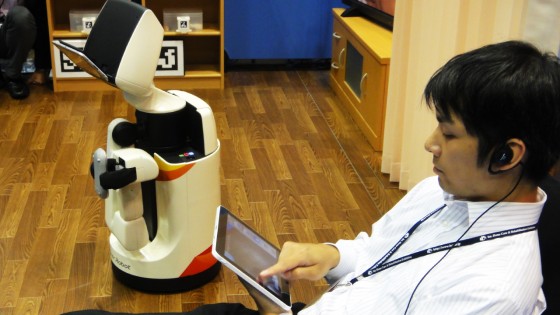 Toyota has developed the Partner Robot, to provide everyday assistance for people with disabilities. This robot has a compact, cylindrical body, so it can turn round in small spaces, as well as folding arms, which can do tasks such as fetching objects and opening curtains. The robot is controlled easily, by using the touch interface on a smartphone or speech recognition. It can also be controlled remotely by a caregiver, while communicating with the user.
“For robots to operate in ordinary living spaces, the most important factor is their size. So, in developing this one, we’ve prioritized making it compact.”
“The picture from the robot’s camera is shown on the user’s tablet. We’ve achieved a capability where, if there’s a dropped object in the picture, the user can tap it, and the robot automatically picks the object up. As for fetching things, it’s currently very difficult for robots to find and bring back objects in ordinary environments. So, for now, we’ve achieved a system where the user puts their favorite things in specific boxes, and registers the boxes, so the robot can automatically fetch things from there.”
The robot’s height can vary between 83cm and 1.3m, so it can reach things in high places. When the robot picks something up, it can also use a suction mechanism, so it can handle thin objects like paper as well.
“Regarding capabilities, we actually surveyed people with disabilities, together with the Japan Service Dog Association, to find out what capabilities users want a robot to have. The results showed that there’s a strong need for robots that can pick up dropped objects, fetch wanted objects, and communicate remotely, to report an emergency, for example. So the first thing we’ve done in developing this robot is, we’ve given it those three capabilities.”
“We’ve done a trial with Yokohama Rehabilitation Center, and we’ve already found some issues that need thinking about. So, the first thing we’ll do now is, we’ll implement capabilities to handle those. For example, people would like the robot to operate switches and open doors. We’ll be testing capabilities like that in our trials.”
tags: c-Health-Medicine, service robots

AUAI is supported by:









