
Robohub.org
IEEE 17th International Conference on Automation Science and Engineering paper awards (with videos)
by Daniel Carrillo-Zapata and IEEE Robotics and Automation Society (RAS)
27
October
2021
share this:
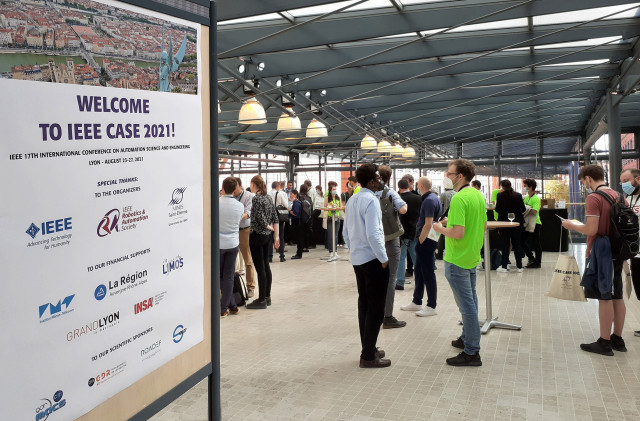
The IEEE International Conference on Automation Science and Engineering (CASE) is the flagship automation conference of the IEEE Robotics and Automation Society and constitutes the primary forum for cross-industry and multidisciplinary research in automation. Its goal is to provide a broad coverage and dissemination of foundational research in automation among researchers, academics, and practitioners. Here we bring you the online presentations by the finalists of the four awards given at the conference. Congratulations to all the finalists and winners!
Best student paper award
Winner
- Designing a User-Centred and Data-Driven Controller for Pushrim-Activated Power-Assisted Wheels: A Case Study
Mahsa Khalili, H.F. Machiel Van der Loos and Jaimie Borisoff
Finalists
- Including Sparse Production Knowledge into Variational Autoencoders to Increase Anomaly Detection Reliability
Tom Hammerbacher, Markus Lange-Hegermann, Gorden Platz
- Synthesis and Implementation of Distributed Supervisory Controllers with Communication Delays
Lars Moormann, Reinier Hendrik Jacob Schouten, Joanna Maria Van de Mortel-Fronczak, Wan Fokkink, Jacobus E. Rooda
- Optimal Planning of Internet Data Centers Decarbonized by Hydrogen-Water-Based Energy Systems
Jinhui Liu, Zhanbo Xu, Jiang Wu, kun liu, Xunhang Sun, Xiaohong Guan
- Deep Reinforcement Learning for Prefab Assembly Planning in Robot-Based Prefabricated Construction
Zhu Aiyu, Gangyan Xu, Pieter Pauwels, Bauke de Vries, Meng Fang
- Singularity-Aware Motion Planning for Multi-Axis Additive Manufacturing
Charlie C.L. Wang, Tianyu Zhang, Xiangjia Chen, Guoxin Fang, Yingjun Tian
Best conference paper award
Winner
- Extended Fabrication-Aware Convolution Learning Framework for Predicting 3D Shape Deformation in Additive Manufacturing
Yuanxiang Wang, Cesar Ruiz, Qiang Huang
Finalists
- Probabilistic Movement Primitive Control Via Control Barrier Functions
Mohammadreza Davoodi, Asif Iqbal, Joe Cloud, William Beksi, Nicholas Gans
- Efficient Optimization-Based Falsification of Cyber-Physical Systems with Multiple Conjunctive Requirements
Logan Mathesen, Giulia Pedrielli, Georgios Fainekos
Best application paper award
Winner
- A Seamless Workflow for Design and Fabrication of Multimaterial Pneumatic Soft Actuators
Lawrence Smith, Travis Hainsworth, Zachary Jordan, Xavier Bell, Robert MacCurdy
Finalists
- Dynamic Multi-Goal Motion Planning with Range Constraints for Autonomous Underwater Vehicles Following Surface Vehicles
James McMahon, Erion Plaku
- OpenUAV Cloud Testbed: a Collaborative Design Studio for Field Robotics
Harish Anand, Stephen A. Rees, Zhiang Chen, Ashwin Jose Poruthukaran, Sarah Bearman, Lakshmi Gana Prasad Antervedi, Jnaneshwar Das
Best healthcare automation paper award
Winner
- Hospital Beds Planning and Admission Control Policies for COVID-19 Pandemic: A Hybrid Computer Simulation Approach
Yiruo Lu, Yongpei Guan, Xiang Zhong, Jennifer Fishe, Thanh Hogan
Finalists
- Rollout-Based Gantry Call-Back Control for Proton Therapy Systems
Feifan Wang, Yu-Li Huang, Feng Ju
- Progress in Development of an Automated Mosquito Salivary Gland Extractor: A Step Forward to Malaria Vaccine Mass Production
Wanze Li, Zhuoqun Zhang, Zhuohong He, Parth Vora, Alan Lai, Balazs Vagvolgyi, Simon Leonard, Anna Goodridge, Ioan Iulian Iordachita, Stephen L. Hoffman, Sumana Chakravarty, B Kim Lee Sim, Russell H. Taylor
tags: c-Research-Innovation

Daniel Carrillo-Zapata
was awared his PhD in swarm robotics at the Bristol Robotics Lab in 2020. He now fosters the culture of "scientific agitation" to engage in two-way conversations between researchers and society.
Daniel Carrillo-Zapata
was awared his PhD in swarm robotics at the Bristol Robotics Lab in 2020. He now fosters the culture of "scientific agitation" to engage in two-way conversations between researchers and society.

IEEE Robotics and Automation Society (RAS)
strives to advance innovation, education, and fundamental and applied research in robotics and automation
IEEE Robotics and Automation Society (RAS)
strives to advance innovation, education, and fundamental and applied research in robotics and automation
AUAI is supported by:








Related posts :
Reimagining robotics for sustainability
EPFL
18 Sep 2026
"Our ambition is not to simply make robots more sustainable; they must actively contribute to solving sustainability challenges."
Watch the ICRA keynote and plenary talks
Lucy Smith
16 Sep 2026
If you missed the conference you can catch up on IEEE TV.
Robots in society, business and culture: August 2026
IEEE Robotics and Automation Society (RAS)
14 Sep 2026
A round up of robotics stories from IEEE RAS.
Building and programming autonomous robots at the York Micromaze Hackathon
Folasayo Ogundipe and UK RAS STEPS
11 Sep 2026
From 25–27 August, UK RAS STEPS members came together for a three-day Micromaze Robot Hackathon.
Robotics roadmaps from around the world spotlight of the month: United States of America
IEEE Robotics and Automation Society (RAS)
09 Sep 2026
US robotics researchers and industry are looking for a cohesive national robotics strategy.
Could robots help tackle loneliness? BBC’s Ann Droid raises questions about the future of care
The Conversation
07 Sep 2026
While the series exaggerates what robots can currently do, some of the technology it depicts is already being tested.
Exploring the Moon will require rovers that can think for themselves – an upcoming NASA mission will test whether they can
The Conversation
04 Sep 2026
NASA is planning to send three small rovers to the Moon to autonomously compute how to best explore a patch of ground.
Surviving the paper deluge: Notes from an ICRA panel on publishing, LLMs, and the future of peer review
IEEE Robotics and Automation Society (RAS)
02 Sep 2026
Experts discuss peer-review challenges and possibilities for reshaping the process.

