Robohub.org
 

One million robots work in car industry worldwide – new record

The automotive industry has the largest number of robots working in factories around the world: Operational stock hit a new record of about one million units. This represents about one third of the total number installed across all industries.
“The automotive industry effectively invented automated manufacturing,” says Marina Bill, President of the International Federation of Robotics. “Today, robots are playing a vital role in enabling this industry’s transition from combustion engines to electric power. Robotic automation helps car manufacturers manage the wholesale changes to long-established manufacturing methods and technologies.”

Robot density in automotive

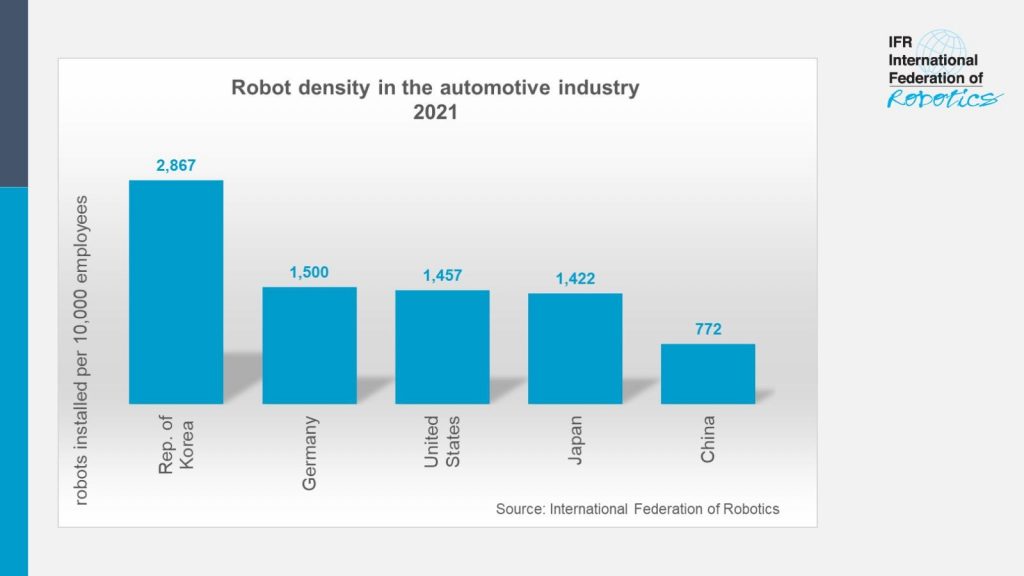
Robot density is a key indicator which illustrates the current level of automation in the top car producing economies: In the Republic of Korea, 2,867 industrial robots per 10,000 employees were in operation in 2021. Germany ranks in second place with 1,500 units followed by the United States counting 1,457 units and Japan with 1,422 units per 10,000 workers.

The world´s biggest car manufacturer, China, has a robot density of 772 units, but is catching up fast: Within a year, new robot installations in the Chinese automotive industry almost doubled to 61,598 units in 2021- accounting for 52% of the total 119,405 units installed in factories around the world.

Electric vehicles drive automation

Ambitious political targets for electric vehicles are forcing the car industry to invest: The European Union has announced plans to end the sale of air-polluting vehicles by 2035. The US government aims to reach a voluntary goal of 50% market share for electric vehicle sales by 2030 and all new vehicles sold in China must be powered by “new energy” by 2035. Half of them must be electric, fuel cell, or plug-in hybrid – the remaining 50%, hybrid vehicles.

Most automotive manufacturers who have already invested in traditional “caged” industrial robots for basic assembling are now also investing in collaborative applications for final assembly and finishing tasks. Tier-two automotive parts suppliers, many of which are SMEs, are slower to automate fully. Yet, as robots become smaller, more adaptable, easier to program, and less capital-intensive this is expected to change.


tags:


International Federation of Robotics (IFR) connects the world of robotics around the globe. We aim at promoting the positive benefits of robots for productivity, competitiveness, economic growth and quality of work and life.


Subscribe to Robohub newsletter on substack


Related posts :

What I’ve learned from 25 years of automated science, and what the future holds: an interview with Ross King

and   14 Apr 2026
Ross King created the first robot scientist back in 2009. He spoke to us about the nature of scientific discovery, the role AI has to play, and his recent work in DNA computing.

Robot Talk Episode 151 – Robots to study the ocean, with Simona Aracri

  10 Apr 2026
In the latest episode of the Robot Talk podcast, Claire chatted to Simona Aracri from National Research Council of Italy about innovative robot designs for oceanography and environmental monitoring.

Generative AI improves a wireless vision system that sees through obstructions

  08 Apr 2026
With this new technique, a robot could more accurately detect hidden objects or understand an indoor scene using reflected Wi-Fi signals.

Resource-constrained image generation and visual understanding: an interview with Aniket Roy

  07 Apr 2026
Aniket tells us about his research exploring how modern generative models can be adapted to operate efficiently while maintaining strong performance.

Back to school: robots learn from factory workers

  02 Apr 2026
A Czech startup is making factory automation easier by letting workers teach robots new tasks through simple demonstrations instead of complex coding.

Resource-sharing boosts robotic resilience

  31 Mar 2026
When a modular robot shares power, sensing, and communication resources among its individual units, it is significantly more resistant to failure than traditional robotic systems.

Robot Talk Episode 150 – House building robots, with Vikas Enti

  27 Mar 2026
In the latest episode of the Robot Talk podcast, Claire chatted to Vikas Enti from Reframe Systems about using robotics and automation to build climate-resilient, high-performance homes.

A history of RoboCup with Manuela Veloso

and   24 Mar 2026
Find out how RoboCup got started and how the competition has evolved, from one of the co-founders.


Robohub is supported by:


Subscribe to Robohub newsletter on substack


©2026.02 - Association for the Understanding of Artificial Intelligence