
Robohub.org
The fate of jobs in relation to robotics is confusing
 Will a robot take your job? Will a higher minimum wage cause job destruction? Or is it all media hype? What’s the truth?
MSNBC asked Bill Gates whether increasing the federal minimum wage is a good idea. He responded: “If you raise the minimum wage, you’re encouraging labor substitution, and you’re going to go buy machines and automate things — or cause jobs to appear outside of that jurisdiction. And so within certain limits it does cause job destruction.”
Will the current political dialogue over raising the federal minimum wage increase the fear people express about robots taking over their jobs? Two infographics attempt to answer that question but instead just add fodder to the grist of the discussion.
 In a not-to-be-taken-too-seriously infographic entitled Techno Takeover “Can your job be done by a robot?”, by MindFlash.com they show the following:
- 3.55 million retail clerks were singled out as likely candidates to be replaced by checkout machines similar to ATMs
- 3.2 million commercial drivers – long-haul, short-run, limos, taxies are all likely to be most effected by automated driving systems
- 2.3 million customer service representatives – better than off-shore call centers?
- Some portion of the 1.5 million members of the armed forces
- 269,900 pharmacists – “robots are unparalleled when it comes to precision”
- 263,800 paralegals sifting through and analyzing legal documents are another target for Watson-like artificial intelligence
- 78,780 medical transcriptionists are being replaced by speech recognition software
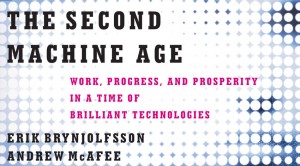
It’s true that employers now have easier, cheaper access to software, automation and cheap expert talent. Brynjolfsson and McAfee, both MIT professors and authors of The Second Machine Age, suggest that:
“We are beginning to automate a lot more cognitive tasks, a lot more of the control systems that determine what to use that power for. In many cases today artificially intelligent machines can make better decisions than humans.” So humans and software-driven machines may increasingly be substitutes, not complements. What’s making this possible are three huge technological advances that just reached their tipping points: exponential, digital and combinatorial.” [Combinatorial advances mean you can take Google Maps and combine them with a smartphone app like Waze, through which drivers automatically transmit traffic conditions on their routes by just carrying their phone in their car, and meld both into a GPS system that not only tells you what the best route is to your destination but what the best route now is because it also sees all the traffic everywhere. Instantly, you’re the smartest driver in town.]
The other infographic, this time by Manolith.com, suggests 10 new jobs that might be in the near-term future – the most current 4 are shown below:

- Become an urban farmer
- Become an alternative reality architect providing virtual augmentation content
- Become a personality programmer offering alternative voices and personalities to Siri-like programs
- Become a remote robot pilot for planes, trains, trucks, delivery vehicles and taxis
Thomas Friedman, in a NY Times Sunday Review article, suggested that over the past 10 years the world has gone from connected to hyperconnected and as a result, employers now have access to above-average software, automation and cheap talent from abroad. Brynjolfsson and McAfee call this the start of the Second Machine Age (described above). The first machine age was the Industrial Revolution and was all about devices and systems to augment human muscle while requiring human control of the activity.
Robotic associations including the A3 (Association for Advancing Automation, a 750-member umbrella association for the RIA, AIA and MCA) and IFR (International Federation of Robotics) have commissioned studies and produced videos which show that deploying robotics does increase and/or preserve wages in the community. Nevertheless, as Bloomberg Businessweek said, “Factory jobs are gone. Get over it.” The truth seems to be that dull, dirty and dangerous jobs will be replaced by automation and robots thereby making products with less spoilage, fewer accidents, higher quality at lower cost – thus they will be more competitive and increase sales with the consequence of increasing workers of a different type: marketing, sales, expediting, warehousing, etc.
tags: analysis, c-Politics-Law-Society, robots and jobs

AUAI is supported by:









