Robohub.org
 

Arduino-powered balancing robot for education, hacking and fun

by
23 May 2014


share this:
LilBot-banner-1

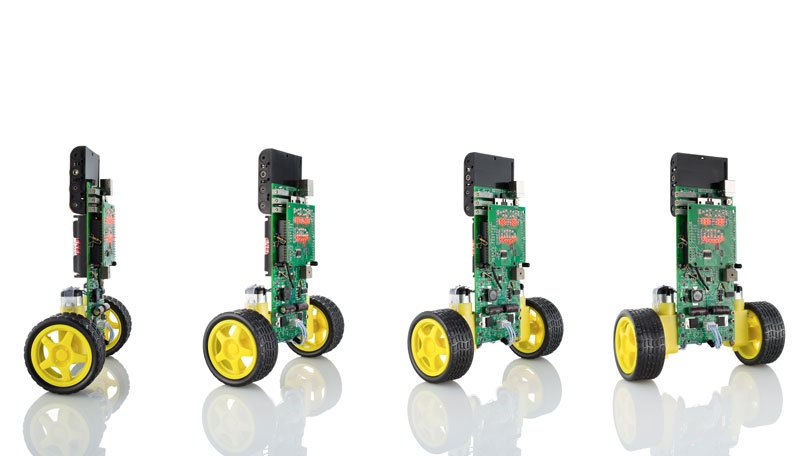
Lil’Bot is an Arduino Uno compatible balancing robot designed as a low-cost teaching vehicle and experimentation platform. Just like an Arduino board, it takes various shields for added functionality. Especially designed for Lil’Bot, the emoShield allows the robot to make various emoticon-like expressions.

For younger children, Lil’Blocks is a graphic programming language based on Blockly (designed by Neil Fraser at Google) and adapted to Arduino by Fred Lin. Blockly is the language of choice for the Hour of Code, an ambitious program to teach children programming in an hour or less. Faithful to that philosophy, Lil’Blocks lets children program a complex balancing robot using tasks as easy as assembling Lego bricks.

A Kickstarter campaign to fund the project is off to a vigorous start, reaching 63% of its funding goal within the first four days. Lil’Bot was conceived at the Mountain View, CA Hacker Dojo.


tags: , , , ,


Chris Hakim

            AUAI is supported by:


Subscribe to Robohub newsletter on substack


Related posts :

Robotics roadmaps from around the world spotlight of the month: Japan

Robots have been a prolific theme in Japanese pop culture and media since the 1950s

Intermittent swimming promotes the energy efficiency of fish-like robot movements

How zebrafish-inspired robots save energy by swimming in bursts.

What does it take for a robot to hold a conversation with a room, not just a person?

and   14 Aug 2026
Find out about a summer school held at Imperial College London.

Robotics roadmaps from around the world

We embark on a tour into some of the recent and prominent robotics roadmaps from around the world.

A ‘5-in-1’ seed-sized surgical robot

Mini robot can move, cut tissue, release drugs, grip and store samples, and generate heat wirelessly

AI agents create virtual playgrounds to help robots get crucial training data

  07 Aug 2026
“SceneSmith” system uses collaborative AI agents to create realistic 3D environments of places like kitchens, hotels, and living rooms, where robots can simulate everyday chores.

Robots in society, business and culture: July 2026

A round up of robotics stories in a new monthly series from IEEE RAS.

Simulated zebrafish and a vision-equipped robotic fish reveal how the body shapes brain circuits

Researchers look to the fish brain to create a robotic zebrafish that can autonomously swim upstream.


AUAI is supported by:


Subscribe to Robohub newsletter on substack


©2026.05 - Association for the Understanding of Artificial Intelligence