Robohub.org
ep.

173

podcast
 

RoboThespian with Will Jackson


by
10 January 2015


share this:


robothespian-bg-1024x0

Transcript below

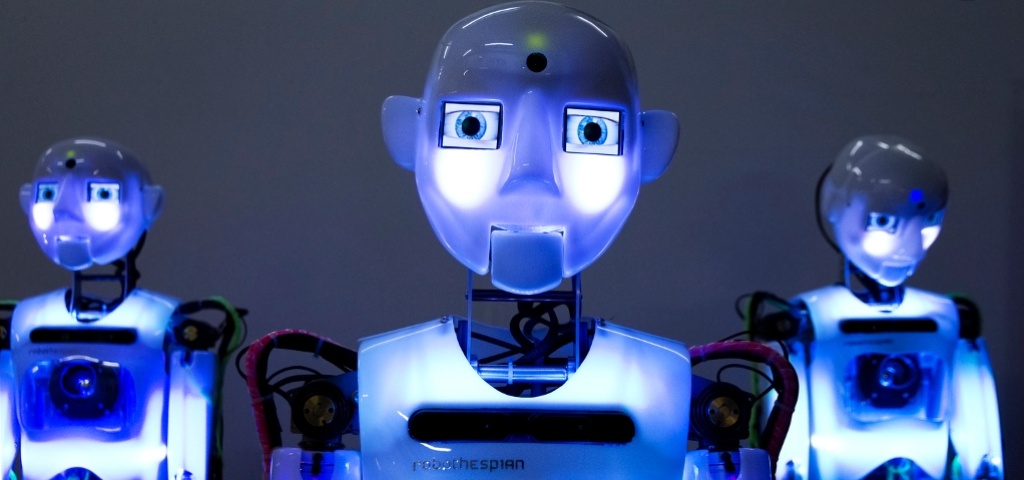
In today’s podcast, Ron Vanderkley speaks with Will Jackson from Engineered Arts Limited about his team’s work making robot actors.

Engineered Arts was founded in October 2004 by Will Jackson, to produce mixed media installations for UK science centres and museums, many of which involved simple mechanical figures, animated by standard industrial controllers.

In early in 2005, the Company began work on the Mechanical Theatre for the Eden Project. This involved three figures, with storylines focused on genetic modification. Rather than designing another set of figures for this new commission, Engineered Arts decided to develop a generic programmable figure that would be used for the Mechanical Theatre, and the succession of similar commissions that would hopefully follow. The result was RoboThespian Mark 1 (RT1).

From thereon, Engineered Arts took a change of direction and now concentrates entirely on development and sales of an ever expanding range of humanoid and semi-humanoid robots featuring natural human-like movement and advanced social behaviours.

RoboThespian, now in its third version, is a life sized humanoid robot designed for human interaction in a public environment. It is fully interactive, multilingual, and user-friendly. Clients range from NASA’s Kennedy Space Centre through to Questacon, The National Science and Technology Centre in Australia. You can watch it in action in the video below.

Will Jackson
Will Jackson and his RoboThespianWill Jackson has a BA in 3D design from University of Brighton, UK and is the Founder of Engineered Arts Ltd.

Links:


tags: ,


Ron Vanderkley


Subscribe to Robohub newsletter on substack


Related posts :

Graphene-based sensor to improve robot touch

  16 Mar 2026
Multiscale-structured miniaturized 3D force sensors for improved robot touch.

Robot Talk Episode 148 – Ethical robot behaviour, with Alan Winfield

  13 Mar 2026
In the latest episode of the Robot Talk podcast, Claire chatted to Alan Winfield from the University of the West of England about developing new standards for ethics and transparency in robotics.

Coding for underwater robotics

  12 Mar 2026
Lincoln Laboratory intern Ivy Mahncke developed and tested algorithms to help human divers and robots navigate underwater.

Restoring surgeons’ sense of touch with robotic fingertips

  10 Mar 2026
Researchers are developing robotic “fingertips” that could give surgeons back their sense of touch during minimally invasive and robotic operations.

Robot Talk Episode 147 – Miniature living robots, with Maria Guix

  06 Mar 2026
In the latest episode of the Robot Talk podcast, Claire chatted to Maria Guix from the University of Barcelona about combining electronics and biology to create biohybrid robots with emergent properties.

Developing an optical tactile sensor for tracking head motion during radiotherapy: an interview with Bhoomika Gandhi

  05 Mar 2026
Bhoomika Gandhi discusses her work on an optical sensor for medical robotics applications.

Humanoid home robots are on the market – but do we really want them?

  03 Mar 2026
Last year, Norwegian-US tech company 1X announced “the world’s first consumer-ready humanoid robot designed to transform life at home”.

Robot Talk Episode 146 – Embodied AI on the ISS, with Jamie Palmer

  27 Feb 2026
In the latest episode of the Robot Talk podcast, Claire chatted to Jamie Palmer from Icarus Robotics about building a robotic labour force to perform routine and risky tasks in orbit.


Robohub is supported by:


Subscribe to Robohub newsletter on substack


©2026.02 - Association for the Understanding of Artificial Intelligence