Robohub.org
 

Video: Giving robots and prostheses a sense of touch
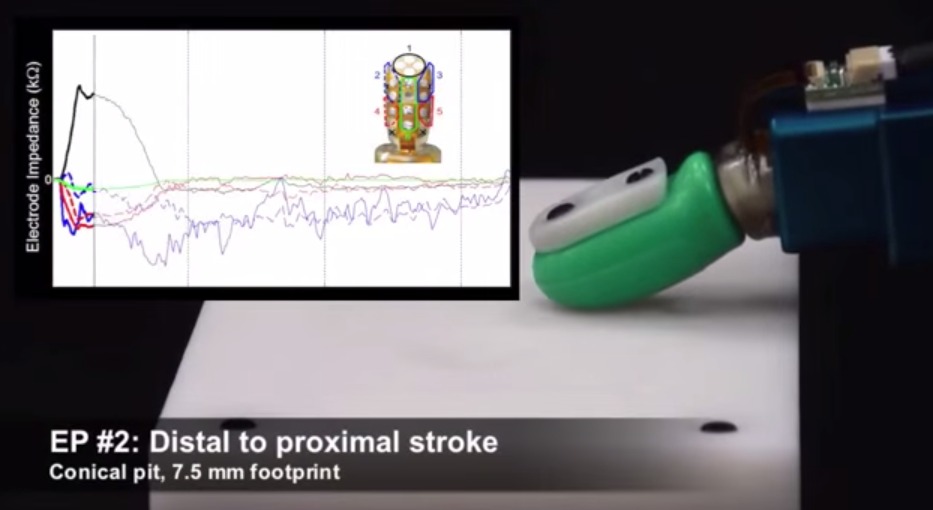
Haptic exploration of fingertip sized geometric features using a multimodal tactile sensor   YouTubeThe UCLA Biomechatronics Lab develops a language of touch that can be “felt” by computers and humans alike.

Research engineers and students in the University of California, Los Angeles (UCLA) Biomechatronics Lab are designing artificial limbs to be more sensational, with the emphasis on sensation.

With support from the National Science Foundation (NSF), the team, led by mechanical engineer Veronica J. Santos, is constructing a language of touch that both a computer and a human can understand. The researchers are quantifying this with mechanical touch sensors that interact with objects of various shapes, sizes and textures. Using an array of instrumentation, Santos’ team is able to translate that interaction into data a computer can understand.

The data is used to create a formula or algorithm that gives the computer the ability to identify patterns among the items it has in its library of experiences and something it has never felt before. This research will help the team develop artificial haptic intelligence, which is, essentially, giving robots, as well as prostheses, the “human touch.”


tags: , , , ,


the National Science Foundation (NSF) is an independent federal US agency created to promote the progress of science.


Subscribe to Robohub newsletter on substack


Related posts :

Resource-sharing boosts robotic resilience

  31 Mar 2026
When a modular robot shares power, sensing, and communication resources among its individual units, it is significantly more resistant to failure than traditional robotic systems.

Robot Talk Episode 150 – House building robots, with Vikas Enti

  27 Mar 2026
In the latest episode of the Robot Talk podcast, Claire chatted to Vikas Enti from Reframe Systems about using robotics and automation to build climate-resilient, high-performance homes.

A history of RoboCup with Manuela Veloso

and   24 Mar 2026
Find out how RoboCup got started and how the competition has evolved, from one of the co-founders.

Robot Talk Episode 149 – Robot safety and security, with Krystal Mattich

  20 Mar 2026
In the latest episode of the Robot Talk podcast, Claire chatted to Krystal Mattich from Brain Corp about trustworthy autonomous robots in public spaces.

A multi-armed robot for assisting with agricultural tasks

  18 Mar 2026
How can a robot safely manipulate branches to reveal hidden flowers while remaining aware of interaction forces and minimizing damage?

Graphene-based sensor to improve robot touch

  16 Mar 2026
Multiscale-structured miniaturized 3D force sensors for improved robot touch.

Robot Talk Episode 148 – Ethical robot behaviour, with Alan Winfield

  13 Mar 2026
In the latest episode of the Robot Talk podcast, Claire chatted to Alan Winfield from the University of the West of England about developing new standards for ethics and transparency in robotics.

Coding for underwater robotics

  12 Mar 2026
Lincoln Laboratory intern Ivy Mahncke developed and tested algorithms to help human divers and robots navigate underwater.


Robohub is supported by:


Subscribe to Robohub newsletter on substack


©2026.02 - Association for the Understanding of Artificial Intelligence