
Robohub.org
Tracing human evolution with robots
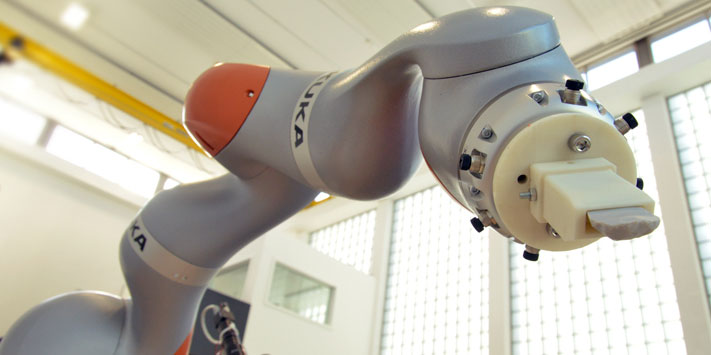
The Kuka lightweight robot with a mounted stone tool replica in an ETH Zurich lab. (Photo: Fabio Bergamin / ETH Zürich)
By Samuel Schlaefli
With the help of robots, archaeologists may soon be able to compare their findings with data from thousands of experimental reference samples, enabling them to determine tool use in the Stone Age. ETH scientists have developed a robotic system and presented it at the industry fair in Hanover.
Kuka-Roboter
Radu Iovita is an archaeologist. He remembers well his student days, when he spent hours scraping away at animal skins with replicas of stone tools found at archaeological sites – all for a bit of pocket money. Through analysis of wear traces under a microscope, archaeologists seek to determine how the tools were used thousands of years ago. This method, known as ‘use-wear analysis’, is a standard approach in modern experimental archaeology today.
“Manual use-wear analysis is incredibly time consuming, and we are unable to control factors such as the force with which a tool is used or its position,” says Iovita. He has spent the past few years looking for opportunities to conduct controlled experiments and experienced initial success with a system using air guns to run a controlled test on the impact-related fractures of Stone Age spearheads.
Archaeologists and robotics team up
But the archaeologist was looking for ways to examine all tools and their application systematically – as well as being as automated as possible. Iovita, now a researcher at the Monrepos Research Centre (RGZM-Leibniz Research Institute for Archaeology) in Neuwied, Germany, remembered Jonas Buchli, a professor at the Institute for Robotics and Intelligent Systems at ETH Zurich, whom he had met 10 years before at a summer school on complex systems. The ETH professor was impressed from the outset with Iovita’s idea to automate archaeological research through the use of robots to standardise the measurements.
Buchli’s then graduate student Johannes Pfleging equipped replicas of stone tools with sensors. Just as Iovita did during his studies, Pfleging scraped at the animal skins, but with a difference: his movements and the force used were recorded by a computer. In doing so, he found evidence that the sensors provided important data that could be used to reproduce and compare the experiments at a later date. But use-wear analysis still remained time-consuming.
By a stroke of luck, the Kuka robotics company had just announced an Innovation Award that made lightweight robots with force control available for use in innovative research projects. These robots are very light in comparison to their load weight and can adapt the forces used to the determined resistance within milliseconds.
A robotic arm for fully automated analysis
One such Kuka robot has been in Buchli’s laboratory since last December. Pfleging, now a doctoral student, has fixed the grey robotic arm with its seven degrees of freedom on to a wooden table. At the end of the arm is a plastic adapter with a piece of wood in which he glued a replica of a stone tool. As soon as Pfleging starts a computer program he wrote himself, the arm begins to use the stone to scrape a piece of leather fastened to the table. After a few rounds, it bends down and guides the tool under a microscope next to it on the table. An image of the stone, magnified 80 times, appears on Pfleging’s computer, revealing fine abrasions.
“With such a system, we can not only automate the painstaking production of wear traces, but also the analysis of the replica,” explains Buchli. Several robots could work leather, stone or wood with replicas of tools 24 hours a day and run the tool after every 50th movement under the microscope to take images of the surface. Thus, a combination of the data and force of the robotic arm would allow a precise reconstruction of how certain abrasions had been achieved. “Through such analytical data, we could one day create massive databases with all the characteristics of archaeologically relevant information on materials and their wear patterns,” explains Buchli.
Deeper insight into ancient civilisations
Wider comparisons such as these have the potential to accelerate the production of knowledge in archaeology and paleoanthropology. For each archaeologically-recovered stone artifact, the researchers could compare a microscopic image with thousands of records from use-wear experiments from around the world, allowing them to make inferences about how the tool was formerly used.
“In archaeology until now, we have been primarily occupied with the morphology of objects,” says Iovita. “However, it is only when we know what the tools were used for that we can make inferences about culture.” It is also generally assumed today that the prehistoric evolutionary development of humankind can be inferred from how tools were used and the cognitive skills needed to use them. In particular, scientists are still groping in the dark when it comes to the use of tools from the period between 3 million and 50,000 years before present.
Paradigm shift underway
Currently, Iovita is experiencing some opposition from within his own profession. Some believe that manual experiments are closer to the past reality; others find that use-wear analysis in general does not advance archaeological theory. Iovita thinks this is mainly due to the fact that most archaeologists have a humanities background and are not familiar with the world of engineers.
“However, a generational and paradigm shift is currently underway,” he believes. “The interest in automated analysis is growing and more and more archaeologists have access to the relevant technology.”
Iovita has put in an application for the establishment of a trace laboratory at the research centre in Neuwied, where the first use-wear analysis with robots will be conducted in the next two to three years. Buchli and Pfleging have now presented their robotic system to experts as part of the Kuka Innovation Award at the industry fair in Hanover. Next, they will develop a prototype in their laboratory that is better suited to archaeological use and cheaper than conventional lightweight robots with force control.
“In 10 years’ time, robotic analysis will be the standard in archaeology,” predicts Buchli. “For the first time, research results would be truly comparable because the methodology behind it is standardised and the devices properly calibrated.”
This article first appeared on ETHZ News.
If you liked this article, you may also be interested in:
- Evolving swimming robots to study origins of extinct vertebrates
- Air, water, energy and food in a nutshell: Space exploration as driver for sustainable robotic agriculture
See all the latest robotics news on Robohub, or sign up for our weekly newsletter.
tags: ETH Zurich, Hannover Messe, Kuka, research, Switzerland

AUAI is supported by:









