Robohub.org
 

Liatris: looking to change how robots see the world

by
20 October 2015


share this:
Liatris

Fully autonomous robotics could be developed today if objects could tell a robot what they are, their purpose and how to utilize them. Liatris is a new open source project built with ROS. Its objective is to reliably read an object’s pose and identity without relying on vision. It presents an opportunity to rip down the barriers that prevent robotics from being present in our everyday lives.

Traditionally, a robot would be required to identify and locate every object in its workspace. Liatris, which is built primarily using ROS, Kivy and Python, instead determines any object’s pose and identity using a touch screen and RFID reader.

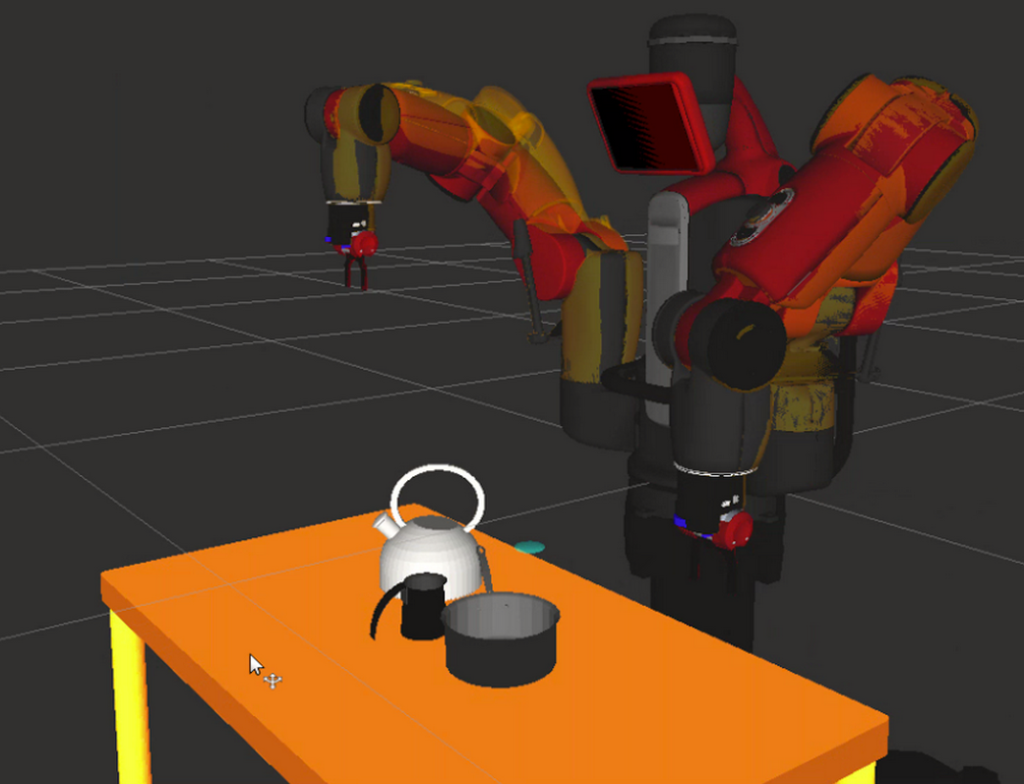
The robot in the video is programmed to identify and grasp any object placed on the touch screen, regardless of the object’s shape, size or positioning. It perceives the object by utilizing the CAD model downloaded from Liatris’ API.

This also tells the robot how to grasp an object while avoiding collisions with other objects (thanks to MoveIt).

The result is an accurate 3D perception and mobile manipulation solution. Liatris can even work simultaneously with multiple objects and touch screens.

Learn more at  Liatris.org


tags: , ,


Mark Silliman is currently the CEO at Smartwaiver, an online waiver solution for businesses.


Subscribe to Robohub newsletter on substack


Related posts :

A multi-armed robot for assisting with agricultural tasks

  18 Mar 2026
How can a robot safely manipulate branches to reveal hidden flowers while remaining aware of interaction forces and minimizing damage?

Graphene-based sensor to improve robot touch

  16 Mar 2026
Multiscale-structured miniaturized 3D force sensors for improved robot touch.

Robot Talk Episode 148 – Ethical robot behaviour, with Alan Winfield

  13 Mar 2026
In the latest episode of the Robot Talk podcast, Claire chatted to Alan Winfield from the University of the West of England about developing new standards for ethics and transparency in robotics.

Coding for underwater robotics

  12 Mar 2026
Lincoln Laboratory intern Ivy Mahncke developed and tested algorithms to help human divers and robots navigate underwater.

Restoring surgeons’ sense of touch with robotic fingertips

  10 Mar 2026
Researchers are developing robotic “fingertips” that could give surgeons back their sense of touch during minimally invasive and robotic operations.

Robot Talk Episode 147 – Miniature living robots, with Maria Guix

  06 Mar 2026
In the latest episode of the Robot Talk podcast, Claire chatted to Maria Guix from the University of Barcelona about combining electronics and biology to create biohybrid robots with emergent properties.

Developing an optical tactile sensor for tracking head motion during radiotherapy: an interview with Bhoomika Gandhi

  05 Mar 2026
Bhoomika Gandhi discusses her work on an optical sensor for medical robotics applications.

Humanoid home robots are on the market – but do we really want them?

  03 Mar 2026
Last year, Norwegian-US tech company 1X announced “the world’s first consumer-ready humanoid robot designed to transform life at home”.


Robohub is supported by:


Subscribe to Robohub newsletter on substack


©2026.02 - Association for the Understanding of Artificial Intelligence