
Robohub.org
ROSCon 2015 recap and videos – part 1
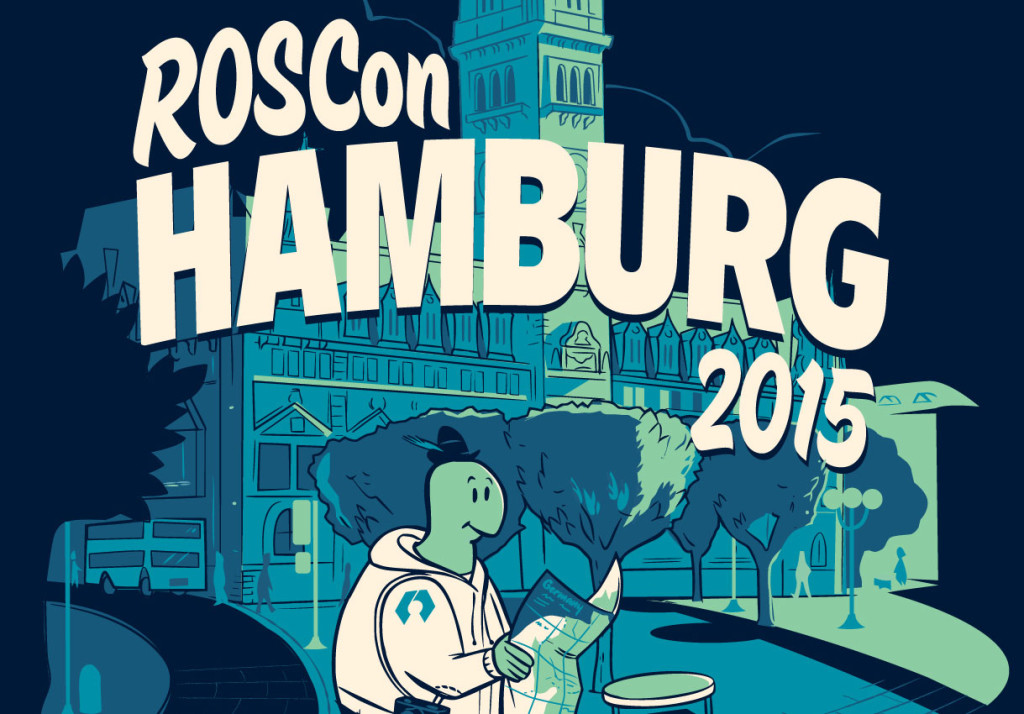
ROSCon is an annual conference focused on ROS, the Robot Operating System. Every year, hundreds of ROS developers of all skill levels and backgrounds, from industry to academia, come together to teach, learn, and show off their latest projects. ROSCon 2015 was held in Hamburg, Germany. Here’s a recap of the first videos posted on the OSRF blog.
Opening Remarks, with Brian Gerkey
Brian is the CEO of the Open Source Robotics Foundation, which oversees core ROS development and helps to coordinate the efforts of the ROS community. Brian helped found OSRF in 2012, after directing open source development at Willow Garage.
In the video, Brian provides an overview of ROSCon attendees and ROS user metrics that shows how diverse the ROS community has become. Brian touches on what’s happened with ROS over the last year, along with the future of ROS and OSRF, and what we have to look forward to in 2016. Brian also touches on DARPA’s Robotics Fast Track program.
An introduction to Team ViGIR’s Open Source Software and DRC Post Mortem, with Stefan Kohlbrecher
Stefan’s early research using tiny soccer-playing humanoid robots at Technische Universität Darmstadt in Germany prepared him well for software development on much larger humanoid robots that don’t play soccer at all. From the Darmstadt Dribblers RoboCup team to the DARPA Robotics Challenge Team ViGIR, Stefan has years of experience with robots that need to walk on two legs and do things while not falling over (much).
Almost all of the software that Team ViGIR used to control its ATLAS robot (named Florian) was ROS based. Stefan credits both the team’s prior experience with ROS, ROS’s existing software base, and its vibrant community for why Team ViGIR made the choice to go with ROS from the very beginning. Controlling the ATLAS robot is exceedingly complex, and Stefan takes us through the software infrastructure that Team ViGIR used during the DRC; from basic perception to motion planning to manipulation and user interfaces.
With lots of pictures and behind-the-scenes videos, Stefan describes how Team ViGIR planned to tackle the challenging DRC Finals course. The team used both high-level autonomy and low-level control, with an emphasis on dynamic, flexible collaboration between robot and operator. Stefan narrates footage of both of Florian’s runs at the DRC Finals; each was eventful, but we won’t spoil it for you.
To wrap up his talk, Stephan describes some of the lessons that Team ViGIR learned through their DRC experience: about ROS, about ridiculously complex humanoid robots, and about participating in a global robotics competition.
Commercial models for the robot generation, with Mark Shuttleworth
In 2004, Canonical released the first version of Ubuntu, a Debian-based open source Linux OS that provides one of the main operational foundations of ROS. Canonical’s founder, Mark Shuttleworth, was CEO of the company until 2009, when he transitioned to a leadership role that lets him focus more on product design and partnerships. In 2002, Mark spent eight days aboard the International Space Station, but that was before the ISS was home to a ROS-powered robot. He currently lives on the Isle of Man with 18 ducks and an occasional sheep. Ubuntu was a platinum co-sponsor of ROSCon 2015, and Mark gave the opening keynote on developing a business in the robot age.
Changes in society and business are both driven by changes in technology, Mark says, encouraging those developing technologies to consider the larger consequences that their work will have, and how those consequences will result in more opportunities. Shuttleworth suggests that robotics developers really need two things at this point: a robust Internet of Things infrastructure, followed by the addition of dynamic mobility that robots represent. However, software is a much more realistic business proposition for a robotics startup, especially if you leverage open source to create a developer community around your product and let others innovate through what you’ve built.
To illustrate this principle, Mark shows a live demo of a hexapod called Erle-Spider, along with a robust, high-level ‘meta’ build and packaging tool called Snapcraft. Snapcraft makes it easy for users to install software and for developers to structure and distribute it without having to worry about conflicts or inter-app security. The immediate future promises opportunities for robotics in entertainment and education, Mark says, especially if hardware, ROS, and an app-like economy can come together to give developers easy, reliable ways to bring their creations to market.
The rest of the videos from the conference can be found here.
tags: c-Events, cx-Research-Innovation, ROS, ROSCon, ROSCon 2015

AUAI is supported by:









