
Robohub.org
Protecting European wine: Vinbot rover optimises harvest and quality
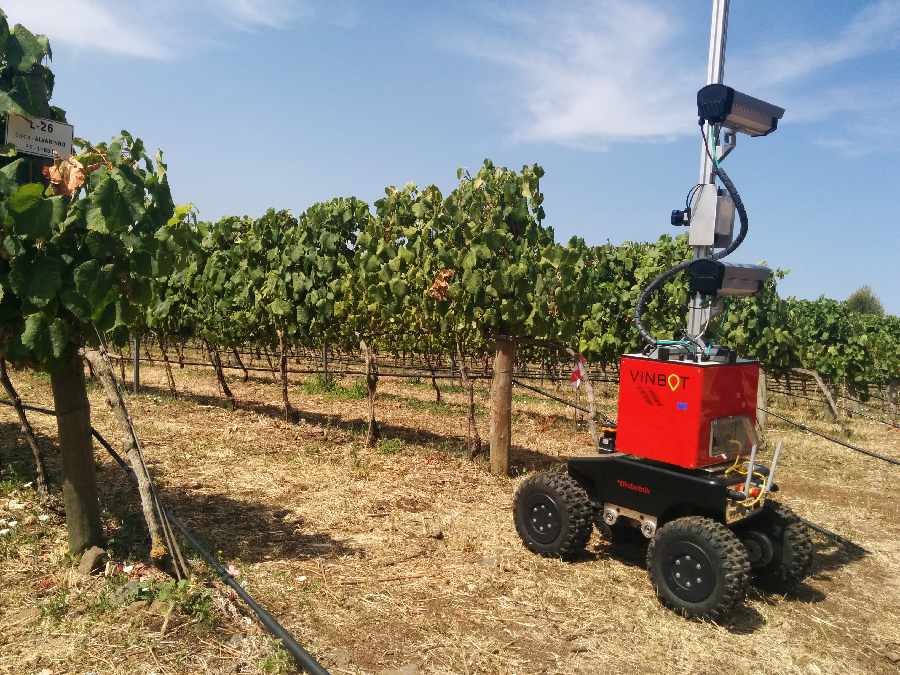
Source: vinbot.eu
by Fintan Burke
With warmer winters and drier summers, climate change might even be having an effect on your favourite bottle of wine.
Winemakers are already witnessing changes. In France, the Burgundy region had its driest July in 66 years in 2015, while Italian producers are planting different grape varieties due to more intense summers.
‘The main problems, I think, are related to quality,’ said Dr Anne-Françoise Adam-Blondon of the National Institute for Agricultural Research, France. ‘The growers are struggling a little bit to keep their product stable in quantity and quality.’
The Issue
Droughts, flood, changing agriculture and rising sea levels – climate change is going to affect every aspect of our lives.
Many researchers believe that some countries will see their social fabric disintegrate as global warming leads to rising inequality and mass migrations.
A key challenge is to anticipate the effects of climate change and adapt our societies accordingly, a topic that will be under discussion at the Adaptation Futures conference in Rotterdam, the Netherlands, from 10 to 13 May.
When extra heat and sunlight boosts the amount of sugar the plant puts into grapes, the wine’s alcohol content can rise above the ideal 12 to 14 % range during fermentation she explains.
It also means that the sugar content develops faster than the polyphenol chemicals that give wines their taste. ‘By stimulating the increase in sugar while the content in polyphenol aromas is not quite mature, you have a lot of sugar very early and the rest of the components are not quite there,’ she said.
To better understand these risks, Dr Adam-Blondon leads the EU-funded INNOVINE project to maintain the high standard of European wine in the growing constraints of climate change.
New grapes
The project has explored breeding grape varieties that better withstand climate change, testing apps and technologies to improve decisions on harvest management, and manipulating plant foliage to see how it helps the plant to adapt.
‘We are progressively understanding a little bit better what happens to the plant under thermal or drought stress,’ said Dr Adam-Blondon, ‘because it’s very complex to understand how the plant will favour, or not, some metabolites in comparison with others.’
The project is nearing completion, and has resulted in a number of publications on new vineyard management techniques. Some winemakers now factor these discoveries in to their operations, says Dr Adam-Blondon.
There are 1.6 million vineyards in the EU and the European wine sector is worth EUR 5 billion annually. France, Italy and Spain account for around 80 % of production, with other important producers including Germany, Portugal, Romania, Greece and Hungary.
While climate change remains a long-term worry for winemakers, the last five years have been the warmest ever recorded, according to the UN’s Food and Agriculture Organization.
The yearly shifts in temperature and sunlight mean that winemakers must keep a close eye on every grapevine throughout each growing season.
‘Imagine – by hand – to know how many square metres each leaf has in a vine, and then to compute for the whole vine, and then for the whole vineyard,’ says Dr Javier Sastre, project coordinator of the EU-funded VINBOT project. ‘This would be crazy.’
Autonomous rover
To improve the accuracy of measurements, the VINBOT project has designed an all-terrain, autonomous rover that scans the leaves of the vineyard with greater accuracy. The long-term aim is to create a commercial product aimed at wine producers.
The rover uses a laser to measure how much actual sunlight is accessible to the leaf surface. It then pieces together these scans to construct a virtual image of the vine and how much sunlight reaches it.
‘What we want to measure here is the square metres of the exposed leaves we have,’ says Dr Sastre, who works on the project as part of Ateknea Solutions, an innovation consultancy based in Barcelona, Spain. ‘The leaves that are behind other leaves are going to be useless; they are not going to receive sunlight.’
The rover also uses GPS to note the location of the scan, so producers have a detailed plan of how each part of their vineyard is performing during the year.
‘The growers are struggling a little bit to keep their product stable in quantity and quality.’
Dr Anne Françoise Adam-Blondon, the National Institute for Agricultural Research, France
The next goal for the VINBOT project, says Dr Sastre, is to focus on collecting all this scanned data into an interface so that producers have a better image of their vineyard.
Another potential application of the rover is a process known as sequential harvesting. By monitoring these scans over the growing year the rover can signal when each particular grapevine is ready to be picked.
‘One of the main advantages of having a map of the yields on the vineyards is with that you can know (when) the vineyard’s lowest yield (is) and can then programme your harvest accordingly,’ said Dr Carlos Lopes of the University of Lisbon, Portugal, who also works on the project.
Another advantage is that producers can spot areas where the vineyards are struggling due to the effects of harsh weather.
‘If you have a map of the yield, you can also understand a bit what is happening in the vineyards,’ he said ‘For example, if you don’t have enough water to irrigate, the yield will decrease – and you can notice that.’
Manuel Ramalho, a Portuguese wine producer who is working with the VINBOT project to develop the technology says that it will enable winegrowers to take a surgical approach to their work.
‘Anything that improves harvesting is welcome,’ he said. ‘The wine market is more demanding than ever and the only way to stand out and ensure customers choose us is to improve our quality. This technology is the future.’
Polyphenols
Used-up grape skins contain high amounts of micronutrients called polyphenols, and a research project has devised a way to extract them efficiently using microwave technology.
‘They (polyphenols) can be used to protect meat, cheese, all kinds of food products from oxidation and they’ve also shown antimicrobial effects against several bacteria,’ said Dr Teresa Moreno of Valladolid University, Spain, who is part of the WINESENSE project.
The project subjects the used grapes to microwaves which can reach 120 degrees Celsius, which opens the cells to expose the polyphenols within. Dr Moreno is now working with others to scale up the process and create a pilot-scale microwave to handle larger quantities.
For more information visit: cordis.europa.eu/project/rcn/110027
tags: agricultural robotics, environment & agriculture, Horizon magazine, research, robohub focus on agricultural robotics

AUAI is supported by:









