
Robohub.org
 

Liquid Robotics set records in PacX

by
06 December 2012


share this:


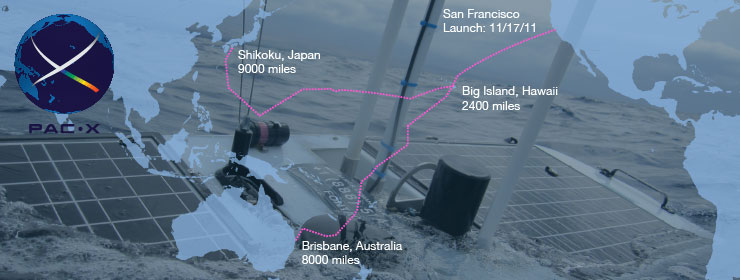
It’s been more than one year and 9,000 nautical miles since Liquid Robotics launched 4 Wave Gliders in San Francisco on November 17, 2011. On November 20, 2012 “Papa Mau” reached the east coast of Australia, near Brisbane. Its sibling “Benjamin” is still enroute, while two other Wave Glider’s ran into delays enroute to Japan. Bill Vass, CEO of Liquid Robotics, announced today that the PacX crossing was a success, both as a research project and the world record for longest autonomous aquatic voyage. In celebration, the top five finalists for the PacX scientific challenge were announced.

“To say we are excited and proud of Papa Mau reaching his final destination is an understatement,” said Bill Vass, CEO of Liquid Robotics. “We set off on the PacX journey to demonstrate that Wave Glider technology could not only survive the high seas and a journey of this length, but more importantly, collect and transmit ocean data in real-time from the most remote portions of the Pacific Ocean. We’ve demonstrated delivery of ocean data services through the most challenging ocean conditions. Mission accomplished.”

An important aspect of the PacX program is the PacX Challenge, a competition designed to encourage scientists and students to make use of the PacX data in interesting, productive, or innovative ways. Research abstracts were submitted from around the world to compete for the grand prize award of a $50,000 research grant from BP and six months of Wave Glider data services.

“Liquid Robotics is proud to announce the PacX Science Board has selected five outstanding finalists to compete for the PacX grand prize,” said Luke Beatman, Oceanographer at Liquid Robotics and chairman of the PacX Science Board. “These scientists will conduct research into some of the world’s most challenging ocean issues ranging from measuring the ocean’s health and respiration to studying the ocean’s biomass – the most fundamental organisms critical to ocean life.” The five PacX finalists are:

J. Michael Beman, University of California Merced, Merced, CA
Nicole Goebel, University of California Santa Cruz, Santa Cruz, CA
Andrew Lucas, Scripps Institution of Oceanography, La Jolla, CA
Elise Ralph, Wise Eddy, Boston, MA
Tracy Villareal, University of Texas, Port Aransas, TX

[press release from Liquid Robotics]



Andra Keay is the Managing Director of Silicon Valley Robotics, founder of Women in Robotics and is a mentor, investor and advisor to startups, accelerators and think tanks, with a strong interest in commercializing socially positive robotics and AI.


Subscribe to Robohub newsletter on substack


Related posts :

What I’ve learned from 25 years of automated science, and what the future holds: an interview with Ross King

and   14 Apr 2026
Ross King created the first robot scientist back in 2009. He spoke to us about the nature of scientific discovery, the role AI has to play, and his recent work in DNA computing.

Robot Talk Episode 151 – Robots to study the ocean, with Simona Aracri

  10 Apr 2026
In the latest episode of the Robot Talk podcast, Claire chatted to Simona Aracri from National Research Council of Italy about innovative robot designs for oceanography and environmental monitoring.

Generative AI improves a wireless vision system that sees through obstructions

  08 Apr 2026
With this new technique, a robot could more accurately detect hidden objects or understand an indoor scene using reflected Wi-Fi signals.

Resource-constrained image generation and visual understanding: an interview with Aniket Roy

  07 Apr 2026
Aniket tells us about his research exploring how modern generative models can be adapted to operate efficiently while maintaining strong performance.

Back to school: robots learn from factory workers

  02 Apr 2026
A Czech startup is making factory automation easier by letting workers teach robots new tasks through simple demonstrations instead of complex coding.

Resource-sharing boosts robotic resilience

  31 Mar 2026
When a modular robot shares power, sensing, and communication resources among its individual units, it is significantly more resistant to failure than traditional robotic systems.

Robot Talk Episode 150 – House building robots, with Vikas Enti

  27 Mar 2026
In the latest episode of the Robot Talk podcast, Claire chatted to Vikas Enti from Reframe Systems about using robotics and automation to build climate-resilient, high-performance homes.

A history of RoboCup with Manuela Veloso

and   24 Mar 2026
Find out how RoboCup got started and how the competition has evolved, from one of the co-founders.


Robohub is supported by:


Subscribe to Robohub newsletter on substack


©2026.02 - Association for the Understanding of Artificial Intelligence









