
Robohub.org
Artificial intelligence expedites breast cancer risk prediction
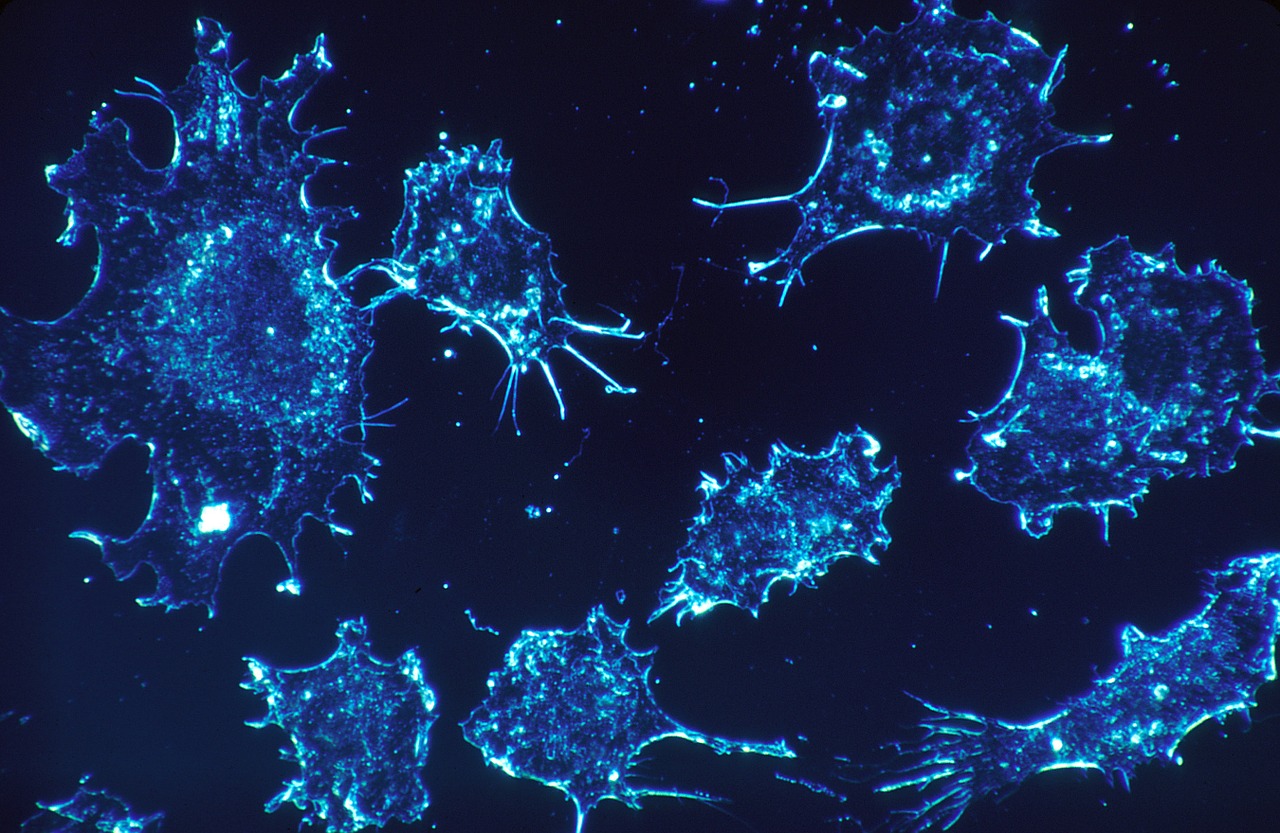
Cancer cells. Credit: CC0
Researchers have developed an artificial intelligence (AI) software that reliably interprets mammograms, assisting doctors with a quick and accurate prediction of breast cancer risk. The AI computer software intuitively translates patient charts into diagnostic information at 30 times human speed and with 99 percent accuracy.
“This software intelligently reviews millions of records in a short amount of time, enabling us to determine breast cancer risk more efficiently using a patient’s mammogram. This has the potential to decrease unnecessary biopsies,” says Stephen T. Wong, Ph.D., P.E., chair of the Department of Systems Medicine and Bioengineering at Houston Methodist Research Institute.
The team led by Wong and Jenny C. Chang, M.D., director of the Houston Methodist Cancer Center used the AI software to evaluate mammograms and pathology reports of 500 breast cancer patients. The software scanned patient charts, collected diagnostic features and correlated mammogram findings with breast cancer subtype. Clinicians used results, like the expression of tumor proteins, to accurately predict each patient’s probability of breast cancer diagnosis.
In the United States, 12.1 million mammograms are performed annually, according to the Centers for Disease Control and Prevention (CDC). Fifty percent yield false positive results, according to the American Cancer Society (ACS), resulting in one in every two healthy women told they have cancer.
Currently, when mammograms fall into the suspicious category, a broad range of 3 to 95 percent cancer risk, patients are recommended for biopsies.
Over 1.6 million breast biopsies are performed annually nationwide, and about 20 percent are unnecessarily performed due to false-positive mammogram results of cancer-free breasts, estimates the ACS.
The Houston Methodist team hopes this artificial intelligence software will help physicians better define the percent risk requiring a biopsy, equipping doctors with a tool to decrease unnecessary breast biopsies.
Manual review of 50 charts took two clinicians 50-70 hours. AI reviewed 500 charts in a few hours, saving over 500 physician hours.
“Accurate review of this many charts would be practically impossible without AI,” says Wong.
Journal reference:
Tejal A. Patel, Mamta Puppala, Richard O. Ogunti, Joe E. Ensor, Tiancheng He, Jitesh B. Shewale, Donna P. Ankerst, Virginia G. Kaklamani, Angel A. Rodriguez, Stephen T. C. Wong, Jenny C. Chang. Correlating mammographic and pathologic findings in clinical decision support using natural language processing and data mining methods. Cancer, 2016; DOI: 10.1002/cncr.30245
Source: Science Daily / Houston Methodist
www.sciencedaily.com/releases/2016/08/160829122106.htm
If you liked this article, you may also want to read:
- Crowdsourcing new strategies for cancer treatment: Towards swarming nanobots
- Developing cost-effective, capable, surgical robots with a sense of “touch”
- Talking Machines: Treating cancer clusters, with Quaid Morris
- Artificial intelligence could transform healthcare, but we need to accept it first
- Microswimmer robot chains can decouple and reconnect in magnetic field
See all the latest robotics news on Robohub, or sign up for our weekly newsletter.
tags: Artificial Intelligence, c-Health-Medicine

AUAI is supported by:









