Robohub.org
ANYmal robot tested on offshore platform
ANYmal
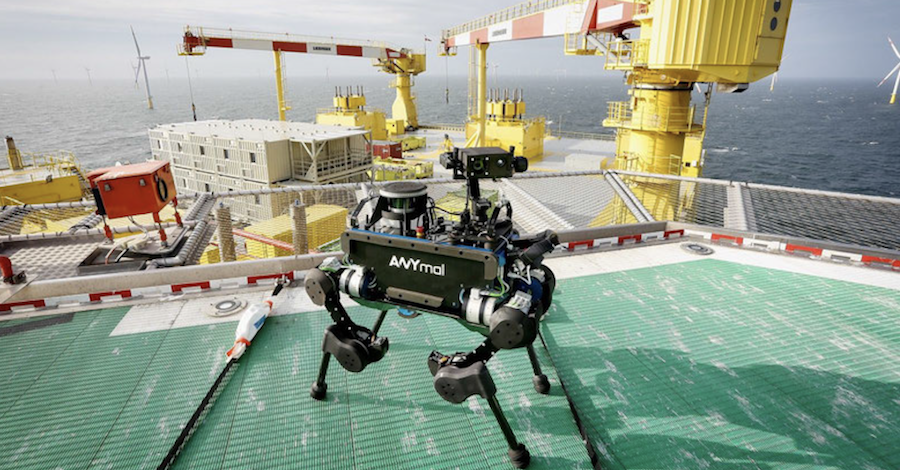
A crucial task for energy providers is the reliable and safe operation of their plants, especially when producing energy offshore. Autonomous mobile robots are able to offer comprehensive support through regular and automated inspection of machinery and infrastructure. In a world’s first pilot installation, transmission system operator TenneT tested the autonomous legged robot ANYmal on one of the world’s largest offshore converter platforms in the North Sea.
In September 2018, the ANYbotics field team boarded a helicopter to fly out to one of the world’s largest offshore converter platforms in the North Sea. Equipped with a customized sensorhead, our four-legged robotic platform ANYmal autonomously performed various inspection tasks of the platform in a one-week pilot installation, making it the world’s first autonomous offshore robot.
Offshore Wind Farms
Offshore energy production is a key component of global energy supply. Apart from oil and natural gas extraction, wind energy is increasingly being produced offshore. One of the key innovators in this field is the Dutch-German transmission system operator TenneT, which connects large-scale offshore wind farms to the onshore grid over a high voltage DC connection. Set out to provide reliable and low-cost energy transmission and distribution, the company adopts most recent technologies.
Robotic Inspection with ANYmal
ANYbotics is partnering with TenneT to evaluate robotic inspection and maintenance on their offshore converter platforms. In periods of unmanned platform operation, a mobile robot helps to reduce the risk of disruptions and ensures the security of the electricity supply. Based on its autonomous navigation capabilities, ANYmal performs routine inspection tasks to monitor machine operations, read out sensory equipment and detect thermal hotspots and oil or water leakages. Whenever required, ANYmal can be remotely operated from an onshore control center in order for TenneT to receive real-time information through the robot’s onboard visual and thermal cameras, microphones and gas detection sensors.
Successful Pilot Installation
Before being deployed on the offshore mission, the ANYbotics field team underwent a rigorous safety training including helicopter escape and survival on sea scenarios. After being taken on a guided tour of the platform to 3D-map the environment and learn the position and characteristics of all inspection points, ANYmal autonomously navigated the platform and processed inspection protocols. The video documents a fully autonomous mission, covering a total of 16 inspection points such as gauges, levers, oil- and water levels and various other visual and thermal measurements.

AUAI is supported by: