Robohub.org
 

Could we make a moral machine?

by
02 March 2016


share this:


Photo source: Alan Winfield

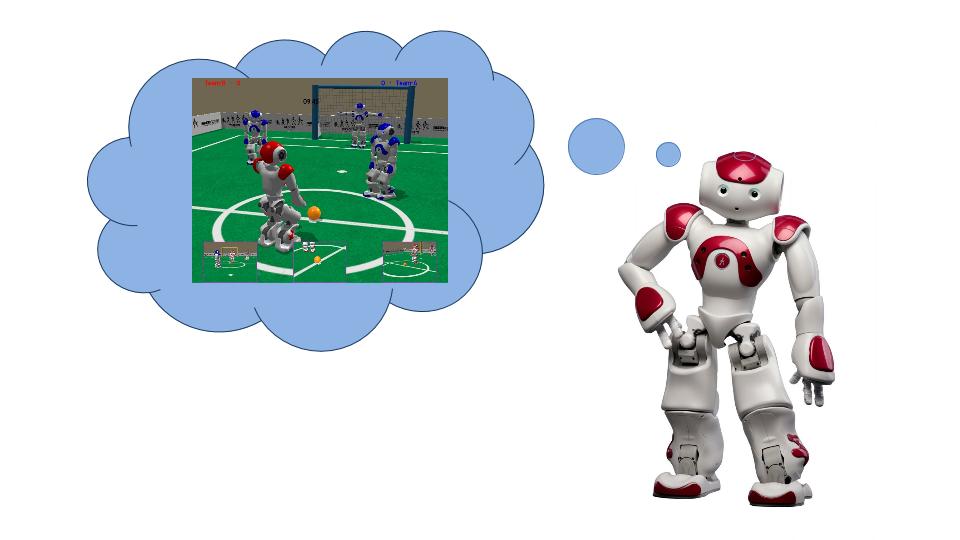
Robot picturing a simulation of itself and its environment and others in the environment. Photo source: Alan Winfield

Could we make a moral machine? A robot capable of choosing or moderating its actions on the basis of ethical rules?

This was how I opened my IdeasLab talk at the World Economic Forum 2016. The format of IdeasLab is 4 five minute (Pecha Kucha) talks, plus discussion and Q&A with the audience. The theme of this Nature IdeasLab was Building an Intelligent Machine, and I was fortunate to have 3 outstanding co-presenters: Vanessa Evers, Maja Pantic and Andrew Moore. You can see all four of our talks on YouTube here.

The IdeasLab variant of Pecha Kucha is pretty challenging for someone used to spending half an hour or more lecturing – 15 slides and 20 seconds per slide.

The biggest lesson – and a surprise to me – is this: robots don’t need to be sentient to be ethical. In other words we don’t need a major breakthrough in artificial intelligence to build an ethical robot.

You can watch the entire IdeasLab video ‘Making an ethical machine’ here:

And since not all of my (ever so carefully chosen) slides are visible in the recording here is the complete deck:

(link to the original file)

And the video clips in slides 11 and 12 are here:

Slide 11: Blue prevents red from reaching danger.
Slide 12: Blue faces an ethical dilemma: our indecisive robot can save them both.


Acknowledgements: I am deeply grateful to colleague Dr Dieter Vanderelst who designed and coded the experiments shown here on slides 10-12. This work is part of the EPSRC funded project Verifiable Autonomy.


tags: , ,


Alan Winfield is Professor in robotics at UWE Bristol. He communicates about science on his personal blog.

            AUAI is supported by:


Subscribe to Robohub newsletter on substack


Related posts :

Developing active and flexible microrobots

  13 May 2026
This class of robots opens up possibilities for biomedical applications.

How to teach the same skill to different robots

  11 May 2026
A new framework to teach a skill to robots with different mechanical designs, allowing them to carry out the same task without rewriting code for each.

Robot Talk Episode 155 – Making aerial robots smarter, with Melissa Greeff

  08 May 2026
In the latest episode of the Robot Talk podcast, Claire chatted to Melissa Greeff from Queen's University about autonomous navigation and learning for drones.

New understanding of insect flight points way to stable flapping-wing robots

  07 May 2026
The way bugs and birds flap their wings may look effortless, but the dynamics that keep them aloft are dizzyingly complex and difficult to quantify.

Robotically assembled building blocks could make construction more efficient and sustainable

  05 May 2026
Research suggests constructing a simple building from interlocking subunits should be mechanically feasible and have a much smaller carbon footprint.

Robot Talk Episode 154 – Visual navigation in insects and robots, with Andrew Philippides

  01 May 2026
In the latest episode of the Robot Talk podcast, Claire chatted to Andrew Philippides from the University of Sussex about what we can learn from ants and bees to improve robot navigation.

Ultralightweight sonar plus AI lets tiny drones navigate like bats

  29 Apr 2026
Researchers develop ultrasound-based perception system inspired by bat echolocation.

Gradient-based planning for world models at longer horizons

  28 Apr 2026
What were the problems that motivated this project and what was the approach to address them?


AUAI is supported by:


Subscribe to Robohub newsletter on substack


©2026.02 - Association for the Understanding of Artificial Intelligence