
Robohub.org
Dynamic target tracking camera system keeps its eye on the ball
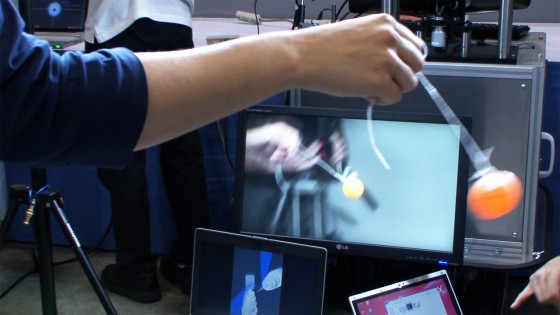
This camera system can track very fast moving objects, keeping them in the center of the screen at all times. Currently under development by the Ishikawa Oku Lab. at the University of Tokyo, this latest version captures Full HD video and can be used outdoors.
“Ordinarily, to change the direction a camera faces, you move the camera mechanically. But in this system, it’s not the camera that moves, it’s the mirrors. This makes it possible to change where you’re looking really quickly. In this demonstration, we’re tracking a table tennis ball. The ball moves extremely fast, but this system can keep compensating for the ball’s motion, so the ball stays in the middle of the image.”
This device consists of two mirrors for pan and tilt, and a group of lenses. The Saccade mirrors can be controlled at high speed, on the order of milliseconds. The mirrors move independently, so this system doesn’t lose its high-speed response even if it’s connected to a large, heavy camera.
Also, by connecting a projector instead of a recording device, images can be projected onto a fast-moving object. This could also be used in AR applications, showing interactive content on moving objects.
“Using a rotating mirror is a common method, but usually, the mirror is in front of the camera, so a very large mirror is needed. But a feature of this system is, it can even capture wide-angle images with a small mirror. That’s because the system contains special optics called a pupil shift system.”
“Another important point is, this system does very fast image processing to recognize the subject. It captures and processes an image every 1/1000th of a second. In this way, it can track the subject stably and continuously, simply by feeding back the subject’s position, without particularly predicting its behavior.”
“For example, this system can record, in great detail, the instant a player hits a home run, including how the bat bends and the ball reacts, and the ball’s subsequent path. Or in soccer, it can record things like penalty kicks in amazing detail. We think this will make it possible to shoot sports in a really compelling way.”
“Right now, we’re actually taking this outdoors to where sports are played, to check how accurately it works. We hope it will be usable for actual broadcasting in about two years.”
tags: Prototype, Vision

AUAI is supported by:









