Robohub.org
Emotionally literate tech to help treat autism
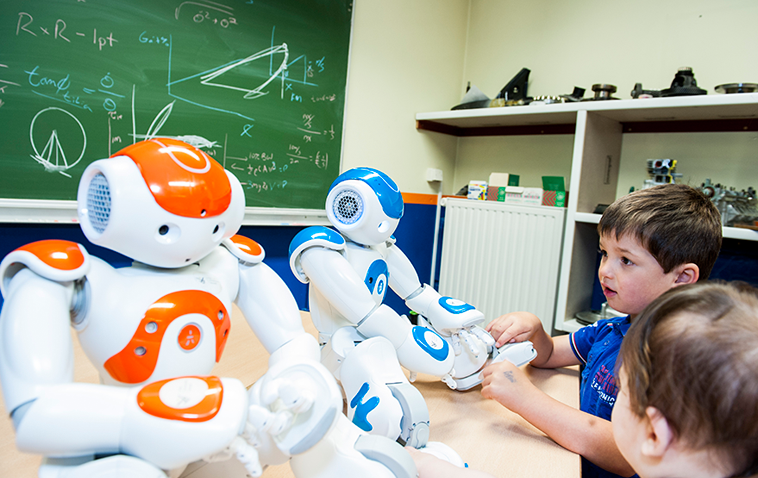
Researchers believe robots can be more effective than puppets and other traditional methods of treating autism. Image courtesy of the DREAM project.
Few could deny the power of computer games and avatars to entertain us and perhaps even educate us. But now researchers are turning to internet and robotic technologies to develop new ways of helping children with autism interact with the world around them.
It’s thanks to developments in artificial intelligence that enable computers to read our emotions through our facial expressions, gestures and tone of voice.
Autistic children often struggle to recognise and express emotions, making it difficult to behave appropriately in social situations and leaving them vulnerable to getting bullied at school.
Now, researchers have developed an online game called Camp Exploration, which aims to help autistic children recognise and express emotions.
‘There are a lot of computer games for autistic children, but what makes ours unique is using technology to recognise behaviour and give the children feedback about the way they show emotion,’ says Bjorn Schuller, an Associate Professor at Imperial College London, UK, who led the EU-funded ASC-Inclusion project which developed the game.
To progress through Camp Exploration, players have to interact through facial expressions, body gestures and vocalisations to express emotions, which are picked up via a webcam and microphone. The intelligent software can then give the player feedback about their communication.
Testing the game in an open trial involving high-functioning autistic children showed not only that they enjoyed playing it, but also that there were significant improvements in the children’s ability to show their emotions and social recognition.
Camp Exploration is being commercialised and should be widely available soon. ‘The technology is definitely ready,’ said Prof. Schuller. ‘We hope it will help the autistic community access therapy, as professional care therapists and specialist schools are not available for autistic children the world over.’
Therapy
When therapists do work with autistic children, they often use puppets and animated characters to engage them in interactive play. However, researchers believe that small, friendly looking robots could be even more effective, not just to act as a go-between, but because they can learn how to respond to a child’s emotional state and infer his or her intentions.
‘We hope it will help the autistic community access therapy.’
Professor Bjorn Schuller, Imperial College London, UK
‘Children with autistic spectrum disorders prefer to interact with non-human agents, and robots are simpler and more predictive than humans, so can serve as an intermediate step for developing better human-to-human interaction,’ said Professor Bram Vanderborght of Vrije Universiteit Brussel, Belgium.
He is part of the EU-funded DREAM project, which is developing robots that can operate autonomously for limited periods of time under the supervision of a therapist and decipher emotions to help autistic children interact in a social environment.
The researchers are programming the robots to contain software to detect where the children are looking during the session, which enables them to evaluate a child’s level of engagement and automatically adapt their behaviour to grab attention, if necessary. Quantifying the level of engagement through markers like these will also help therapists to measure a child’s progress more objectively than is currently possible.
‘Researchers have found that children with autism spectrum disorders are more responsive to social feedback when it is provided by technological means, rather than a human,’ said Prof. Vanderborght.
The ethical and legal considerations of using robots to interact with children are enormous: there are fears about safety, trust, and who should take responsibility for the robot’s behaviour. These considerations are being evaluated hand-in-hand, as DREAM reserachers are developing and testing the technology within an integrated research programme.
‘DREAM is paving the way, not only for other forms of robot-enhanced therapy, but also for more integration between research and innovation and ethics,’ said Professor Mark Coeckelbergh of De Montfort University, UK, who is also working on the project.
Combatting social disorders
Humanoid robotics and computer avatars could also help rehabilitate people suffering from social disorders such as schizophrenia or social phobia. It’s thanks to the theory of similarity, which suggests that it is easier to interact socially with someone who looks, behaves or moves like us.
Researchers on the EU-funded AlterEgo project have developed a system to enable a robot or computer avatar to interact with a patient whilst playing a version of the mirror game, in which two players try to copy each other’s motion whilst playing with coloured balls that can move horizontally on a string.
Initially the avatar is like an alter ego, created to look and move like the patient to enhance his or her feelings of attachment. Over time the avatar is slowly altered to become less similar, thus helping with social rehabilitation.
‘It is very challenging to build an avatar that is intelligent enough to synchronise its motion with a human player, but our initial results are very exciting,’ says Professor Mario di Bernardo, from the University of Bristol, UK. He says the researchers are now looking at getting groups of people and avatars interacting with one another, setting up multiple human-machine interactions for social rehabilitation.
For more information see:
tags: EU, research


AUAI is supported by: