Robohub.org
 

Field and service robotics: The rubber meets the road at FSR in Toronto this June

by
03 June 2015


share this:
toronto

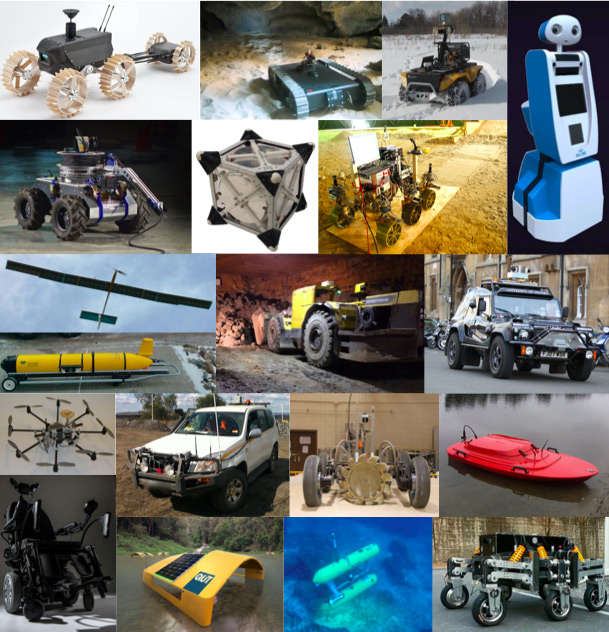
While there has been a lot of recent attention in the media surrounding self-driving cars and drones, the field and service robotics community has been quietly toiling away for much longer. Later this month, the world’s top experts on field and service robotics will meet to discuss their latest accomplishments at the bi-annual Field and Service Robotics (FSR) conference. These researchers are applying robots to real-world problems such as monitoring of lakes and oceans, autonomous wheelchairs, automated mining, space exploration, and yes, self-driving cars and drones, too. The first FSR was held in Canberra, Australia, in 1997, and it remains the only focussed meeting (single-track) on field and service applications of robots.

This year’s FSR (the 10th edition) will be held in Toronto, Canada, from June 23rd to 26th and the lineup could not be more exciting. There will be 42 papers presented on a wide variety of applications and the keynote speakers are second-to-none: Dr. Chris Urmson (Google[x]), Prof. Paul Newman (Oxford), Prof. Sanjiv Singh (Carnegie Mellon), and Ryan Gariepy (Clearpath Robotics). The full list of talks and abstracts can be found on the FSR webpage.

Science fiction often asks us to imagine what a world full of robots might look like. Well, look no further. The field and service robotics community is approaching this vision at breakneck speed. If you’re interested in previewing your future with robots, register and join us in Toronto for FSR 2015. The robots are coming …


tags: , , ,


Tim Barfoot Dr. Timothy Barfoot (Professor, University of Toronto Institute for Aerospace Studies -- UTIAS) holds the Canada Research Chair (Tier II) in Autonomous Space Robotics and works in the area of guidance, navigation, and control of mobile robots for space and terrestrial applications.

            AUAI is supported by:


Subscribe to Robohub newsletter on substack


Related posts :

A ‘5-in-1’ seed-sized surgical robot

Mini robot can move, cut tissue, release drugs, grip and store samples, and generate heat wirelessly

AI agents create virtual playgrounds to help robots get crucial training data

  07 Aug 2026
“SceneSmith” system uses collaborative AI agents to create realistic 3D environments of places like kitchens, hotels, and living rooms, where robots can simulate everyday chores.

Robots in society, business and culture: July 2026

A round up of robotics stories in a new monthly series from IEEE RAS.

Simulated zebrafish and a vision-equipped robotic fish reveal how the body shapes brain circuits

Researchers look to the fish brain to create a robotic zebrafish that can autonomously swim upstream.

Researchers develop modular nanorobot

  31 Jul 2026
A team at the University of Basel has developed a versatile nanorobot with propulsion and payload modules.

Surviving the paper deluge: a one-year study in learning from demonstration

With the explosion of robotics research, staying current in fields like Learning from Demonstration is a monumental challenge.

Soft robotic heart offers new way to study disease and test life-saving devices

Researchers have developed a soft robotic model of the human heart that can mimic disease and provide a realistic environment for testing the next generation of cardiac devices.

A mini robot to simplify dental treatment

  24 Jul 2026
Researchers have developed a miniature dental robot that could one day automatically prepare teeth for crowns.


AUAI is supported by:


Subscribe to Robohub newsletter on substack


©2026.05 - Association for the Understanding of Artificial Intelligence