Robohub.org
 

Gazebo rendering abstraction

by
30 September 2015


share this:

Ignition_Rendering
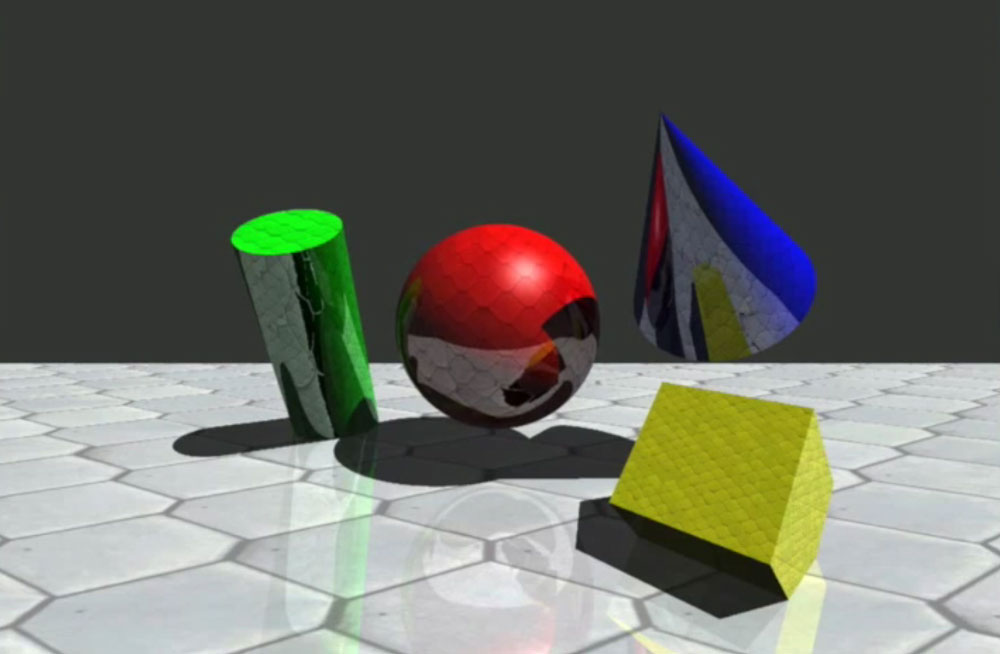
During his internship with OSRF, Mike Kasper developed a new ignition-robotics rendering library. The key feature of this library is that it provides an abstract render-engine interface for building and rendering scenes that allows the library to employ multiple underlying render engines.

The motivation for this work was to extend Gazebo’s rendering capabilities to provide near photo-realistic imagery for simulated camera sensors. This could then be used for the development and testing of perceptions algorithms.

As Gazebo currently employs the Object-Oriented Graphics Rendering Engine (OGRE), an OGRE-based implementation has been added to the ignition-rendering library. Additionally, a render-engine using NVIDIA’s OptiX ray-tracing engine has also been implemented. The current OptiX-based render-engine employs simple ray-tracing techniques, but will employ physically based path-tracing techniques in the future to generate photo-realistic imagery.

The following videos give an overview of the libraries’ current capabilities:

Source code for the ignition-rendering library is available here:
https://bitbucket.org/ignitionrobotics/ign-rendering


tags: ,


Open Source Robotics Foundation supports the development, distribution, and adoption of open source software for use in robotics research, education, and product development.

            AUAI is supported by:


Subscribe to Robohub newsletter on substack


Related posts :

How green is your robot? And other awkward questions

Robots clean rivers and sort waste, monitor ecosystems, and inspect renewable-energy infrastructure. But even the greenest robot has an environmental footprint.

These tiny drones are powered by sound

  24 Aug 2026
EPFL engineers have designed acoustic cavities that convert sound waves into thrust, propelling small robots and ultralight aerial vehicles without on-board actuators or electronics.

#AAMAS2026 blue sky award winner: Foundation world models for agents in changing environments

and   21 Aug 2026
Hear from the AAMAS 2026 Best Blue Sky Paper Award winner.

Robotics roadmaps from around the world spotlight of the month: Japan

Robots have been a prolific theme in Japanese pop culture and media since the 1950s

Intermittent swimming promotes the energy efficiency of fish-like robot movements

How zebrafish-inspired robots save energy by swimming in bursts.

What does it take for a robot to hold a conversation with a room, not just a person?

and   14 Aug 2026
Find out about a summer school held at Imperial College London.

Robotics roadmaps from around the world

We embark on a tour into some of the recent and prominent robotics roadmaps from around the world.

A ‘5-in-1’ seed-sized surgical robot

Mini robot can move, cut tissue, release drugs, grip and store samples, and generate heat wirelessly


AUAI is supported by:


Subscribe to Robohub newsletter on substack


©2026.05 - Association for the Understanding of Artificial Intelligence