Robohub.org
Indego joins Ekso with FDA exoskeleton approvals
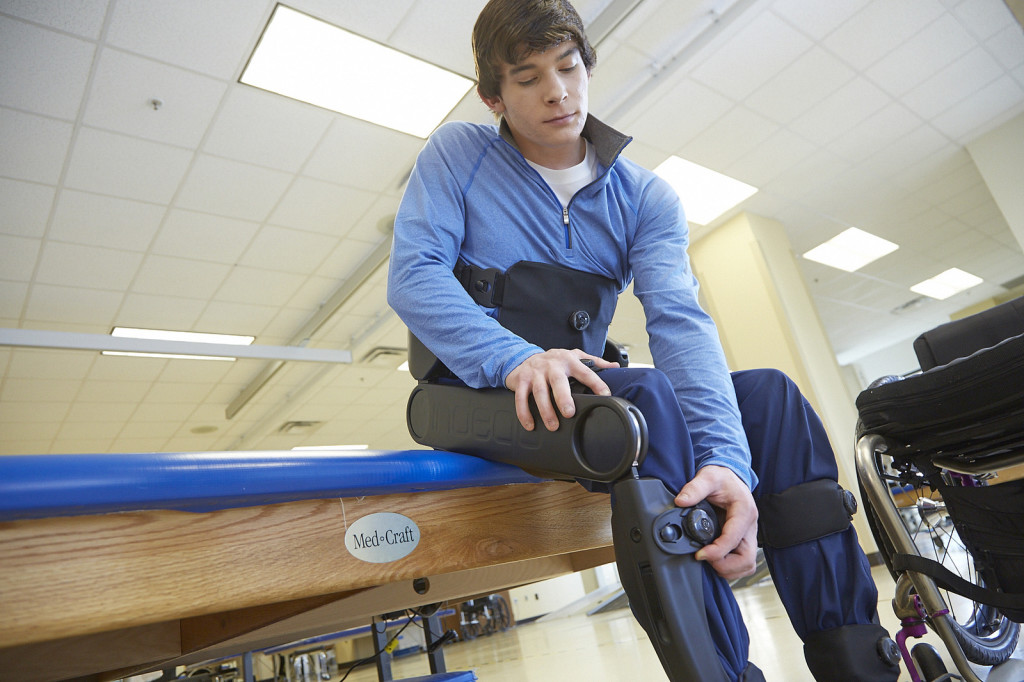
Putting on the Indego. Credit: Parker Hannifin Corporation/Flickr.
Indego is the result of 10 years of development by engineers at Vanderbilt University, funded by the National Institute of Child Health and Human Development. In 2012 it was licensed to Parker Hannifin (recently renamed to just Parker) for commercialization and marketing. It is an external skeleton that works by strapping it around the patient’s torso, legs are also strapped with supports from the hips to the knees and from the knees to the feet. Computer-controlled motors act as knee and hip joints. Patients use forearm crutches to keep their balance.

Ekso test pilot and ambassador. Credit Ekso Bionics/Flickr.
The international group of exoskeleton providers with various FDA or CE certifications is growing and currently includes: Ekso in the US; Cyberdyne in the EU and Japan; ExoAtlet from Russia; and Israel’s ReWalk. Other providers are in the process of getting approvals or developing commercial versions of their products, that includes:
- Italy’s Wearable Robotics Kinetek
- Canada’s Bionik Labs’ ARKE
- US Bionics’ SuitX
- Rise Robotics’ Exosuit (also from the US)
- Thailand’s Medico Robotics Powersuit
- Switzerland’s Noonee chairless chair
- France’s Wandercraft
- Spain’s Technaid Exo-H2
- and the UK’s REX Bionics’ mobility device.
Many of these startups are seeking insurance policy and coverage from the related healthcare insurers and agencies in addition to CE and FDA approvals for their devices. Japan’s Health Ministry approved Cyberdyne’s HAL exo suit as a medical device that enables it to be paid by the public health insurance system. Cyberdyne has announced plans to submit a request to the health ministry to make this possible.
Insurance coverage
FDA and CE approvals help insurance review boards rule regarding whether to cover exoskeletons. ReWalk was the first in the US to receive workman’s compensation coverage after multiple challenges and reviews. But general health insurance coverage has been slow to approve these new devices either for personal use or even for rehab sessions prescribed by a doctor.
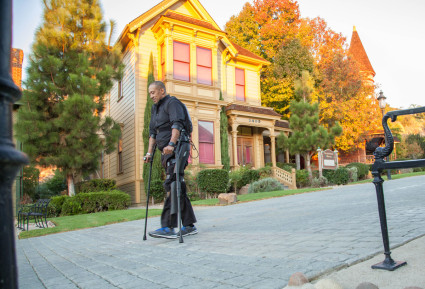
Source: ReWalk
In February of this year, in what could be a major turning point for people with spinal cord injuries, a medical review board ruled that a health insurance provider is obligated to provide coverage and reimbursement for a $69,500 ReWalk robotic exoskeleton. The unnamed health plan initially denied coverage, but after an independent review board dug into the beneficiary’s case and the current state of exoskeleton technology it ruled that the exoskeleton was “medically necessary.”
The review board determined that the exoskeleton was necessary because it allowed the patient to walk. This ruling implies that walking is not a luxury for patients with spinal injuries, but a right—and that if the technology exists and is mechanically sound, insurance companies must cover them.
ReWalk CEO Larry Jasinski was pleased by the decision stating in a press release:
“Health benefit providers have historically been hesitant to acknowledge the clinical benefits in their case assessments. This ruling, and subsequent coverage and reimbursement, will help ReWalk in our efforts to facilitate greater patient access to the device.”
If you enjoyed this post you may also like reading:
- Understanding joint impedance with a knee exoskeleton
- Body-enhancing exoskeletons could be stepping into industrial trials next year
- Clinical trials begin for Russia’s first medical exoskeleton
- Review board rules health insurance must cover robotic exoskeletons
tags: Ekso, exoskeleton, healthcare

AUAI is supported by: