
Robohub.org
 

Intuitive Surgical upgrades da Vinci surgical system and recalls tools used by them

by
06 April 2014


share this:
da_Vinci_Xi_system_560_560_80_s_c1

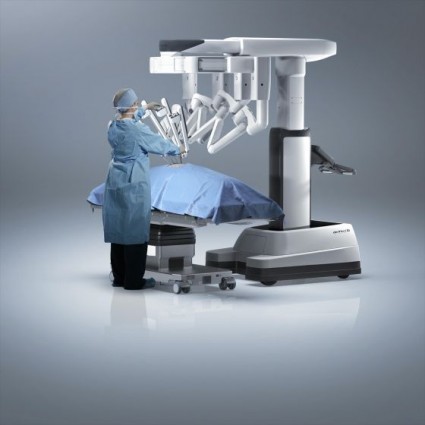
Intuitive Surgical announced FDA clearance and US introduction of their new da Vinci Xi Surgical System which has a movable overhead architecture rather than the fixed floor-mounted existing systems.

“The new overhead architecture means that multi-quadrant surgery can be performed without repositioning the system, an innovation long sought by surgeons,” said Gary Guthart, Intuitive CEO.

Additional features of the Xi system include:

  • A new compact endoscope architecture with improved visual definition
  • An ability to use the endoscope in any system arm
  • Smaller, thinner arms with newly designed joints offering a greater range of motion
  • Longer shafts designed to give surgeons greater operative reach

Recall:

Intuitive will recall 5,200 cannulae (tubes inserted into system single-port entry into the patient designed to optimize triangulation and provide unobstructed views of the surgical field) and replace them with an updated version that can withstand higher force and is less likely to be improperly placed. There have been 98 incidents of damage to the cannulas in 19,000 procedures using them (0.5%).

The new da Vinci Xi system doesn’t use these cannulae; it uses longer redesigned ones.


tags:


Frank Tobe is the owner and publisher of The Robot Report, and is also a panel member for Robohub's Robotics by Invitation series.

            AUAI is supported by:


Subscribe to Robohub newsletter on substack


Related posts :

Developing active and flexible microrobots

  13 May 2026
This class of robots opens up possibilities for biomedical applications.

How to teach the same skill to different robots

  11 May 2026
A new framework to teach a skill to robots with different mechanical designs, allowing them to carry out the same task without rewriting code for each.

Robot Talk Episode 155 – Making aerial robots smarter, with Melissa Greeff

  08 May 2026
In the latest episode of the Robot Talk podcast, Claire chatted to Melissa Greeff from Queen's University about autonomous navigation and learning for drones.

New understanding of insect flight points way to stable flapping-wing robots

  07 May 2026
The way bugs and birds flap their wings may look effortless, but the dynamics that keep them aloft are dizzyingly complex and difficult to quantify.

Robotically assembled building blocks could make construction more efficient and sustainable

  05 May 2026
Research suggests constructing a simple building from interlocking subunits should be mechanically feasible and have a much smaller carbon footprint.

Robot Talk Episode 154 – Visual navigation in insects and robots, with Andrew Philippides

  01 May 2026
In the latest episode of the Robot Talk podcast, Claire chatted to Andrew Philippides from the University of Sussex about what we can learn from ants and bees to improve robot navigation.

Ultralightweight sonar plus AI lets tiny drones navigate like bats

  29 Apr 2026
Researchers develop ultrasound-based perception system inspired by bat echolocation.

Gradient-based planning for world models at longer horizons

  28 Apr 2026
What were the problems that motivated this project and what was the approach to address them?


AUAI is supported by:


Subscribe to Robohub newsletter on substack


©2026.02 - Association for the Understanding of Artificial Intelligence









