
Robohub.org
IROS2013 is not just funny robot videos

If the latest funny videos of robots falling over is all you hear about IROS2013, it’s understandable. This is the 26th year of IROS, the IEEE/RSJ International Conference on Intelligent Robots and Systems, and it’s a big conference. So big that it’s actually hard to know how to make sense of it. This conference starts out academic but then it delves into history and branches out into the industry with forums and the iREX expo and into social impact, with workshops and the contiguous conference ARSO, or Advanced Robotics and Its Social Impact.
Held at Tokyo Big Sight over 5 days, Nov 3 to 6, IROS has 170+ sessions presenting almost 1000 papers. There are about 2750 speakers listed, and, as many papers have 3-6 authors, the work of 4-5000 people is on show here, not counting the efforts of the organizers and exhibitors! That makes a lot of potential movement in the field of robotics, particularly when you consider that ICRA is a similarly large conference and the number of other robotics conferences is growing.
But with the increasing number of conferences, perhaps they are just ‘degree mills’, events necessary for the production of PhDs, rather than for propelling the robotics industry forward. However, for those in academia present at IROS, the organizers are proud to point out that the 904 papers accepted this year were of very high standard. The percentage of accepted papers is decreasing (43%), as the number of papers submitted each year increases (2094).
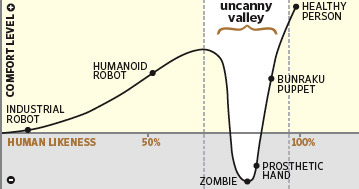
Some of the feature events at IROS2013 include a tribute to Masahiro Mori and a forum on innovation and industry. The Uncanny Valley Revisited: A Tribute to Masahiro Mori is a special session organized by Ken Goldberg and Minoru Asara.
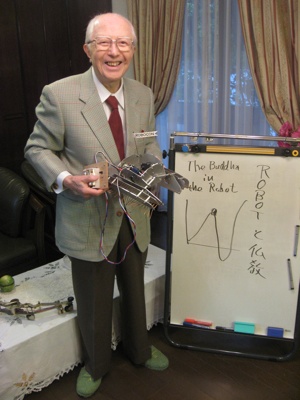
Emeritus Professor Mori will address an audience of international researchers in Robotics to comment on the thinking behind his article and how it has evolved over the past 40 years, followed by responses from a panel of roboticists and media theorists.
Professor Mori’s influential 1970 article, Bukimi no Tani Gensho, describes a phenomenon where the appeal of animated beings undergoes a steep non-linearity as they become increasingly similar to humans. Subsequently labeled the “Uncanny Valley” as a reference to Sigmund Freud’s 1916 essay on the Uncanny, the Uncanny Valley continues to have widespread influence in the fields of robotics, design, gaming, computer animation, art, and plastic surgery.
The IROS plenary sessions are also much easier to describe than the technical sessions. Plenary speakers are; Marc Raibert, Boston Dynamics; Prof. Masayuki Yamato, Tokyo Women’s Medical University; and Prof. Tim C. Lüth, Technische Universität München;
While Marc Raibert’s plenary had plenty of funny video footage of robots falling over, he also made clear his motivations in tackling the challenge of dynamic movement. Raibert is not at all inspired to create human or animal like robots from the perspective of how we feel about them. For Raibert, the challenge lies in creating any sort of robot that can move just a fraction as well as an animal can. He points out that even very young humans and animals are able to move and balance far better than robots, although Boston Dynamics are starting to achieve a great deal of stability in their bipeds and quadrupeds.
Founded by Raibert in 1992, Boston Dynamics develops some of the world’s most advanced robots, such as BigDog, AlphaDog, Petman, Atlas and Cheetah. The company specializes in dynamic robots that move with the agility and athleticism normally found only in people and animals. The Atlas robots are the humanoid standards used in the DRC or Darpa Robotics Challenge, to push forward the development of disaster response robots.
And finally, expect more robot pictures on Thursday when the robot expo iREX opens in conjunction with the IROS and ARSO conferences. This year is the 20th anniversary of the biannual event. The last expo in 2011 showcased Japan’s renowned robotics technology, plus 43 companies from overseas with 98 booths. This year, iREX has added a service robotics section, so alongside all the research labs and major companies like Kuka, Fanuc, Schunck, Toyota, Mitsubishi etc., you’ll see companies like Clearpath, Coppelia, Cyberbotics, DJI Innovations, Engineered Arts, Force Dimension, and Shadow Robot.
tags: events, IROS2013

AUAI is supported by:









