
Robohub.org
 

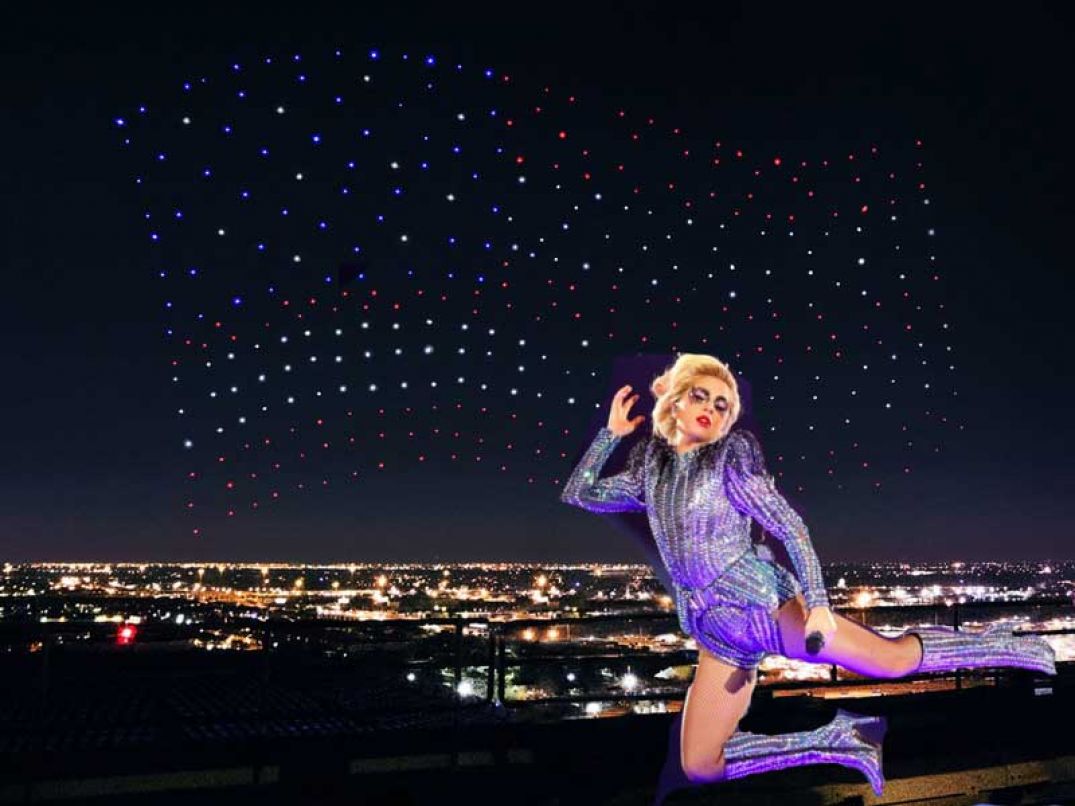
Lady Gaga, 300 Intel drones, and the Super Bowl

by
07 February 2017


share this:

Lady Gaga performing at Super bowl LI Source: NFL/YouTube

Three hundred drones flashed their colored lights and created a flying American flag as Lady Gaga sang a blend of “God Bless America” and “This Land Is Your Land” to 160 million viewers of the Super Bowl. Oh, and two football teams played into overtime, and the final score was 34 to 28.

Intel, Disney and ARS Electronica were all involved in the development of the drones, software and content. But because of restrictions by the FAA, the drones didn’t actually perform during the Super Bowl half-time show. They were actually filmed earlier, sync’d into Lady Gaga’s song as background, and appeared on all the monitors as though they were really there overhead.

All the tech media seemed to be in a huff because of the FAA restriction, but the spectacular effect of 300 drones creating America’s red, white and blue flag (and, in a 10-second ad after the game, the Pepsi and Intel logos as well), was reason enough to review the details of how it all worked and who did it.

The “Shooting Star” drones by Intel are a foot across and weigh just eight ounces to soften impacts. Each is equipped with a special LED that can produce four billion color combinations. The performance was coordinated by a central computer that can do unlimited UAV animations in three dimension. Intel recently set a world record by flying 500 of them together (video below) and said “we hope this experience inspires other creatives, artists and innovators to really think about how they can incorporate drone technology in new ways.” The sophisticated algorithms even check the battery levels and assign lesser roles to weaker drones — if one should drop out, a reserve unit automatically takes its place within a few seconds.

The Intel folks produced this video which describe the process:


tags: , ,


Frank Tobe is the owner and publisher of The Robot Report, and is also a panel member for Robohub's Robotics by Invitation series.

            AUAI is supported by:


Subscribe to Robohub newsletter on substack


Related posts :

Robotics roadmaps from around the world

We embark on a tour into some of the recent and prominent robotics roadmaps from around the world.

A ‘5-in-1’ seed-sized surgical robot

Mini robot can move, cut tissue, release drugs, grip and store samples, and generate heat wirelessly

AI agents create virtual playgrounds to help robots get crucial training data

  07 Aug 2026
“SceneSmith” system uses collaborative AI agents to create realistic 3D environments of places like kitchens, hotels, and living rooms, where robots can simulate everyday chores.

Robots in society, business and culture: July 2026

A round up of robotics stories in a new monthly series from IEEE RAS.

Simulated zebrafish and a vision-equipped robotic fish reveal how the body shapes brain circuits

Researchers look to the fish brain to create a robotic zebrafish that can autonomously swim upstream.

Researchers develop modular nanorobot

  31 Jul 2026
A team at the University of Basel has developed a versatile nanorobot with propulsion and payload modules.

Surviving the paper deluge: a one-year study in learning from demonstration

With the explosion of robotics research, staying current in fields like Learning from Demonstration is a monumental challenge.

Soft robotic heart offers new way to study disease and test life-saving devices

Researchers have developed a soft robotic model of the human heart that can mimic disease and provide a realistic environment for testing the next generation of cardiac devices.


AUAI is supported by:


Subscribe to Robohub newsletter on substack


©2026.05 - Association for the Understanding of Artificial Intelligence









