Robohub.org
 

Marketing service uses facial recognition tech to estimate gender, age, and visiting frequency

by
12 November 2012


share this:
12-0209-r

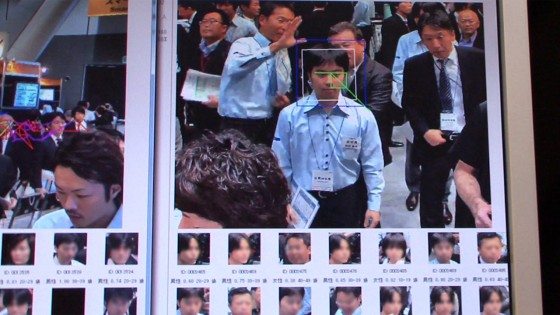
NEC has developed a marketing service that utilizes facial recognition technology to estimates the age and gender of customers, and accumulates the data, along with the dates and times that customers visit stores. This data is then used to analyze trends in customer behavior and visit frequency.

This service is provided in Japan via NEC’s cloud computing technology, only requires a regular PC and video camera, and is available for approximately $880 (70,000 yen) per month per store.

“This service is mainly intended for retailers that have several stores. It provides retailers with customer attributes based on facial images. That information is helpful for sales strategies.”

This service can also detect repeat customers across multiple stores. It uses a face detection and comparison engine developed by NEC, called NeoFace.

“NeoFace ranked top in tests by the USA’s NIST. Here, we’re using this high-precision facial recognition technology in a marketing service. But NEC is also developing various other services, such as intruder surveillance, using facial recognition technology.”

Face data is encrypted in real time and converted into characteristic data sets for analysis. Because face data can’t be restored from characteristic data, there’s no risk that face data will be inadvertently disclosed.

“Retailers can find out how many customers visit their stores at each time of day, and what customers’ attributes are. This enables them to fine-tune their sales strategies. For example, the data could be used to run campaigns targeting men and women in their 20s.”


tags:


DigInfo TV is a Tokyo-based online video news platform dedicated to producing original coverage of cutting edge technology, research and products from Japan.


Related posts :


Robot Talk Episode 136 – Making driverless vehicles smarter, with Shimon Whiteson

  05 Dec 2025
In the latest episode of the Robot Talk podcast, Claire chatted to Shimon Whiteson from Waymo about machine learning for autonomous vehicles.

Why companies don’t share AV crash data – and how they could

  01 Dec 2025
Researchers have created a roadmap outlining the barriers and opportunities to encourage AV companies to share the data to make AVs safer.

Robot Talk Episode 135 – Robot anatomy and design, with Chapa Sirithunge

  28 Nov 2025
In the latest episode of the Robot Talk podcast, Claire chatted to Chapa Sirithunge from University of Cambridge about what robots can teach us about human anatomy, and vice versa.

Learning robust controllers that work across many partially observable environments

  27 Nov 2025
Exploring designing controllers that perform reliably even when the environment may not be precisely known.

Human-robot interaction design retreat

  25 Nov 2025
Find out more about an event exploring design for human-robot interaction.

Robot Talk Episode 134 – Robotics as a hobby, with Kevin McAleer

  21 Nov 2025
In the latest episode of the Robot Talk podcast, Claire chatted to Kevin McAleer from kevsrobots about how to get started building robots at home.

ACM SIGAI Autonomous Agents Award 2026 open for nominations

  19 Nov 2025
Nominations are solicited for the 2026 ACM SIGAI Autonomous Agents Research Award.


Robohub is supported by:


Would you like to learn how to tell impactful stories about your robot or AI system?


scicomm
training the next generation of science communicators in robotics & AI


©2025.05 - Association for the Understanding of Artificial Intelligence