Robohub.org
 

Mirobot: An open source WiFi robot for kids

by
14 May 2014


share this:
mirobot_med

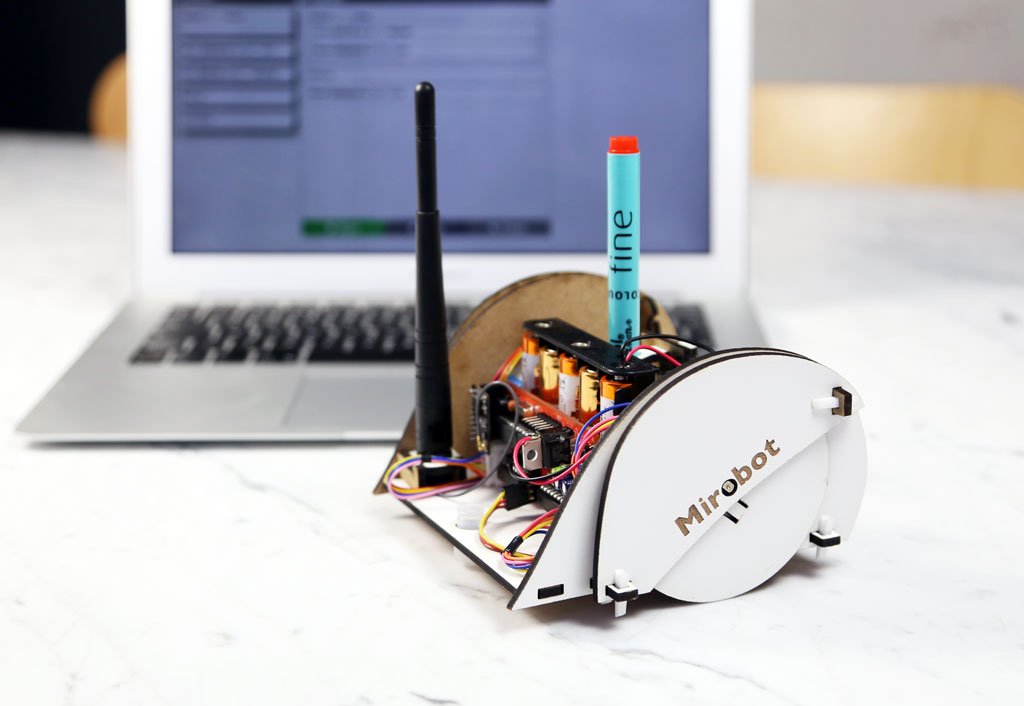
Mirobot is a robotics kit that’s designed to get kids more interested in technology, engineering and programming. Children solder and build it themselves, and then can use a drag-and-drop programming tool in their browser to get the robot to draw shapes and patterns.

All of the designs and software are open source, which means that once it has been used for its original purpose, it can be adapted to do new and unforeseen things. Although primarily a drawing robot, it can also use additional sensors in order to be able to experiment with making it autonomous. Arduino compatibility means that extending and modifying it is well documented and straightforward. Using WiFi with JSON over WebSockets to communicate which means that it can be easily controlled from a web browser as well as easily integrated into any other programming language or tool.

Mirobot was inspired by a visit to the London Science Museum when I came across one of the original Turtle robots used in schools in the UK in the late 70s and 80s. I used to use these robots as a child and thought it would be interesting to make a modern version that was based around open hardware platforms like the Arduino. The idea that what was once a very expensive piece of equipment could now be made inexpensively really appealed to me. Moving from one-per-school to one-per-child is a great advance and enables much greater learning.

It’s currently on Kickstarter and has made great progress – it’s 320% funded now with a little over a week left to go.


tags: , , , ,


Ben Pirt


Subscribe to Robohub newsletter on substack


Related posts :

Robot Talk Episode 148 – Ethical robot behaviour, with Alan Winfield

  13 Mar 2026
In the latest episode of the Robot Talk podcast, Claire chatted to Alan Winfield from the University of the West of England about developing new standards for ethics and transparency in robotics.

Coding for underwater robotics

  12 Mar 2026
Lincoln Laboratory intern Ivy Mahncke developed and tested algorithms to help human divers and robots navigate underwater.

Restoring surgeons’ sense of touch with robotic fingertips

  10 Mar 2026
Researchers are developing robotic “fingertips” that could give surgeons back their sense of touch during minimally invasive and robotic operations.

Robot Talk Episode 147 – Miniature living robots, with Maria Guix

  06 Mar 2026
In the latest episode of the Robot Talk podcast, Claire chatted to Maria Guix from the University of Barcelona about combining electronics and biology to create biohybrid robots with emergent properties.

Developing an optical tactile sensor for tracking head motion during radiotherapy: an interview with Bhoomika Gandhi

  05 Mar 2026
Bhoomika Gandhi discusses her work on an optical sensor for medical robotics applications.

Humanoid home robots are on the market – but do we really want them?

  03 Mar 2026
Last year, Norwegian-US tech company 1X announced “the world’s first consumer-ready humanoid robot designed to transform life at home”.

Robot Talk Episode 146 – Embodied AI on the ISS, with Jamie Palmer

  27 Feb 2026
In the latest episode of the Robot Talk podcast, Claire chatted to Jamie Palmer from Icarus Robotics about building a robotic labour force to perform routine and risky tasks in orbit.

I developed an app that uses drone footage to track plastic litter on beaches

  26 Feb 2026
Plastic pollution is one of those problems everyone can see, yet few know how to tackle it effectively.


Robohub is supported by:


Subscribe to Robohub newsletter on substack


©2026.02 - Association for the Understanding of Artificial Intelligence