
Robohub.org
How to teach the same skill to different robots
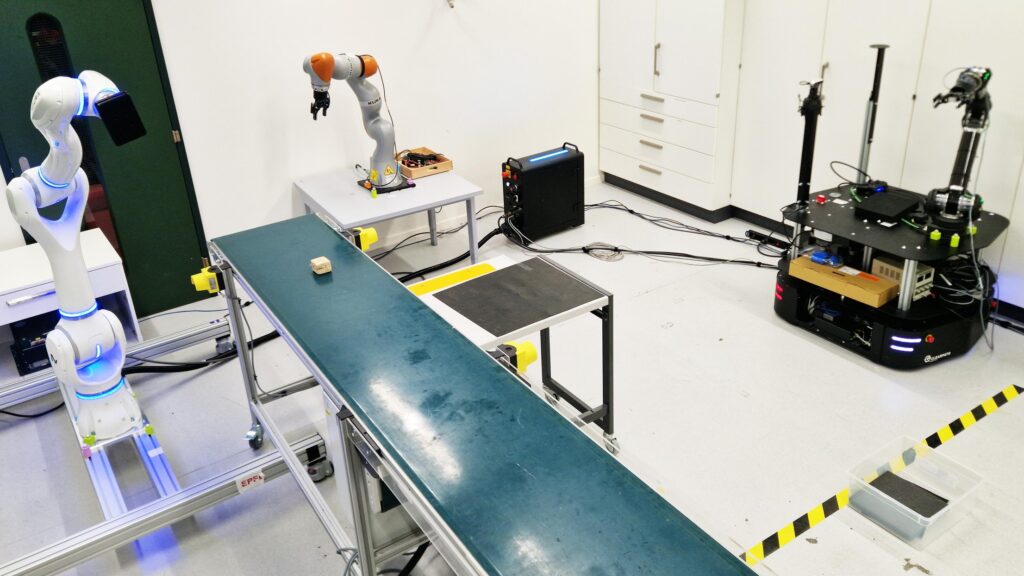 The assembly line task setup. Credit: 2026 LASA EPFL CC-BY-SA.
By Celia Luterbacher
In today’s manufacturing environments, upgrading a robot fleet often means starting from scratch – not only replacing hardware, but also reprogramming tasks. Even when two robots are built to perform similar jobs, different joint arrangements or movement limits mean that a task programmed for one robot often can’t be used on another. Enabling skills to transfer directly between robots could make these systems more sustainable and cost-efficient.
To meet this challenge, researchers in the Learning Algorithms and Systems Laboratory (LASA) in EPFL’s School of Engineering have developed a new robotic control framework called Kinematic Intelligence. The method takes a human-demonstrated task, mathematically converts it into a general movement strategy, and then adapts it so that different robots can perform it based on their physical design. The research has been published in Science Robotics.
“This work addresses a long-standing challenge in robotics: how to transfer a learned skill across robots with different mechanical structures, while guaranteeing safe and predictable behavior,” says LASA head Aude Billard. “This approach could significantly reduce the time and expertise needed to deploy robots in real-world settings.”
Kinematic Intelligence for transferable robot learning
To build their framework, the researchers first took human-demonstrated object‑manipulation tasks – such as placing, pushing and throwing – and recorded them using motion-capture technology. Then, they mathematically converted these recorded tasks into general movement strategies. They also developed a systematic classification of the physical limits of different robot designs, including how far their joints can move and which positions they must avoid to remain stable. The framework then uses this classification to automatically tailor the general movement strategies to different robot bodies, ensuring they can carry out tasks safely within their mechanical limits.
In an assembly line experiment, a human demonstrated a task by pushing a wooden block off a conveyor belt onto a workbench, placing it on a table, and finally throwing it into a basket. By using Kinematic Intelligence, three completely different commercial robots were able to reproduce this same sequence safely and reliably.
“Each robot handled different steps of the task, and the system performed successfully even when the step allocation was changed,” explains LASA PhD student and co-first author Sthithpragya Gupta. “Each robot interprets the same skill in its own way, but always within safe and feasible limits.”
Towards scalable and future-ready robotics
The researchers aim to extend the framework to settings such as human-robot collaboration and natural language-based interaction. For example, Kinematic Intelligence could allow a person to instruct a robot with simple commands at home, with no need for technical programming. The approach is also relevant for emerging robotic platforms, where rapid hardware evolution means that today’s machines may soon be replaced by newer versions. Enabling seamless transfer of skills across such platforms could play a key role in making them practical and scalable.
“Our goal is to remove the need for technical expertise while still ensuring safe and reliable operation,” summarizes LASA scientist and co-first author Durgesh Haribhau Salunkhe. “The user brings the idea and the desired behavior, and the robot should take care of the rest.”
Reference
Demonstrate once, execute on many: Kinematic intelligence for cross-robot skill transfer, S Gupta, D H Salunkhe, A Billard, Science Robotics (2026).

AUAI is supported by:









