Robohub.org
‘Robots or jobs’ is key focus of #ERF2015
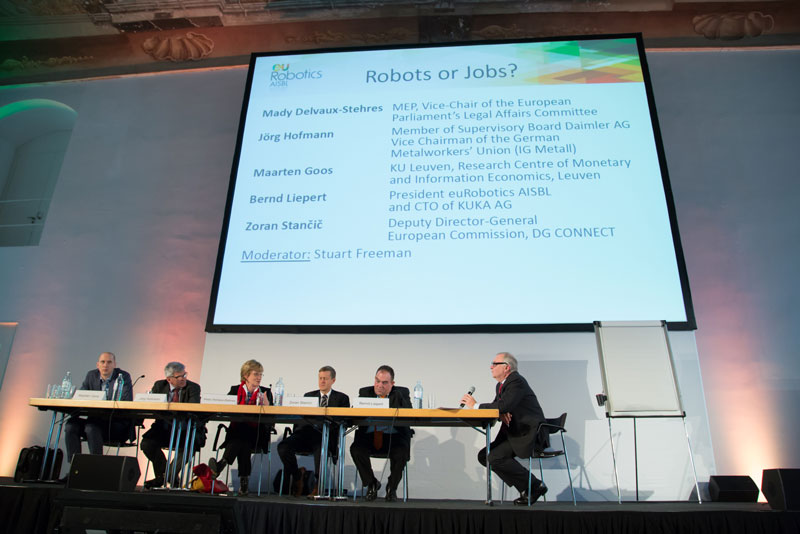
European Robotic Forum 2015. Credits: Viennamotion KG.
The importance of allaying public fears that robots will create mass unemployment was the theme of the opening session at the 2015 European Robotics Forum (ERF), which kicked off in Vienna on Tuesday.
ERF is the largest robotics networking event in Europe and this year attracted a record number of delegates. Over 600 were in attendance, including industrialists, researchers, investors, politicians and media.
The opening session featured a panel discussion entitled Robots or Jobs? The issue was introduced by Bernd Liepert, President of the European stakeholders association, euRobotics and CTO of industrial robotics manufacturer, KUKA.
“There are fears from economists that robots are replacing jobs in large numbers,” he said, quoting statistics indicating that up to 50% of jobs could be lost to automation.
Zoran Stancic, Deputy Director-General at the European Commission, DG CONNECT, followed Mr Liepert on the podium and was quick to point out that “there is clearly information that robots don’t steal jobs. We have to make this information freely available to all stakeholders.”
Jorg Hofmann, who is on the board of car manufacturer Daimler, and Vice Chairman of the German Metalworker’s Union (IG Metall), followed up, saying that “past waves of innovation have been counterbalanced by gains in other sectors.”
“It’s not a question of jobs, it’s a question of quality of jobs…” he said. “And how we qualify our workforce to manage this change.”
The session developed into a wider panel discussion with the addition of Mady Delvaux-Stehres, MEP, Vice-Chair of the European Parliament’s Legal Affairs Committee and Maarten Goos of Leuven University’s Research Centre of Monetary and Information Economics.
Mr Goos was introduced as one of the leading researchers in this area, and spoke about the “complimentary effect” of robotics.
“If you look at the academic literature, you have to conclude that, in general, introducing robotics increases employment,” he said, explaining that, as we work with robots, productivity goes up and generates income.
He pointed out that the studies warning of up to 50% in job losses use a specific methodology, which he called “a set of subjective guesses.” His view is that we should move away from that methodology.
However, a number of challenges need to be addressed, he believes. One of these is the nature of work, which will undoubtedly change. Pushing people into programming is, he said, not the only solution to this. We should also develop more creative, communicative skills, which can compliment robotics.
But he warned that we may be lacking the right institutions to support these upcoming changes. In addition, we need to change from top down to bottom up policy in order to deal with the issues robotics will present.
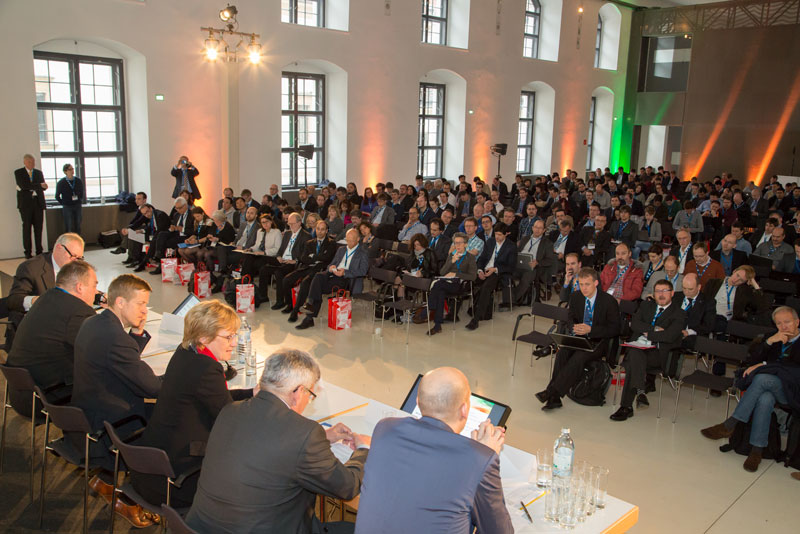
European Robotic Forum 2015. Credits: Viennamotion KG.
The European Commission is, however, determined to play a leading role in developing a framework that national institutions will be able to emulate when they come to legislate on the changes jn employment and society brought about by robotics.
To this end, a new working group has been established to develop concrete proposals that it hopes to present to the European Parliament next month, Mady Delvaux-Stehres informed delegates.
The group will address topics including liability for damage, social impact and data privacy. The overall goals are to strengthen the European economy, protect the social and fundamental rights of the citizen, and bridge the gap between politicians and the scientific community.
But, on the ground level, developing systems that are easy for people to use is key to public acceptance of robotics , a view shared by many on the panel.
“We need the human being, we need smart factories, not dark factories. We need to train people to work in these factories, with increased skills,” said Mr Liepert.
“A new generation R [for robots] is growing up with vacuum cleaning robots, autonomous cars and co-working robots. To develop robot systems that are easy to use by people – that’s a key driver.”
Co-working with robots, the panel agreed, is a necessary part of our community in Europe and we need to develop strategies to convince the general public about the benefit of robotics.
The panel offered a number of solutions as to how this may be achieved:
“We can only solve the problem if we address the usability,” was the view of Mr Liepert. He used the smartphone as analogy, saying people have no fear of it because they understand it and robotics could benefit by emulating similar ease of use, which would in turn promote acceptability. On the academic front, he believes there is a lot of work to be done to achieve this objective.
Mr Stannic believes that communication with the wider public is key, particularly when it comes to older users. He urged delegates to view an inspirational video of a 94-year-old describing the difference technology has made to her life. The commission has made the video available on You Tube.
“We all have prejudices,” he said. “We need to address our fears and problems. When you can see concretely how you can benefit, it helps.”
Mr Goos pointed out that public mistrust of technology is nothing new; similar issues were present at the dawn of the industrial revolution. The answer then was mass education, teaching people how to read and write. He believes that we haven’t yet pinned down strategies to reassure the public in respect of robotics. “Dealing with their fears,” he said, “should be part of the overall policy.”
tags: co-robots, ERF2015, EU, EU Robotics Forum, events, politics, robots and jobs

AUAI is supported by: