
Robohub.org
Service robots get multiple positive forecasts
UPDATED 7/22/15 Commercial drones will reach $4.8B by 2021. Agricultural robots will reach $16.8B by 2021 and $73.9B by 2024. And demand for healthcare robotics to show “tremendous growth” in the next 5 years.
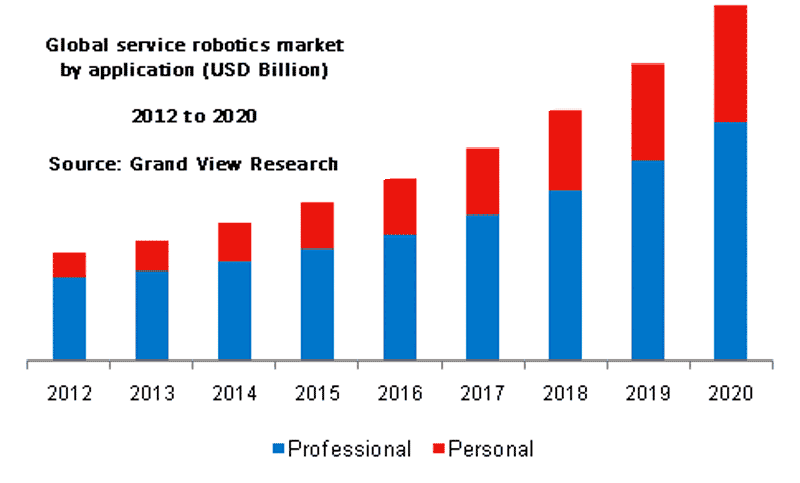 According to a recent Wintergreen Research report, the worldwide industrial robot market will grow at 11.5% annually and reach $48.9B by 2021. But another area of robotics is growing at a much faster rate: service robots, i.e., non-manufacturing robots for professional use, for defense, in the field, for logistics, medical, personal, entertainment and household use, are becoming a booming segment of the global robotics industry with a 20% or higher year-over-year growth rate.An Allied Market Research Report covering the combined robot technology market (service and industrial) forecasts the combined market to reach $82.7B by 2020, a lower figure that Wintergreen and Tractica but still indicative of exponential growth.
Three recent research reports support this thesis.
1. Global healthcare robotics market by application (orthopedic, neurology, laparoscopy) and type (surgical, rehabilitation, telemedicine, assistive robots, orthotics, prosthetics, radio surgery, exoskeleton) – segmentation and forecast to 2020
140 pages, $4,000, Occams Business Research and Consulting
Demand for robotics in healthcare, especially surgical procedures, is increasing. Safety, better clinical outcomes, and reduced labor costs are leading to an exponential growth in demand not only for robotic-assisted surgery, but in many other segments of healthcare such as sanitation, sterilization, lab processing and materials handling. Limited to economies that are heavily invested in medical care, growth is seen to be exponential to 2020 and steady thereafter. This report is projecting “tremendous growth.”
2. Agricultural Robots: Driverless Tractors, Unmanned Aerial Vehicles, Material Management, Field Crops and Forest Management, Soil Management, Dairy Management, and Animal Management for Precision Agriculture
61 pages, $3,500, Tractica
Demand for the robots involved in various agricultural processes like harvesting, pruning, weeding, pick-and-place, sorting, seeding, spraying, and materials handling has increased significantly. This demand is being driven by the global trends of population growth, increasing strain on the food supply, availability of farm workers, the challenges and complexities of farm labor, the rising overall cost of farm workers, shrinking farmlands, climate change, the growth of indoor farming, and the automation of the agriculture industry. Tractica anticipates that the overall agricultural robot market will reach $3 billion by the end of 2015 and anticipates a healthy growth rate to reach $16.8 billion by the end of 2020. Tractica also forecasts that the market will continue its momentum and reach $73.9 billion by 2024.
3. Commercial Drones: Highways in the Sky, Commercial Unmanned Aerial Systems (UAS), Market Shares, Strategies, and Forecasts, Worldwide, 2015-2021
973 pages, $3,900, Radiant Insights
Next generation commercial drones will replace existing commercial airfreight delivery systems. Other uses include 3D mapping, commercial pipeline observation, border patrol, package delivery, photography, and agriculture. Drones markets offer more economical visualization and navigation. Visualization includes mapping, inspection, surveillance, and package delivery. Unmanned aircraft with cameras are able to do things that cannot be done in any other way which bodes well for sales. Unmanned aerial systems were $609 million in 2014 and are forecast to reach $4.8 billion dollars, worldwide, by 2021.
There is even a drone counter measures research report by Frost & Sullivan which describes various methods to counter unmanned aerial vehicles of all types (C-UAS). This is predominantly done by and for the military and includes radar, acoustic and other sensor detection and the ability to distinguish a bird from a UAS. There are alternative methods of dealing with the identified drone too.
53 pages, $1,500, Frost & Sullivan
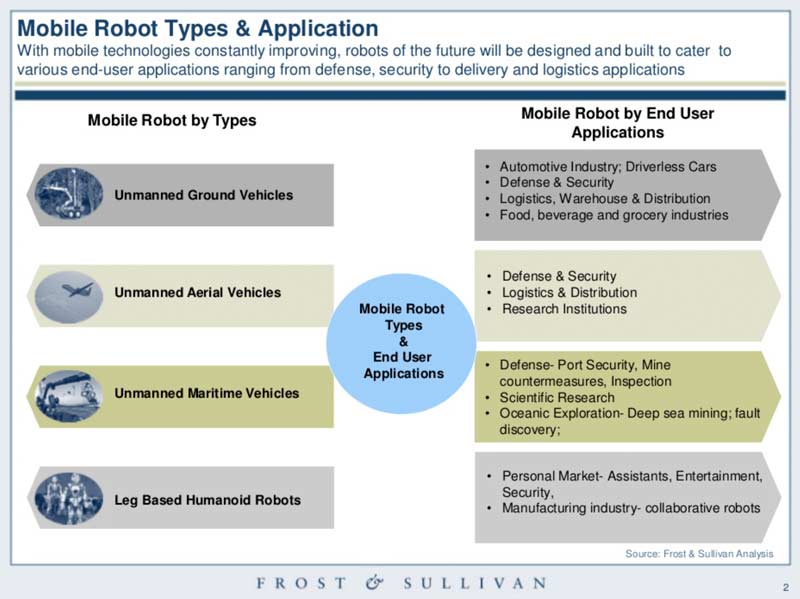
Another research report, from Frost & Sullivan entitled “The Future of Mobile Robots,” costs $15,000 and attempts to describe the various types of mobile robots and how they are being deployed by end users. Although sales figures were hidden in the press materials, they are forecasting that by 2020 there will be 26 million mobile robots at work as delivery drones, autonomous driverless cars, and at work in smart factories, warehouses and distribution centers.
tags: business, service robotics

AUAI is supported by:









