Robohub.org
 

The future of space rescue – watch the R2t2 event live

by
02 November 2016


share this:

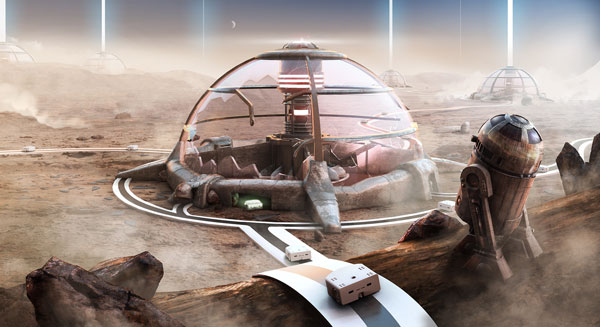
r2t2_illu_fullres_highresToday, the Swiss Robotics Industry Day will play host to the R2t2 rescue mission and we are heading straight for the future!

The year is 2032 and a meteorite has damaged a power station on Mars. 16 teams of school-aged children spread across the world have each been given control of a robot based on Mars and have been commanded to work together to assess the damage and restart the main generator.

The teams will need to programme the robots taking into account the time lag taken for instructions to travel from planet Earth to Mars (between three and 21 minutes depending on the orbit) in order to get the generator restarted in time. Teams will programme their robots and send in their expertise from across the world, including Switzerland, France, South Africa, Russia and Italy.

You can watch along live and see the future of space travel at https://www.thymio.org/en:thymio-r2t2 from 13:30 (CET) today.

Watch the live stream

About the Thymio robot


tags: ,


NCCR Robotics

            AUAI is supported by:


Subscribe to Robohub newsletter on substack


Related posts :

Reimagining robotics for sustainability

  18 Sep 2026
"Our ambition is not to simply make robots more sustainable; they must actively contribute to solving sustainability challenges."

Watch the ICRA keynote and plenary talks

  16 Sep 2026
If you missed the conference you can catch up on IEEE TV.

Building and programming autonomous robots at the York Micromaze Hackathon

and   11 Sep 2026
From 25–27 August, UK RAS STEPS members came together for a three-day Micromaze Robot Hackathon.

Robotics roadmaps from around the world spotlight of the month: United States of America

US robotics researchers and industry are looking for a cohesive national robotics strategy.

Could robots help tackle loneliness? BBC’s Ann Droid raises questions about the future of care

  07 Sep 2026
While the series exaggerates what robots can currently do, some of the technology it depicts is already being tested.

Exploring the Moon will require rovers that can think for themselves – an upcoming NASA mission will test whether they can

  04 Sep 2026
NASA is planning to send three small rovers to the Moon to autonomously compute how to best explore a patch of ground.

Surviving the paper deluge: Notes from an ICRA panel on publishing, LLMs, and the future of peer review

Experts discuss peer-review challenges and possibilities for reshaping the process.


AUAI is supported by:


Subscribe to Robohub newsletter on substack


©2026.05 - Association for the Understanding of Artificial Intelligence