Robohub.org
 

The Year of CoCoRo Video #29/52: Jeff – preprogrammed trajectory


by
22 July 2015


share this:

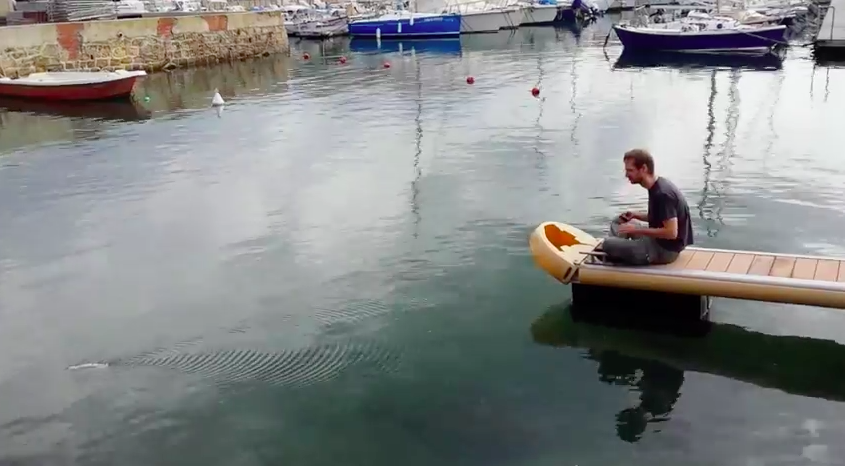
The EU-funded Collective Cognitive Robotics (CoCoRo) project has built a swarm of 41 autonomous underwater vehicles (AVs) that show collective cognition. Throughout 2015 – The Year of CoCoRo – we’ll be uploading a new weekly video detailing the latest stage in its development. This video shows the robot Jeff diving along a preprogrammed trajectory.
cocoro_29

Our test of “dead reckoning” was performed by a Jeff robot in Livorno harbor. The robot was programmed to follow a straight-line trajectory, then perform a circular search pattern (including collision avoidance) and end with a direct return to the starting point. The robot used only a magnetic compass sensor, an internal clock and blue-light LEDs for collision avoidance. Considering the simplicity of the technology, we were surprised at how efficiently it performed, despite the currents in the harbor and occasional collision-avoidance behavior triggered by the buoys.


tags: , , , , , , ,


Thomas Schmickl is an Associate Professor at Karl-Franzens University, Graz, Austria, and a lecturer at the University for Applied Sciences in St. Pölten, Austria.

            AUAI is supported by:


Subscribe to Robohub newsletter on substack


Related posts :

Surviving the paper deluge: Notes from an ICRA panel on publishing, LLMs, and the future of peer review

Experts discuss peer-review challenges and possibilities for reshaping the process.

When expressive humanoid robots are awkward, people become wary – new brain study

  31 Aug 2026
People become more suspicious of a humanoid robot that makes errors, especially when the robot is an expressive conversation partner.

First 11 vs 11 humanoid soccer game played at RoboCup 2026

  28 Aug 2026
Watch highlights from this historic match.

How green is your robot? And other awkward questions

Robots clean rivers and sort waste, monitor ecosystems, and inspect renewable-energy infrastructure. But even the greenest robot has an environmental footprint.

These tiny drones are powered by sound

  24 Aug 2026
EPFL engineers have designed acoustic cavities that convert sound waves into thrust, propelling small robots and ultralight aerial vehicles without on-board actuators or electronics.

#AAMAS2026 blue sky award winner: Foundation world models for agents in changing environments

and   21 Aug 2026
Hear from the AAMAS 2026 Best Blue Sky Paper Award winner.

Robotics roadmaps from around the world spotlight of the month: Japan

Robots have been a prolific theme in Japanese pop culture and media since the 1950s

Intermittent swimming promotes the energy efficiency of fish-like robot movements

How zebrafish-inspired robots save energy by swimming in bursts.


AUAI is supported by:


Subscribe to Robohub newsletter on substack


©2026.05 - Association for the Understanding of Artificial Intelligence