Robohub.org
 

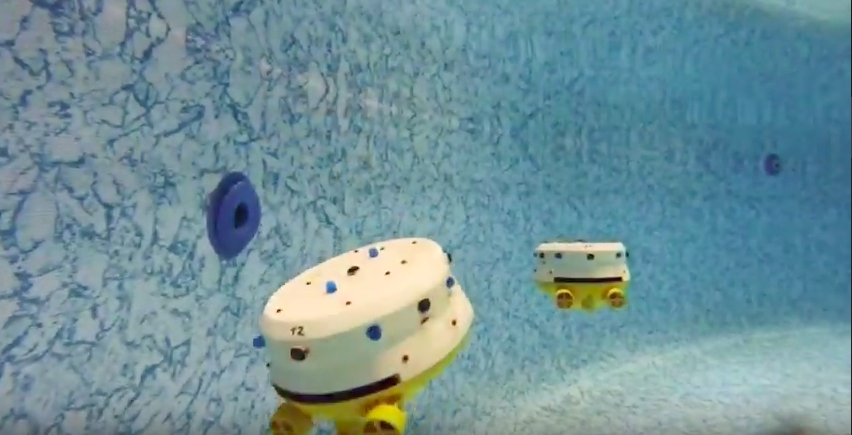
The Year of CoCoRo Video #44/52: Lily shoaling

by
03 November 2015


share this:
Cocoro44

The EU-funded Collective Cognitive Robotics (CoCoRo) project has built a swarm of 41 autonomous underwater vehicles (AVs) that show collective cognition. Throughout 2015 – The Year of CoCoRo – we’ll be uploading a new weekly video detailing the latest stage in its development. This week’s video shows Lily robots individually demonstrating behavior to enable coherent global swarming.

For a swarm it is crucial that the robots stay together. One method of achieving this is to generate a “virtual fence” around the swarm, as we have already demonstrated with various “confinement” videos in the Year of CoCoRo (weeks 17-19). Besides those methods, it helps if the robots can stay together – like a school of fish, a flock of birds or a swarm of mosquitos. We wanted to mimic these simple individual actions to produce  a coherent, global swarming behavior.

Our Lily robots observe blinking, blue-light signals form neighboring robots. Based on the estimated distance between the robots, they decide – with threshold-based mechanisms – which direction to turn, and how to adjust their motion speed. Although this system is very simple it nicely allows the robots to stay together for longer periods of time.


tags: , , , , ,


Thomas Schmickl is an Associate Professor at Karl-Franzens University, Graz, Austria, and a lecturer at the University for Applied Sciences in St. Pölten, Austria.


Subscribe to Robohub newsletter on substack


Related posts :

What I’ve learned from 25 years of automated science, and what the future holds: an interview with Ross King

and   14 Apr 2026
Ross King created the first robot scientist back in 2009. He spoke to us about the nature of scientific discovery, the role AI has to play, and his recent work in DNA computing.

Robot Talk Episode 151 – Robots to study the ocean, with Simona Aracri

  10 Apr 2026
In the latest episode of the Robot Talk podcast, Claire chatted to Simona Aracri from National Research Council of Italy about innovative robot designs for oceanography and environmental monitoring.

Generative AI improves a wireless vision system that sees through obstructions

  08 Apr 2026
With this new technique, a robot could more accurately detect hidden objects or understand an indoor scene using reflected Wi-Fi signals.

Resource-constrained image generation and visual understanding: an interview with Aniket Roy

  07 Apr 2026
Aniket tells us about his research exploring how modern generative models can be adapted to operate efficiently while maintaining strong performance.

Back to school: robots learn from factory workers

  02 Apr 2026
A Czech startup is making factory automation easier by letting workers teach robots new tasks through simple demonstrations instead of complex coding.

Resource-sharing boosts robotic resilience

  31 Mar 2026
When a modular robot shares power, sensing, and communication resources among its individual units, it is significantly more resistant to failure than traditional robotic systems.

Robot Talk Episode 150 – House building robots, with Vikas Enti

  27 Mar 2026
In the latest episode of the Robot Talk podcast, Claire chatted to Vikas Enti from Reframe Systems about using robotics and automation to build climate-resilient, high-performance homes.

A history of RoboCup with Manuela Veloso

and   24 Mar 2026
Find out how RoboCup got started and how the competition has evolved, from one of the co-founders.


Robohub is supported by:


Subscribe to Robohub newsletter on substack


©2026.02 - Association for the Understanding of Artificial Intelligence