
Robohub.org
What’s new in robotics this week? U.S. Army showcases driverless technology
The pioneer of artificial intelligence left us at 88 years old; Google’s ‘AI’ breakthrough; Robotic customer service; the army showcases examples of driverless trucks; world fastest Rubik cube solving, and more.
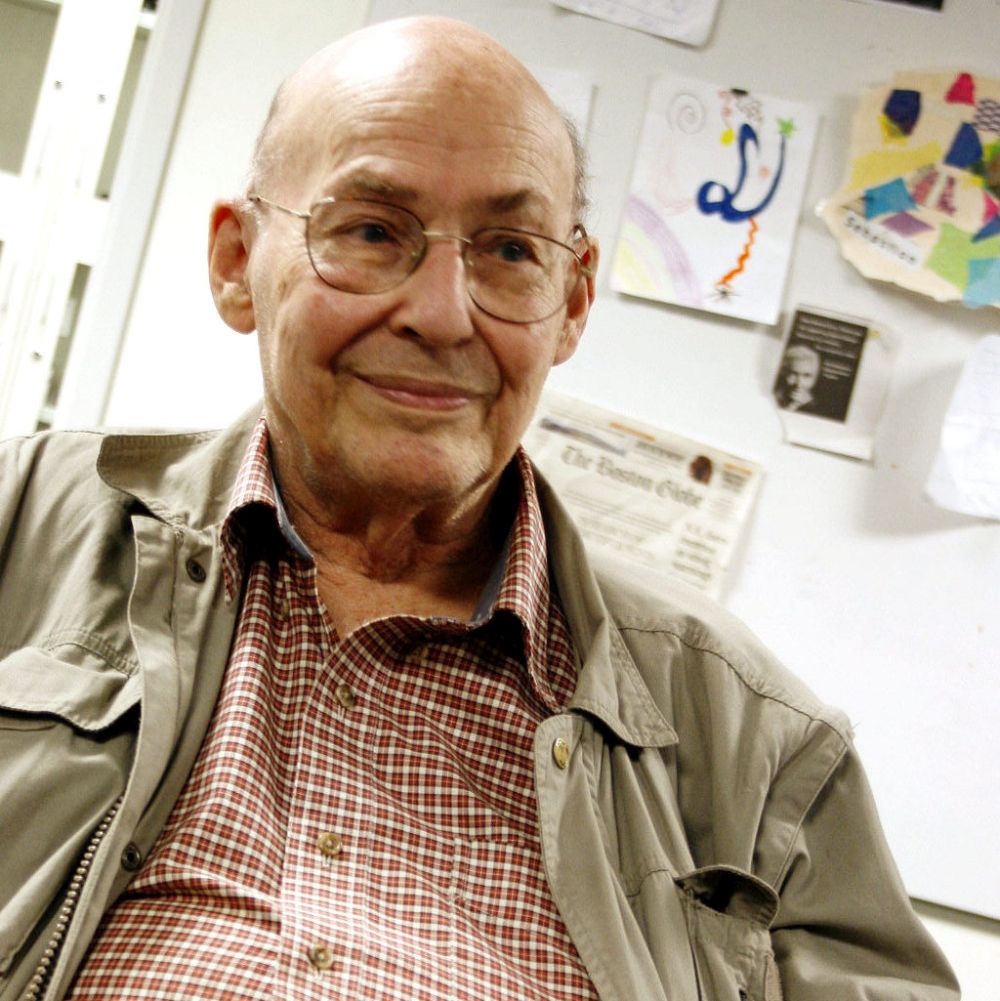
Photo credit: Sethwoodworth, Wikimedia Commons
“Will robots inherit the earth? Yes, but they will be our children.”
Marvin Minsky
1927-2016
Marvin Minsky, Pioneer in Artificial Intelligence, Dies at 88 (New York Times)
Marvin Minsky, one of the pioneers of artificial intelligence and robotics, passed away in Boston. Founder of Massachusetts Institute of Technology’s AI lab, inventor, Turing Award winner, and the author of several influential books, Minsky‘s impact on the field of artificial intelligence has been enormous:
Well before the advent of the microprocessor and the supercomputer, Professor Minsky, a revered computer science educator at M.I.T., laid the foundation for the field of artificial intelligence by demonstrating the possibilities of imparting common-sense reasoning to computers.
Minsky also created what he dubbed “the ultimate machine” an example of which can be seen in the video below. Every home should have one:
See also:
Marvin Minsky’s 2003 TED talk “Health, Population and The Human Mind”
We Asked a Robot to Write an Obit for AI Pioneer Marvin Minsky (Wired)
What Marvin Minsky Still Means for AI (Technology Review)
Google achieves AI ‘breakthrough’ by beating Go champion (BBC News)
In an important breakthrough for artificial intelligence research, a system based on reinforcement learning created by Google’s DeepMind division has defeated the European Go champion 5-0 in a series of challenge games –the first time AI software has defeated a top-level human Go player.
Known as “AlphaGo,” the software combines advanced tree search algorithms with deep neural networks to master a game which is much more challenging to AI than chess, as the BBC explains:
Go is thought to date back to ancient China, several thousand years ago.
Using black-and-white stones on a grid, players gain the upper hand by surrounding their opponents pieces with their own.
The rules are simpler than those of chess, but a player typically has a choice of 200 moves compared with about 20 in chess.There are more possible positions in Go than atoms in the universe, according to DeepMind’s team.
Google’s original blog post includes a brief but fascinating timeline of computers mastering games:
The first game mastered by a computer was noughts and crosses (also known as tic-tac-toe) in 1952. Then fell checkers in 1994. In 1997 Deep Blue famously beat Garry Kasparov at chess. It’s not limited to board games either—IBM’s Watson [PDF] bested two champions at Jeopardy in 2011, and in 2014 our own algorithms learned to play dozens of Atari games just from the raw pixel inputs. But to date, Go has thwarted AI researchers; computers still only play Go as well as amateurs.
DeepMind’s chief executive, Demis Hassabis, told the BBC that the AlphaGo software followed a three-stage process, which began by making it analyze 30 million moves from games played by professionals:
“It learns what patterns generally occur – what sort are good and what sort are bad. If you like, that’s the part of the program that learns the intuitive part of Go.
“It now plays different versions of itself millions and millions of times, and each time it gets incrementally better. It learns from its mistakes.
“The final step is known as the Monte Carlo Tree Search, which is really the planning stage.
“Now it has all the intuitive knowledge about which positions are good in Go, it can make long-range plans.”
The researcher’s paper was published in Nature this week.
SoftBank says Pepper on a roll, will staff cellphone store in Tokyo (The Japan Times)
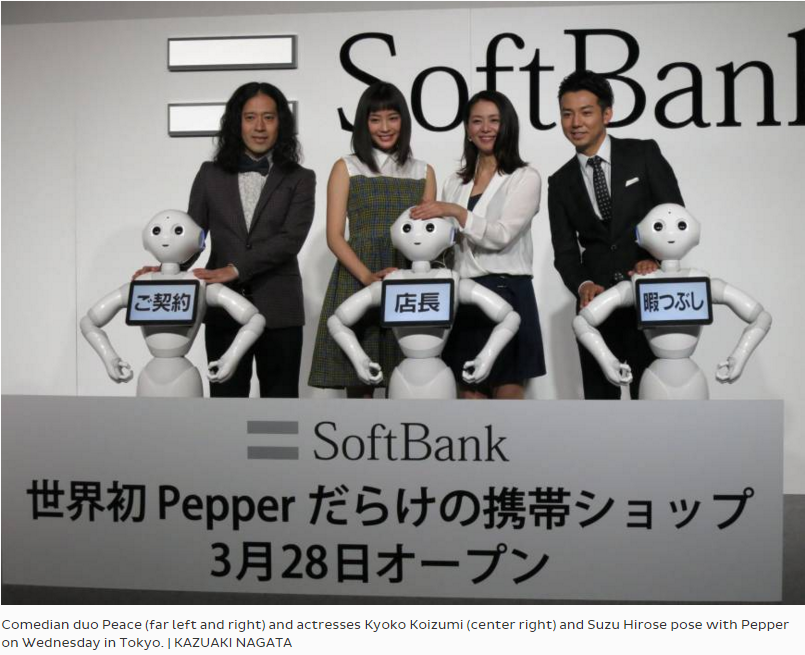
SoftBank Corp.’s Pepper robot –a humanoid robot designed to provide customer service– is gaining lots of good press and steadily increasing its customer base.
This week, the company announced that five or six Peppers will staff a cellphone store in Tokyo from March 28 to April 3 –albeit with a little human help:
Customers will be able to ask the robots for explanations of the various cellphone options, and for those that decide to buy, the robot will attempt to complete the sales process.
However, SoftBank says it is difficult for the robots to check people’s IDs when signing a contract, so humans will be on hand to intervene.
All this good publicity and growing customer base doesn’t necessarily translate into short-term profit, however, Fumihide Tomizawa, who heads SoftBank Robotics, told The Japan Times:
The Pepper business will not turn a profit this year or next.
Fame is one thing, but commercial success, [Tomizawa] said, will take time.
SoftBank estimates that more than 500 firms are now using Pepper, which is pretty impressive for a robot that launched just last year. Nissan Motor Corp. uses Pepper to provide customer service in 100 outlets. SoftBank has partnered with as many as 200 firms with plans to develop business applications for Pepper that leverage Internet connectivity and cloud-based artificial intelligence.
The Army Showcases Two Examples Of Driverless Technology (The Detroit News)
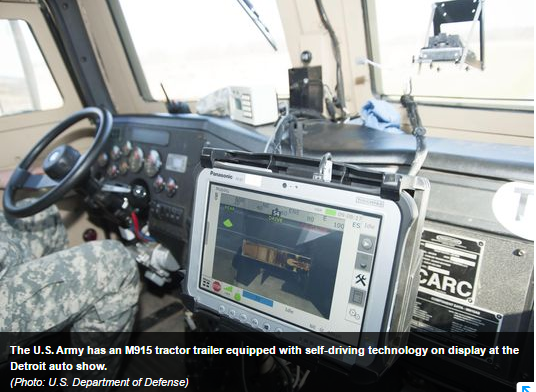
The U.S. Army Tank Automotive Research, Development and Engineering Center (TARDEC) showcased two examples of driverless technology at the Detroit auto show: the first, a system mounted on a M915 tractor trailer and the second mounted on a Cummins-powered Peterbilt Class 8 semi-tractor:
Paul D. Rogers, director of the TARDEC program, noted that many attacks on soldiers occur along resupply routes, and autonomous capability would require fewer soldiers to be in the vehicle, lessening exposure.
“That not only lessens the risk for the soldier, but we can move the same amount of material, equipment and supplies with fewer soldiers, so we become much more efficient,” Rogers said.
Manpower is a major expense in the military, including drivers who always travel with a backup, “safety” driver who is present in case the main driver gets injured or fatigued.
And finally…
- Watch this robot solve a Rubik’s cube in 1 second (via VentureBeat)
- Davos 2016: Robotics Winners and Losers (via Financial Times)
- Teaching Robots to Be More Than Simple Servants (Discover Magazine/Soundcloud)
- 5 Technologies That Blur The Line Between Robot And Human (Huffington Post)
- How Does BB-8 Work? (HowBB8Works)
- Harvard Given $28 million To Build AI That Works As Fast As The Human Brain (Daily Mail)
- Is Harm to a Prosthetic Limb Property Damage or Personal Injury? (Motherboard)
tags: What's new in robotics this week


AUAI is supported by:









