Robohub.org
 

Write and play your own sheet music with the Gocen

by
09 November 2012


share this:
12-0205-r

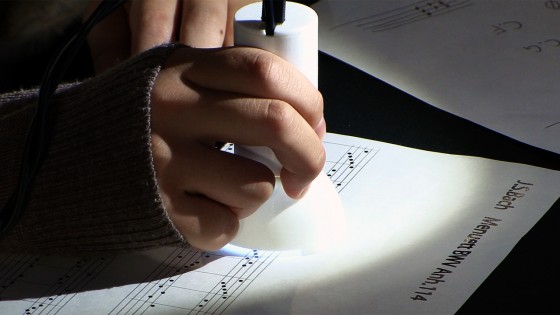
The Gocen is a device which scans and plays handwritten sheet music in real time. It is being developed by a group at the Tokyo Metropolitan University led by Assistant Professor Tetsuaki Baba.

“First, the system looks at the stave, then at the notes, then at the position of the notes, to determine the high notes. In addition, it directly reads words such as piano or guitar. The computer automatically recognizes them, and changes the instrument. Also, for example, if this melody is in F minor, rather than C major, when the system reads the letters Fm, it has the ability to add four flats.”

The sheet music image is analyzed using the OpenCV library in combination with a unique algorithm. While the play head is above a note it will continue to sound that key, and in the case of stringed instruments, if you move it up and down it can make the pitch fluctuate. Also, the size of the notes determines the volume level and it can handle chords as well.

“This idea arose when we were talking with music publishing companies. Until now, sheet music was really only used by placing it on a stand to play an instrument. But it could be played by computer in real time, and given various expressions. We think a system like this will make it easier for children and beginners to learn about musical notation.”

“Lots of people use computers to compose music, but it’s been found through research that paper works well at the initial stage, for deciding what kind of composition, or what kind of melody. In that regard, I feel that this system is very effective as a composition support system.”


tags:


DigInfo TV is a Tokyo-based online video news platform dedicated to producing original coverage of cutting edge technology, research and products from Japan.


Related posts :


The science of human touch – and why it’s so hard to replicate in robots

  24 Dec 2025
Trying to give robots a sense of touch forces us to confront just how astonishingly sophisticated human touch really is.

Bio-hybrid robots turn food waste into functional machines

  22 Dec 2025
EPFL scientists have integrated discarded crustacean shells into robotic devices, leveraging the strength and flexibility of natural materials for robotic applications.

Robot Talk Episode 138 – Robots in the environment, with Stefano Mintchev

  19 Dec 2025
In the latest episode of the Robot Talk podcast, Claire chatted to Stefano Mintchev from ETH Zürich about robots to explore and monitor the natural environment.

Artificial tendons give muscle-powered robots a boost

  18 Dec 2025
The new design from MIT engineers could pump up many biohybrid builds.

Robot Talk Episode 137 – Getting two-legged robots moving, with Oluwami Dosunmu-Ogunbi

  12 Dec 2025
In the latest episode of the Robot Talk podcast, Claire chatted to Oluwami Dosunmu-Ogunbi from Ohio Northern University about bipedal robots that can walk and even climb stairs.

Radboud chemists are working with companies and robots on the transition from oil-based to bio-based materials

  10 Dec 2025
The search for new materials can be accelerated by using robots and AI models.


Robohub is supported by:


Would you like to learn how to tell impactful stories about your robot or AI system?


scicomm
training the next generation of science communicators in robotics & AI


©2025.05 - Association for the Understanding of Artificial Intelligence