Robohub.org
 

Yamaha JWX-2 wheelchair power assist unit can be attached to almost any wheelchair

by
16 October 2012


share this:
12-0176-r

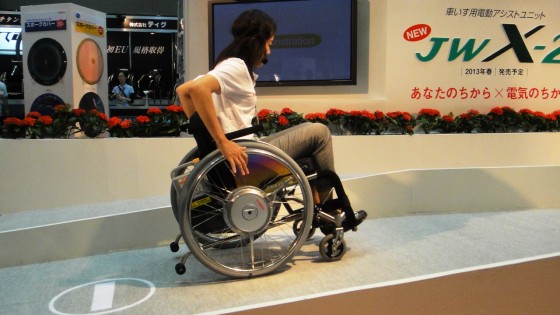
Yamaha Motor has developed an electrical assist unit for wheelchairs, called the JWX-2.

The JWX-2 applies PAS technology from assisted bicycles to wheelchairs. The electric assist works in line with the load on the wheelchair’s hand rims, enabling it to operate smoothly on slopes, where the load is high, and on carpets.

“We currently offer a unit called the JW-II, but this one differs in two main ways. In the previous version, the motor was pillbox-shaped and stuck out, so there were some cases where it couldn’t be attached to the wheelchair. Here, we’ve made the pillbox motor flat, so the surface it’s attached by is flat. This means the JW-II can be attached to virtually any wheelchair.”

This newly developed, flat AC servomotor also enables the axle position to be adjusted in the up-down and front-back directions. Plus, it’s more efficient, which increases the travel range by about 20%.

“We previously offered three types, to match the user’s physical condition. For example, users could choose Type A or B depending on their grip strength. But this new unit can be connected to a PC, enabling the user to create settings with software called JW Smart Tune. For example, hardly anyone has exactly the same strength in their left and right arms. So, people who are weaker on the left can get stronger assistance on the left, enabling them to move straight ahead.”

The assist is switched on and off simply by pressing a button. Additionally, the left and right buttons can be used to set different assist levels, which can be used on steep and gentle slopes.

“We’ll be releasing this in spring 2013, as we’re still developing it. We haven’t decided the price yet, but it’ll be based on those of current models.”


tags:


DigInfo TV is a Tokyo-based online video news platform dedicated to producing original coverage of cutting edge technology, research and products from Japan.

            AUAI is supported by:


Subscribe to Robohub newsletter on substack


Related posts :

Robot Talk Episode 156 – Rugged robots for dangerous missions, with Gavin Kenneally

  15 May 2026
In the latest episode of the Robot Talk podcast, Claire chatted to Gavin Kenneally from Ghost Robotics about robot dogs for defence, security, and public safety.

Developing active and flexible microrobots

  13 May 2026
This class of robots opens up possibilities for biomedical applications.

How to teach the same skill to different robots

  11 May 2026
A new framework to teach a skill to robots with different mechanical designs, allowing them to carry out the same task without rewriting code for each.

Robot Talk Episode 155 – Making aerial robots smarter, with Melissa Greeff

  08 May 2026
In the latest episode of the Robot Talk podcast, Claire chatted to Melissa Greeff from Queen's University about autonomous navigation and learning for drones.

New understanding of insect flight points way to stable flapping-wing robots

  07 May 2026
The way bugs and birds flap their wings may look effortless, but the dynamics that keep them aloft are dizzyingly complex and difficult to quantify.

Robotically assembled building blocks could make construction more efficient and sustainable

  05 May 2026
Research suggests constructing a simple building from interlocking subunits should be mechanically feasible and have a much smaller carbon footprint.

Robot Talk Episode 154 – Visual navigation in insects and robots, with Andrew Philippides

  01 May 2026
In the latest episode of the Robot Talk podcast, Claire chatted to Andrew Philippides from the University of Sussex about what we can learn from ants and bees to improve robot navigation.

Ultralightweight sonar plus AI lets tiny drones navigate like bats

  29 Apr 2026
Researchers develop ultrasound-based perception system inspired by bat echolocation.


AUAI is supported by:


Subscribe to Robohub newsletter on substack


©2026.02 - Association for the Understanding of Artificial Intelligence