
Robohub.org
1,000 Robot Makers!
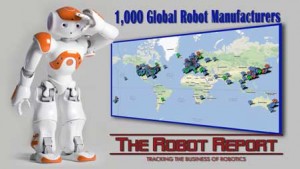
Well — almost 1,000. Presented on this map are 977 robot manufacturers and the top 20 robotics universities and research facilities. Every type of company; every facet of the industry; most industrialized countries of the world are represented. From big companies like KUKA, ABB and Fanuc to start-ups like Redwood Robotics in California and Etnamatica in Sicily; from Iceland to Western Australia. These companies are robot makers; they may or may not also be robot users. That’s for another map.
Red markers reflect 200+ industrial robot makers; Green is for the 170+ start-up companies; and Blue is separated into two groups: “S” for service robots for governmental and corporate use while “P” covers service robots for private or personal use. Yellow is used to show the location of the top 20 robotic research and educational facilities. A country-by-country table is shown below.
The global map does not cover an additional 825 ancillary businesses such as image systems, software developers, engineering and consulting firms, integrators and resellers, designers, servo, laser and stereo camera providers, etc. Nor does it cover 225 other educational facilities and research labs. These can be found in our Ancillary Businesses and Educational and Research Facilities Directories.
The map is also limited by my own research capabilities, language translation limitations, and scarcity of information about robotics companies in emerging countries. It show a single entry for a company headquarters regardless how many branches, subsidiaries and locations that company might have.
In spite of all those caveats, at first glance I was impressed by the sheer quantity of the markers. One can easily see that many of the start-ups and service robotics companies are located near prominent Yellow-marked universities and research labs in clusters surrounding Carnegie Mellon, MIT and Harvard, UC Berkeley, Stanford and Willow Garage, the University of Tokyo and TITECH, etc. Or areas of innovation and energy like Seoul, Korea, Israel and New York City.
Red markers – industrial robot makers – stand out for their predominance in the industrial sections of the world: Germany, Switzerland and Central and Western Europe and the UK, Japan, Korea and the Great Lakes area of the US.
Blue markers – service robots (every other type of robot except industrial) are everywhere as are Green start-up markers. These are the emerging robotics companies in non-industrial robotics: robots used in healthcare, scientific labs, for defense and security, in academia, as toys, for remote presence and autonomous mobility underwater, on the ground and in the air and for a myriad of other uses.
This map will continue to grow above the 1,000 mark as I continue my research. If I’ve missed your company or companies that you know about, please send me a message.


Frank Tobe
is the owner and publisher of The Robot Report, and is also a panel member for Robohub's Robotics by Invitation series.
Frank Tobe
is the owner and publisher of The Robot Report, and is also a panel member for Robohub's Robotics by Invitation series.
AUAI is supported by:









Related posts :
Robots in Society, Business and Culture: September 2026
IEEE Robotics and Automation Society (RAS)
26 Oct 2026
We showcase a selection of robotics stories from society, business, research and culture.
Robot Talk Episode 167 – Automating construction, with Jan Petrš
Robot Talk
23 Oct 2026
In the latest episode of the Robot Talk podcast, Claire chatted to Jan Petrš from École Polytechnique Fédérale de Lausanne about novel robot designs for construction and architecture.
ACM SIGAI Autonomous Agents Award 2027 open for nominations
ACM SIGAI
20 Oct 2026
Nominations are solicited for the 2027 ACM SIGAI Autonomous Agents Research Award.
Powered by muscle cells, a paper-thin robot swims through watery maze
MIT News
19 Oct 2026
MIT engineers’ new aquabot offers a way to design small, efficient “biohybrid” robots.
Robot Talk Episode 166 – Evolving robot bodies and brains, with Rika Antonova
Robot Talk
16 Oct 2026
In the latest episode of the Robot Talk podcast, Claire chatted to Rika Antonova from the University of Cambridge about using artificial intelligence to develop complimentary robot hardware and algorithms.
Neurosymbolic planning using natural language communication for cooperative autonomous vehicles
Read about work that was nominated for the AAMAS 2026 best paper award.
Humanoid robots can sprint and box – but the real test is doing the laundry
The Conversation
12 Oct 2026
No robot system can yet reliably handle the whole laundry process. Even folding remains a challenge.
Robot Talk Episode 165 – Robots behind the research, with Kushant Patel
Robot Talk
09 Oct 2026
In the latest episode of the Robot Talk podcast, Claire chatted to Kushant Patel from Brookhaven National Laboratory about robots that work in scientific facilities, such as particle accelerators.

