Robohub.org
 

AJung Moon on “Do robots need heads?”

by
15 August 2013


share this:

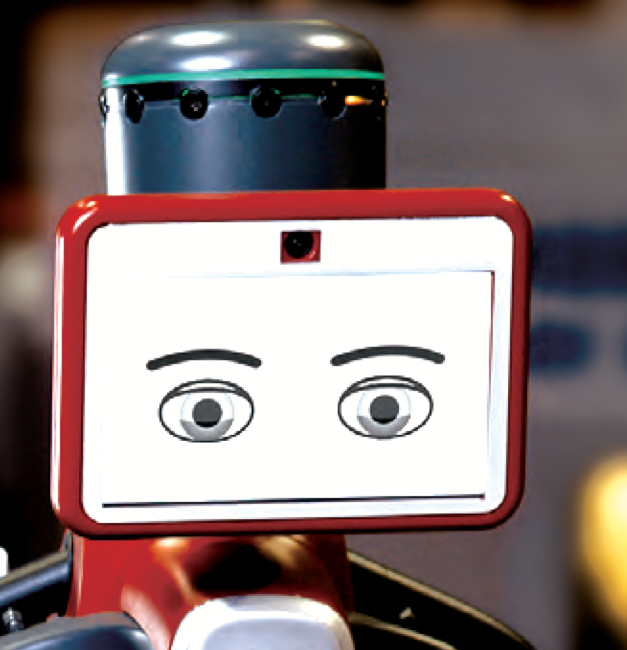
Robohub.org-baxterAre you curious about what your future robotic assistants will look like?

My bet is that by the time you buy your very first robotic butler, it will have a friendly head on it that moves. In fact, it would be a good idea to make robots with heads if they are intended to share spaces and objects with people. That’s because the head is a really expressive part of our body we naturally use (a lot) to convey essential information to each other.  Robots will need to do the same if they are going to hang out with us soft-tissued human beings at our homes and offices.

For example, when people are attending to something, they tend to be looking at the thing they are attending to. People also look at the direction they are headed when they walk, and make eye contact when they talk. People nod with their head when they want to show agreement about what is being said. Without these nonverbal cues from the head interacting with each other would be much more difficult, because we wouldn’t know what each other are doing.

Rodney Brooks, a pioneer in robotics and now Chairman and CTO of Rethink Robotics, had this in mind when he built Baxter. Although Baxter’s arms are as bulky-looking as its traditional industrial robotics predecessors, one of the innovative components of it is the fact that it features a moving head that makes its interaction with not-so-trained users very intuitive

http://www.youtube.com/watch?v=4OIxWMTrGl8

If robots are to do meaningful things around us in a safe manner, it’s essential that we know what the robot is attending to, where it is headed, and what it is about to do – a lot of which a robot head can help with. That way, we won’t have to be a roboticist to know when it is safe to be around a robot holding on to a giant knife to make you cucumber salad. <optionally embed cucumber slicing robot

http://www.youtube.com/watch?v=ZvDXrZX-SCA


tags:


AJung Moon HRI researcher at McGill and publicity co-chair for the ICRA 2022 conference

            AUAI is supported by:


Subscribe to Robohub newsletter on substack


Related posts :

Developing active and flexible microrobots

  13 May 2026
This class of robots opens up possibilities for biomedical applications.

How to teach the same skill to different robots

  11 May 2026
A new framework to teach a skill to robots with different mechanical designs, allowing them to carry out the same task without rewriting code for each.

Robot Talk Episode 155 – Making aerial robots smarter, with Melissa Greeff

  08 May 2026
In the latest episode of the Robot Talk podcast, Claire chatted to Melissa Greeff from Queen's University about autonomous navigation and learning for drones.

New understanding of insect flight points way to stable flapping-wing robots

  07 May 2026
The way bugs and birds flap their wings may look effortless, but the dynamics that keep them aloft are dizzyingly complex and difficult to quantify.

Robotically assembled building blocks could make construction more efficient and sustainable

  05 May 2026
Research suggests constructing a simple building from interlocking subunits should be mechanically feasible and have a much smaller carbon footprint.

Robot Talk Episode 154 – Visual navigation in insects and robots, with Andrew Philippides

  01 May 2026
In the latest episode of the Robot Talk podcast, Claire chatted to Andrew Philippides from the University of Sussex about what we can learn from ants and bees to improve robot navigation.

Ultralightweight sonar plus AI lets tiny drones navigate like bats

  29 Apr 2026
Researchers develop ultrasound-based perception system inspired by bat echolocation.

Gradient-based planning for world models at longer horizons

  28 Apr 2026
What were the problems that motivated this project and what was the approach to address them?


AUAI is supported by:


Subscribe to Robohub newsletter on substack


©2026.02 - Association for the Understanding of Artificial Intelligence