Robohub.org
 

Bioinspired robotics #1: Swarm collectives, with Radhika Nagpal

by
28 October 2015


share this:
Source: Wyss Institute at Harvard University

Source: Wyss Institute at Harvard University

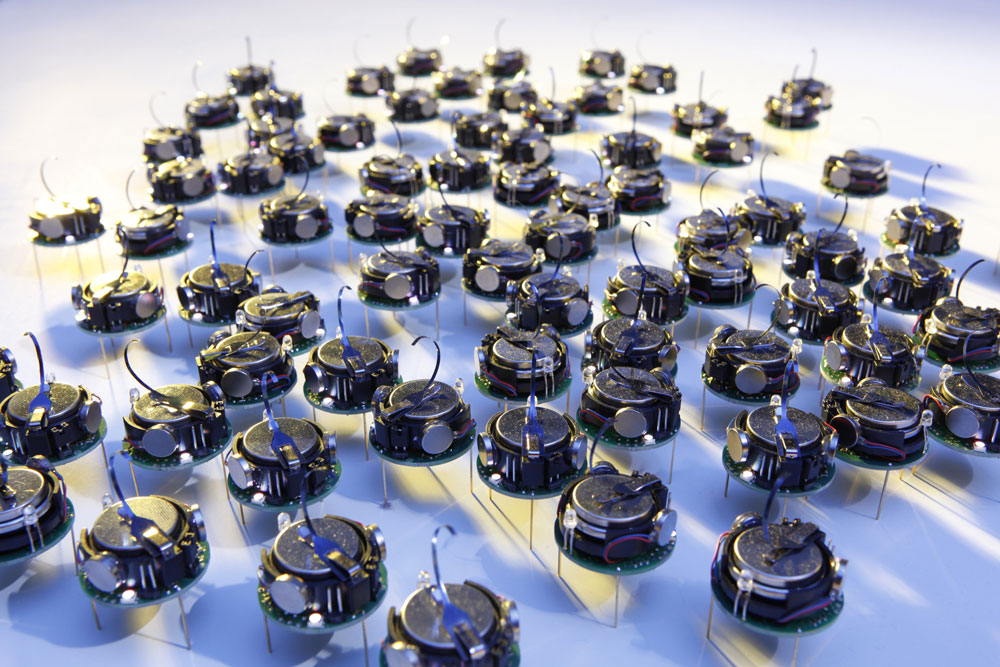
In the Disruptive Podcast series, Terrence McNally speaks directly with Wyss Institute researchers, exploring what motivates them and how they envision our future as might be impacted by their disruptive technologies. In part 1 of the Disruptive: Bioinspired Robotics podcast episode, Wyss Founding Core Faculty Member Radhika Nagpal discusses swarm collectives, as well as the challenges faced by women in the engineering and computer science fields.

Nagpal is developing programming paradigms that enable new types of robotic systems to mimic the collective behaviors of living creatures. Inspired by bee swarms and termite colonies, she is applying nature’s approach to decentralized cooperation to engineer new collective systems that meet real-world challenges. Biological systems, from embryos to social insects, depend upon the coordinated behavior of large numbers of individual agents to achieve highly complex outcomes — termites build skyscrapers and embryonic cells develop into healthy babies. Nagpal is building new types of distributed systems — from multi-modular robots and robot swarms, to vast sensor networks — that have similar capabilities.


If you liked this article, you may also be interested in:

See all the latest robotics news on Robohub, or sign up for our weekly newsletter.


tags: , , , , , ,


Wyss Institute uses Nature's design principles to develop bioinspired materials and devices that will transform medicine and create a more sustainable world.

            AUAI is supported by:


Subscribe to Robohub newsletter on substack


Related posts :

Global robotics technology roadmap

  03 Jun 2026
A multi-regional, cross-domain strategic perspective for Europe, Asia, and the United States.

RoboChem Flex: democratisation of the autonomous synthesis robot

  02 Jun 2026
A versatile, modular design and the option for "human-in-the-loop" analytics.

Robot Talk Episode 158 – Autonomous robot deliveries, with Ahti Heinla

  29 May 2026
In the latest episode of the Robot Talk podcast, Claire chatted to Ahti Heinla from Starship Technologies about their AI-powered delivery robots that operate independently on streets and pavements.

Light-activated gel could impact wearables, soft robotics, and more

  28 May 2026
In the field of ionotronics, data are transferred through ions, potentially providing a bridge between electronics and biological tissue.

Handle with care: Soft robot gripper picks ripe fruit without bruising

  27 May 2026
Stretchable fiber-optic sensors used to create a soft robot gripper.

Robot Talk Episode 157 – Generating new robot designs, with Josie Hughes

  22 May 2026
In the latest episode of the Robot Talk podcast, Claire chatted to Josie Hughes from École Polytechnique Fédérale de Lausanne about using AI to develop new designs for robotic manipulators.

Robotics Café brings together autonomous robot practitioners

  20 May 2026
Recently launched series for researchers, students and industry practitioners aims to provide a platform for students to present their work.

Table tennis robot defeats some of world’s best players – why this has major implications for robotics

  18 May 2026
Ace, from Sony AI, is the first robot to beat elite human players in competitive physical sport.


AUAI is supported by:


Subscribe to Robohub newsletter on substack


©2026.05 - Association for the Understanding of Artificial Intelligence