
Robohub.org
Forget the octocopter, let’s talk about Kiva
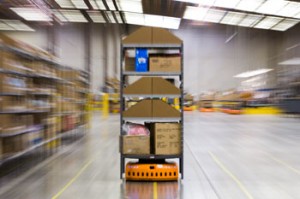 Given all the chatter on drones and automation, we thought it would be a good time to dive deeper into the Kiva opportunity and potential impact on leverage/margins. For the sake of our analysis, we take a look at what the Kiva margin impact could be if Kiva automation were to be integrated across all of AMZN’s NA fulfillment operations. In short, we estimate that Kiva could drive fulfillment cost savings in the $450-900M range or be 60-120 bps accretive to CSOI margin in NA alone – underscoring a bigger global opportunity.
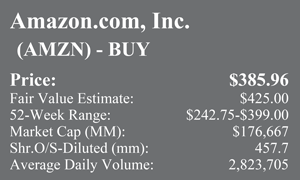 Moreover, the secondary impact is the potential limitation of outside sales of Kiva to other key retailers and impact on existing Kiva customers over time. We continue to believe AMZN is poised for strong volume growth and market share gains (3P, Prime, digital, etc.) and believe margins should improve slightly in FY14. Our 3 key driver thesis of: 1) 30-40% volume growth, (2) service fee growth of 40-50%, and (3) expanding GM appears intact as AMZN cycles through easier unit comps. We reiterate our BUY rating and $425 FV based on 1.7x FY15 EV/Sales, as we believe AMZN is poised for strong unit growth and market share gains in FY14.
 Key Points
Key commentary from Q3 – Kiva rollout begins. On 3/19/12, AMZN announced the $775M cash acquisition of Kiva Systems. The plan at the time of the acquisition was to incorporate Kiva’s fulfillment technology into AMZN’s FC’s; however, since then there was little commentary around integration until the Q3 earnings release, when CEO Jeff Bezos noted that they had “deployed 1,382 Kiva robots in three FCs”. Based on our previous work with Kiva and other covered eCommerce companies, and recent discussions with Fulfillment experts, we believe this could be a significant opportunity to drive higher operating efficiency across AMZN’s massive FC network.
Kiva can potentially drive 20-40% improvement in cost per order (CPO). Within a fulfillment center direct labor (pick, pack, sort) remains one of the most expensive tasks in fulfillment. Within that direct labor cost, travel time (i.e. moving around and picking items) will likely be the most expensive and largest cost component. The leverage that Kiva can provide lies in reducing the amount of product “touches” and pick times that a pick worker must perform, or going from multi-touch to single touch where pick rates can improve by 2x. Based on discussions with industry sources which have indicated that Kiva can reduce a company’s CPO by 20-40%+, we have constructed a CPO and Kiva efficiency analysis on the following pages to help quantify the potential margin impact.
Potential for $450-900M in cost savings or 60-120 bps accretive to CSOI margins. For our analysis, we focused on AMZN’s NA fulfillment operations which are further along in development and worked to isolate the direct labor component (see figure 1), or the costs associated with pick/pack/ship. By our math, we calculate AMZN’s NA CPO to be in the $3.50-3.75 range in FY13 (see figure 2), which we estimate has gone up given rapid FC build out. We believe this is fairly consistent based on discussions we’ve had with industry professionals who have commented that large scale fulfillment operations have CPO’s in the ~$3 range. Assuming a 20-40% reduction in our calculated CPO based on Kiva implementation (see figure 3), we estimate that Kiva could drive fulfillment cost savings in the $450-900M range or be 60-120 bps accretive to CSOI margin.
View the full report.
tags: Amazon, business, Kiva

AUAI is supported by:









