Robohub.org
 

Gazebo rendering abstraction

by
30 September 2015


share this:

Ignition_Rendering
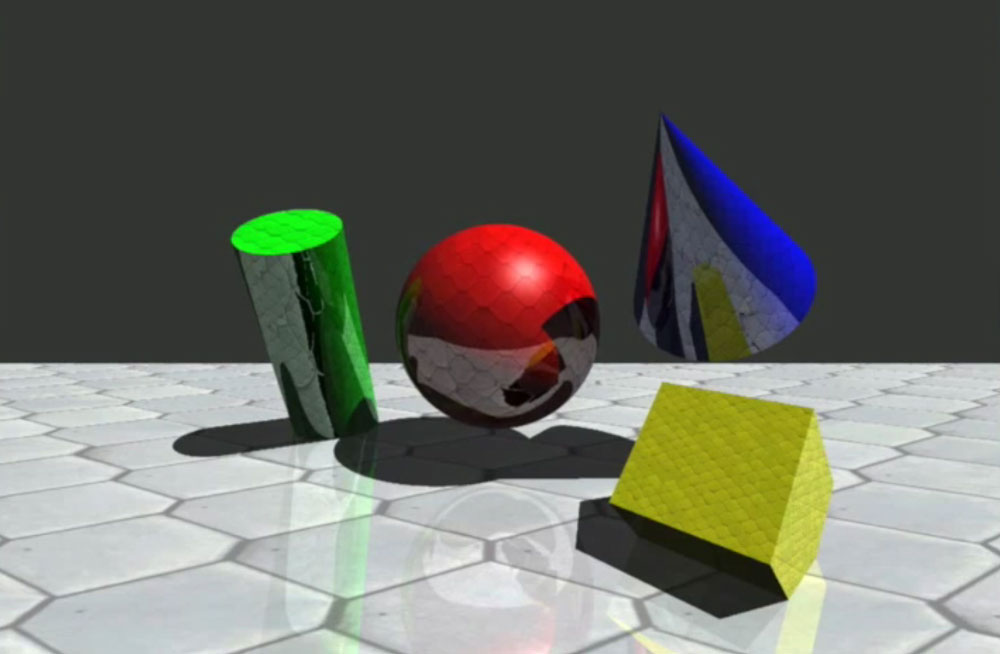
During his internship with OSRF, Mike Kasper developed a new ignition-robotics rendering library. The key feature of this library is that it provides an abstract render-engine interface for building and rendering scenes that allows the library to employ multiple underlying render engines.

The motivation for this work was to extend Gazebo’s rendering capabilities to provide near photo-realistic imagery for simulated camera sensors. This could then be used for the development and testing of perceptions algorithms.

As Gazebo currently employs the Object-Oriented Graphics Rendering Engine (OGRE), an OGRE-based implementation has been added to the ignition-rendering library. Additionally, a render-engine using NVIDIA’s OptiX ray-tracing engine has also been implemented. The current OptiX-based render-engine employs simple ray-tracing techniques, but will employ physically based path-tracing techniques in the future to generate photo-realistic imagery.

The following videos give an overview of the libraries’ current capabilities:

Source code for the ignition-rendering library is available here:
https://bitbucket.org/ignitionrobotics/ign-rendering


tags: ,


Open Source Robotics Foundation supports the development, distribution, and adoption of open source software for use in robotics research, education, and product development.

            AUAI is supported by:


Subscribe to Robohub newsletter on substack


Related posts :

Gradient-based planning for world models at longer horizons

  28 Apr 2026
What were the problems that motivated this project and what was the approach to address them?

Robot Talk Episode 153 – Origami-inspired robots, with Chenying Liu

  24 Apr 2026
In the latest episode of the Robot Talk podcast, Claire chatted to Chenying Liu from University of Oxford about how a robot's physical form can actively contribute to sensing, processing, decision-making, and movement.

Sony AI table tennis robot outplays elite human players

  22 Apr 2026
New robot and AI system has beaten professional and elite table tennis players.

AI system learns to keep warehouse robot traffic running smoothly

  20 Apr 2026
This new approach adapts to decide which robots should get the right of way at every moment, avoiding congestion and increasing throughput.

Robot Talk Episode 152 – Dexterous robot hands, with Rich Walker

  17 Apr 2026
In the latest episode of the Robot Talk podcast, Claire chatted to Rich Walker from Shadow Robot Company about their advanced robotic hands for research and industry.

What I’ve learned from 25 years of automated science, and what the future holds: an interview with Ross King

and   14 Apr 2026
Ross King created the first robot scientist back in 2009. He spoke to us about the nature of scientific discovery, the role AI has to play, and his recent work in DNA computing.

Robot Talk Episode 151 – Robots to study the ocean, with Simona Aracri

  10 Apr 2026
In the latest episode of the Robot Talk podcast, Claire chatted to Simona Aracri from National Research Council of Italy about innovative robot designs for oceanography and environmental monitoring.

Generative AI improves a wireless vision system that sees through obstructions

  08 Apr 2026
With this new technique, a robot could more accurately detect hidden objects or understand an indoor scene using reflected Wi-Fi signals.


AUAI is supported by:


Subscribe to Robohub newsletter on substack


©2026.02 - Association for the Understanding of Artificial Intelligence