Robohub.org
 

Localization uncertainty-aware exploration planning
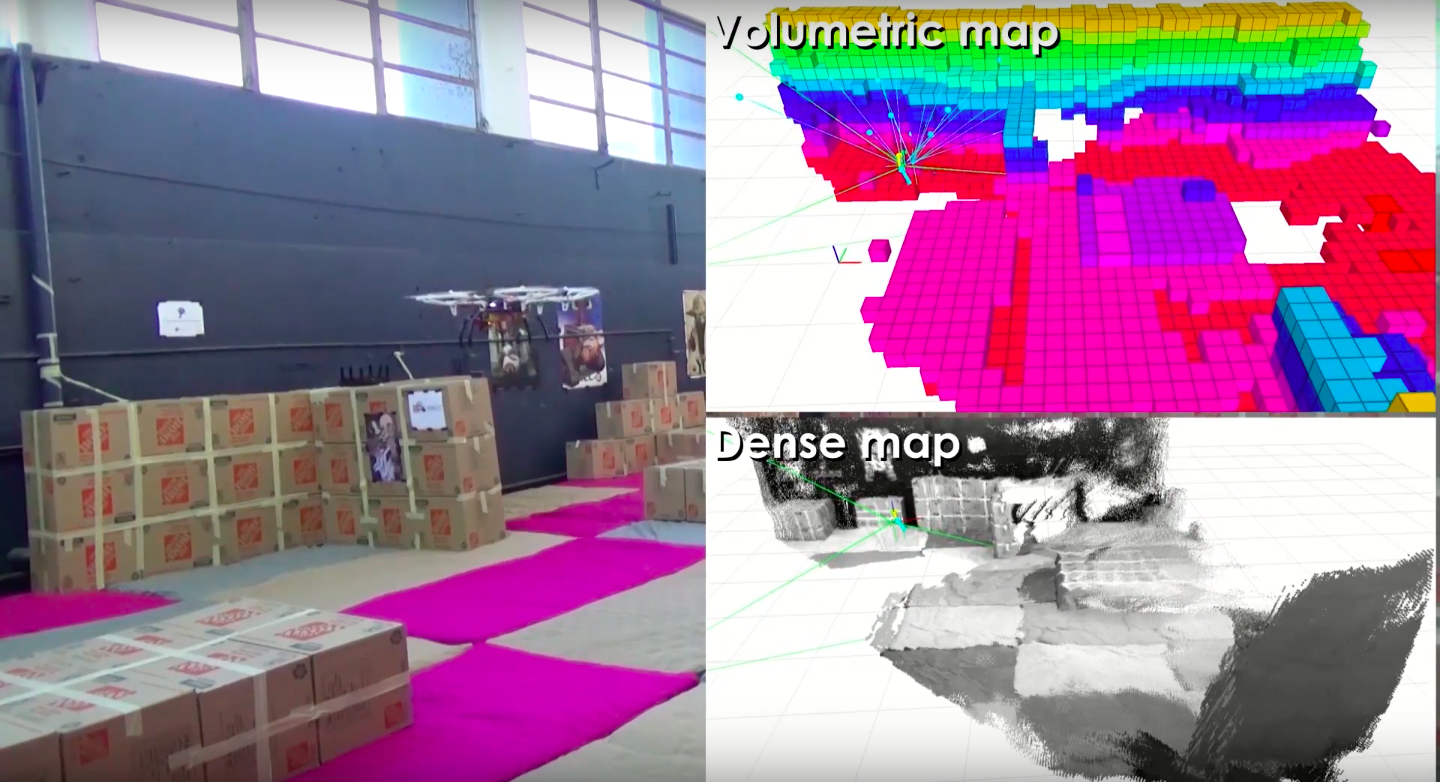
Autonomous exploration and reliable mapping of unknown environments corresponds to a major challenge for mobile robotic systems. For many important application domains, such as industrial inspection or search and rescue, this task is further challenged from the fact that such operations often have to take place in GPS-denied environments and possibly visually-degraded conditions.
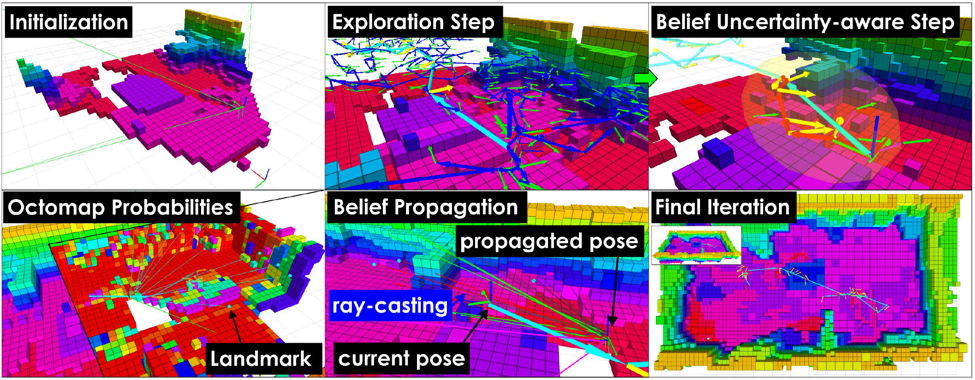
Source: Dr Kostas Alexis, UNR

In this work, we move away from deterministic approaches on autonomous exploration and we propose a localization uncertainty-aware autonomous receding horizon exploration and mapping planner verified using aerial robots. This planner follows a two-step optimization paradigm. At first, in an online computed random tree the algorithm finds a finite-horizon branch that optimizes the amount of space expected to be explored. The first viewpoint configuration of this branch is selected, but the path towards it is decided through a second planning step. Within that, a new tree is sampled, admissible branches arriving at the reference viewpoint are found and the robot belief about its state and the tracked landmarks of the environment is propagated. The branch that minimizes the expected localization uncertainty is selected, the corresponding path is executed by the robot and the whole process is iteratively repeated.

The algorithm has been experimentally verified with aerial robotic platforms equipped with a stereo visual-inertial system operating in both well-lit and dark conditions, as shown in our videos:

To enable further developments, research collaboration and consistent comparison, we have released an open source version of our localization uncertainty-aware exploration and mapping planner, experimental datasets and interfaces. To get the code, please visit: https://github.com/unr-arl/rhem_planner

This research was conducted at the Autonomous Robots Lab of the University of Nevada, Reno.


Reference:

Christos Papachristos, Shehryar Khattak, Kostas Alexis, “Uncertainty-aware Receding Horizon Exploration and Mapping using Aerial Robots,” IEEE International Conference on Robotics and Automation (ICRA), May 29-June 3, 2017, Singapore

If you liked this article, you may also want to read:


tags: ,


Christos Papachristos is a PostDoctoral Researcher, Autonomous Robots Lab, at University of Nevada, Reno.

Shehryar Khattak is a PhD Candidate, at the Autonomous Robots Lab, University of Nevada, Reno.

Kostas Alexis is an assistant professor at Computer Science & Engineering of the University of Nevada, Reno

            AUAI is supported by:


Subscribe to Robohub newsletter on substack


Related posts :

AI brings object-level vision prosthetics closer to reality

  23 Jun 2026
Researchers are developing AI models that could one day enable vision prosthetics able to restore meaningful, object-level sight for the blind.

AURA Foresight Reaches Global XPRIZE Wildfire Finals in Alaska

  19 Jun 2026
One of only four teams remaining from more than 130 competitors worldwide, our team AURA Foresight is developing autonomous technology to stop wildfires before they grow out of control. AURA Foresi...

Robot Talk Episode 161 – Collaborative haptic systems, with Allison Okamura

  19 Jun 2026
In the latest episode of the Robot Talk podcast, Claire chatted to Allison Okamura from Stanford University about developing advanced robotic systems for haptic (touch) interaction.

New research enables a robot to chart a better course

  17 Jun 2026
By rapidly generating a smooth path plan that cuts travel time and avoids obstacles, the open-source “MIGHTY” system could streamline disaster recovery and parcel delivery.

Entangled robotic matter with cohesive motion

  15 Jun 2026
Engineers have developed a robotic collective that behaves less like a machine and more like a material that flows.

Robot Talk Episode 160 – Robotic blacksmiths, with Edward Mehr

  12 Jun 2026
In the latest episode of the Robot Talk podcast, Claire chatted to Edward Mehr from Machina Labs about their RoboCraftsman that shapes complex metal parts for the aerospace, defence, and automotive industries.

Congratulations to the #AAMAS2026 best paper award winners

  08 Jun 2026
Find out who won in the categories of best paper, best student paper, and best blue sky paper.

Robot Talk Episode 159 – Robot sensing and manipulation, with Maria Koskinopoulou

  05 Jun 2026
In the latest episode of the Robot Talk podcast, Claire chatted to Maria Koskinopoulou from Heriot-Watt University about autonomous robotic manipulators for surgery, industry, and beyond.


AUAI is supported by:


Subscribe to Robohub newsletter on substack


©2026.05 - Association for the Understanding of Artificial Intelligence