Robohub.org
Soft robotics for adaptive building facades
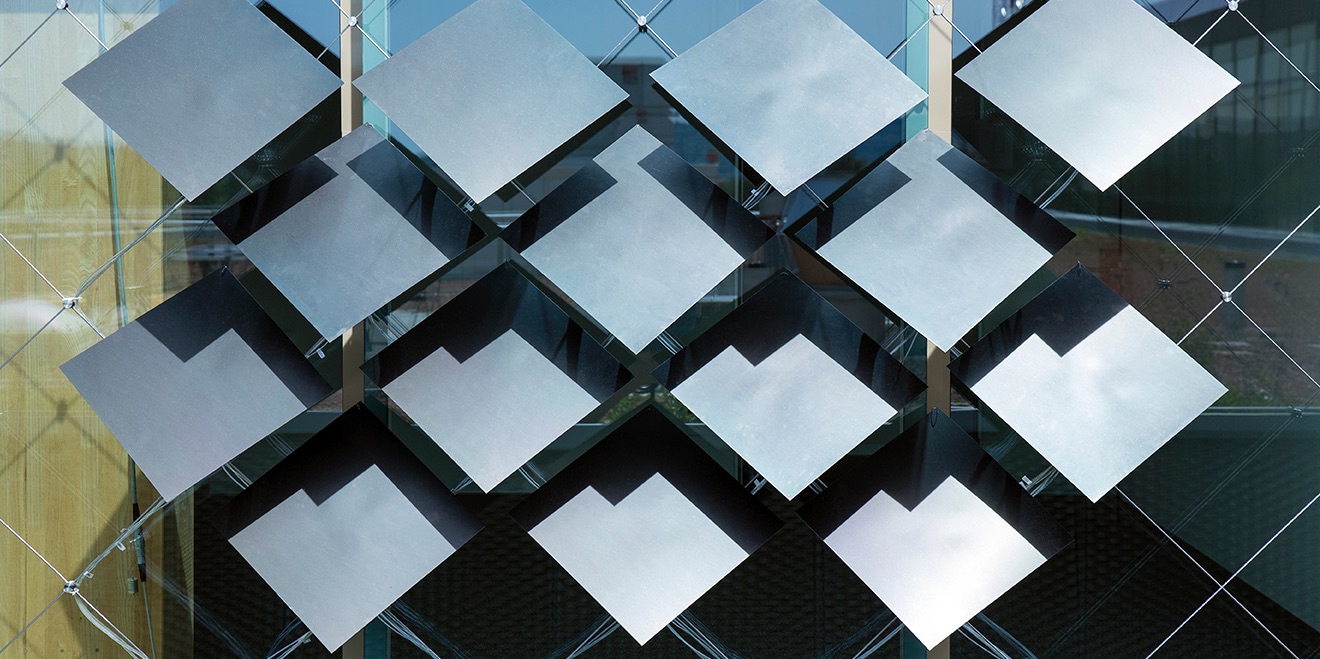
The adaptive solar façade is assembled on the south side of the House of Natural Resources. (Photo: Marco Carocari)
By Arno Schlüter
Today, building envelopes tend to be static and unable to adapt to changing conditions. Now, for the first time, an adaptable façade has been used for the newly inaugurated House of Natural Resources (HoNR) that produces electricity and regulates light and heat generation.
The envelope of a building is of great importance to its energy balance, and insulation and air-tightness have improved significantly in recent years. But there is also significant untapped potential when it comes to contributing to the transition of our energy system towards renewable energy sources: the building envelope of a building, particularly the façade, can be designed to recover heat and generate electricity.
From rigid to dynamic structures
As the boundary between interior and exterior spaces, the façade influences the air, light and heat balance of a building significantly – and thus has a direct impact on the comfort of users. Both spaces are stochastic by nature: they change constantly and conditions are at best only vaguely predictable. And yet the envelope of a building is usually static, focusing on only one or just a few different situations. Today’s building envelope is rarely adaptable to changes in weather or the use of a room. This considerable potential for energy conservation and generation, as well as improved comfort, remains unused.
At the Chair of Architecture and Building Systems, we are researching approaches to make the building envelope more dynamic, efficient and adaptive. One example is the adaptive solar façade, which consists of individual modules mounted on a cable network on the façade. By adjusting the amount of solar radiation through the window, they can control the light and heat of the internal space and at the same time produce electricity through highly efficient thin-film solar cell modules. The adaptive solar façade is also very lightweight, so in contrast to traditional photovoltaic panels it can be mounted almost anywhere, including on existing buildings.
Soft robotics for adaptability
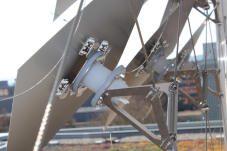
The soft actuator can move the module. (Photo: Professorship of Architecture and Building Systems)
The modules are moveable thanks to a new device, the soft robotic actuator, which originates from a new and promising field of robotics, soft robotics. It is made of flexible materials that take multiple forms when the pressure in the special chambers change. Such actuators are normally used mainly for prosthetic and biomimetic robots; we are now exploring and developing them for future energy and climate systems in buildings.
Our soft actuator is manufactured with a specially developed hollow casting process and the chamber is then filled with air. Valves control the air flow by pumping or releasing air to deform the actuator and thus move the solar element selectively. With soft actuators, we can control each adaptive solar façade module individually and rotate it on two axes, either on its own or in groups. This enables the modules to track the sun’s movement and generate power, use or limit solar power, create privacy or open up the view. An intelligent and adaptive regulator allows the façade to adapt to changing weather conditions and the habits and wishes of the user.
Prototype at the House of Natural Resources
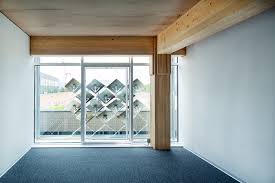
A view of the adaptive solar façade from inside the building. (Photo: Marco Carocari)
Without soft actuators, such functionality would be possible only through a complex combination of several mechanical parts. These would be less durable and more expensive – making it unlikely that they would achieve widespread use in façades. In contrast, our actuator costs only a few francs when produced industrially. The soft actuator has been proven to be robust in cyclic tests in the laboratory; now it has to prove that it is just as effective in the harsh conditions of a building façade. To test this, along with various other factors, we have assembled a prototype façade of 50 modules on the south side of the House of Natural Resources (HoNR).
The module uses highly efficient copper indium gallium selenide (CIGS) thin-film solar cells for top performance: the solar cells are developed by the EMPA spin-off Flisom [1], our industrial partner in the project. First life-cycle calculations have shown that it would take only 18 months for the adaptive solar façade to offset the CO2 emitted in the module’s manufacture.
As part of the EU Climate-KIC’s Building Technology Accelerator flagship project [2], we are currently investigating how and in what form the adaptive solar façade, and thus the soft actuator, can be developed into a marketable product. If this is successful, our adaptive façade could contribute to the efficient generation of building energy and thus to energy transition.
Further information
House of Natural Resources HoNR
Website of the Chair of Architecture and Building Systems.
References:
[1] EMPA spin-off Flisom
[2] EU Climate-KIC BTA flagship project
tags: architectural robotics, ETH Zurich, research, robohub focus on soft robotics, soft robotics

AUAI is supported by: