Robohub.org
 

Teaching robots the physics of sliding and pushing objects

by
16 June 2016


share this:

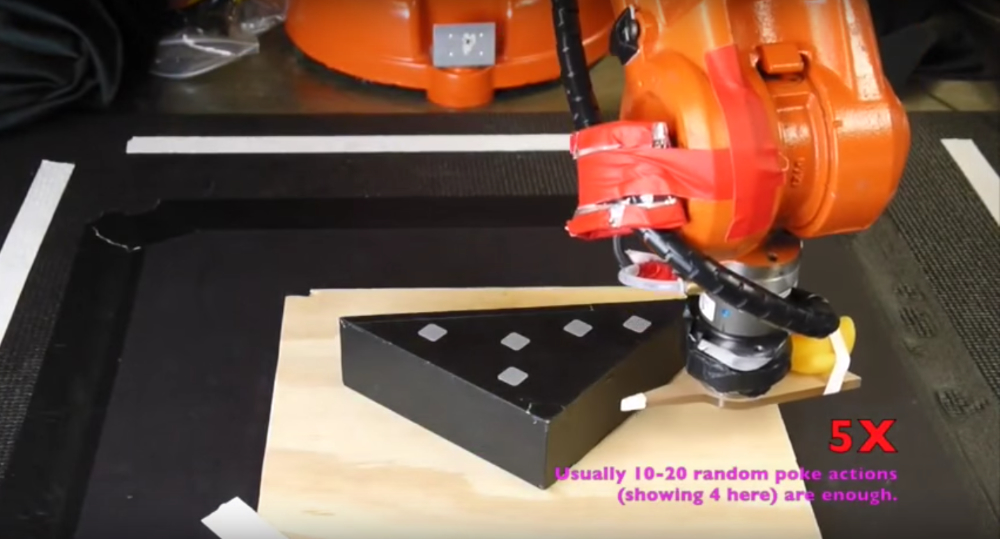
Robot learns to push object and identifies patch friction model. Source: YouTube

Robot learns to push object and identifies patch friction model. Source: YouTube


The Manipulation Lab at the CMU Robotics Institute proposes a computational model that relates an applied robot action to the resultant object motion. Their research won the Best Conference Paper Award at ICRA 2016.

Understanding the mechanics of manipulation is essential for robots to autonomously interact with the physical world. One of the common manipulation scenarios involves pushing objects in a plane subject to dry friction. We propose a planar friction (force-motion) model that relates an applied robot action to the resultant object motion.
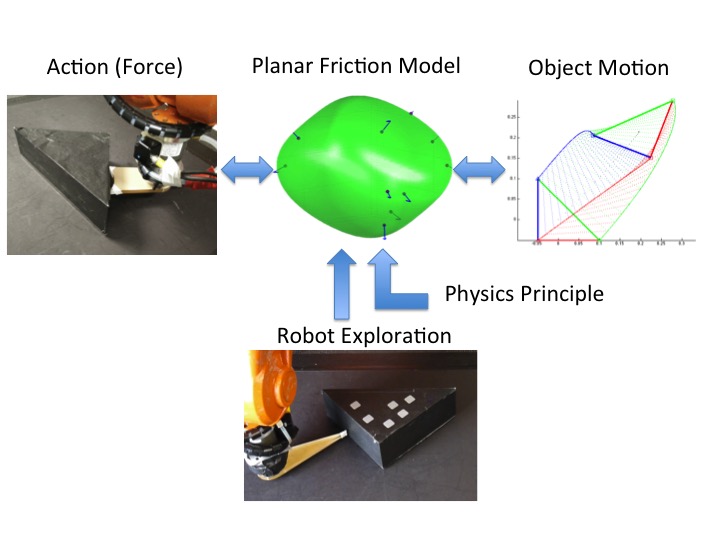
The robot randomly pokes the object of known shape with a point finger to collect force-motion data. We then optimize a convex polynomial friction representation with physics-based constraints. Based on the representation, we demonstrate applications of stable pushing and dynamic sliding simulation.

The robot randomly pokes the object of known shape with a point finger to collect force-motion data. We then optimize a convex polynomial friction representation with physics-based constraints. Based on the representation, we demonstrate applications of stable pushing and dynamic sliding simulation.

The difficulty lies in that the contact between the object and supporting surface is an area-to-area contact with unknown pressure distribution. We don’t know which part of the area is supporting how much weight nor do we know the coefficient of friction. This makes object motion hard to predict. The key observation is the space of generalized friction force forms a convex set based on the principle of maximum dissipation (a generalized Coulomb’s friction law) [1]. The boundary of such set is termed as limit surface [2]. The geometry of such surface, albeit convex, can be complicated. Fortunately, we have shown that level sets of sum of squares convex polynomials turn out to be good geometric approximations. Another advantage is the model is very data-efficient, i.e., model identification only requires few force and velocity data collected by the robot pushing the object with a point finger. There are some additional nice provable properties of the models, and with these properties, we are able to perform applications including stable pushing and free sliding dynamics simulation.

[1] J. J. Moreau, “Unilateral contact and dry friction in finite freedom dynamics,” in Nonsmooth Mechanics and Applications, pp. 1–82, Springer, 1988.

[2] S. Goyal, A. Ruina, and J. Papadopoulos, “Planar sliding with dry friction. Part 1. Limit surface and moment function,” Wear, vol. 143, pp. 307–330, 1991.

Paper: A Convex Polynomial Force-Motion Model for Planar Sliding: Identification and Application: Jiaji Zhou, Robert Paolini, James Bagnell, Matthew T. Mason

Read the award winning paper here


tags: ,


Jiaji Zhou is a PhD student in the Robotics Institute of Carnegie Mellon University.

            AUAI is supported by:


Subscribe to Robohub newsletter on substack


Related posts :

Table tennis robot defeats some of world’s best players – why this has major implications for robotics

  18 May 2026
Ace, from Sony AI, is the first robot to beat elite human players in competitive physical sport.

Robot Talk Episode 156 – Rugged robots for dangerous missions, with Gavin Kenneally

  15 May 2026
In the latest episode of the Robot Talk podcast, Claire chatted to Gavin Kenneally from Ghost Robotics about robot dogs for defence, security, and public safety.

Developing active and flexible microrobots

  13 May 2026
This class of robots opens up possibilities for biomedical applications.

How to teach the same skill to different robots

  11 May 2026
A new framework to teach a skill to robots with different mechanical designs, allowing them to carry out the same task without rewriting code for each.

Robot Talk Episode 155 – Making aerial robots smarter, with Melissa Greeff

  08 May 2026
In the latest episode of the Robot Talk podcast, Claire chatted to Melissa Greeff from Queen's University about autonomous navigation and learning for drones.

New understanding of insect flight points way to stable flapping-wing robots

  07 May 2026
The way bugs and birds flap their wings may look effortless, but the dynamics that keep them aloft are dizzyingly complex and difficult to quantify.

Robotically assembled building blocks could make construction more efficient and sustainable

  05 May 2026
Research suggests constructing a simple building from interlocking subunits should be mechanically feasible and have a much smaller carbon footprint.

Robot Talk Episode 154 – Visual navigation in insects and robots, with Andrew Philippides

  01 May 2026
In the latest episode of the Robot Talk podcast, Claire chatted to Andrew Philippides from the University of Sussex about what we can learn from ants and bees to improve robot navigation.


AUAI is supported by:


Subscribe to Robohub newsletter on substack


©2026.02 - Association for the Understanding of Artificial Intelligence