
Robohub.org
194 Chinese robot companies
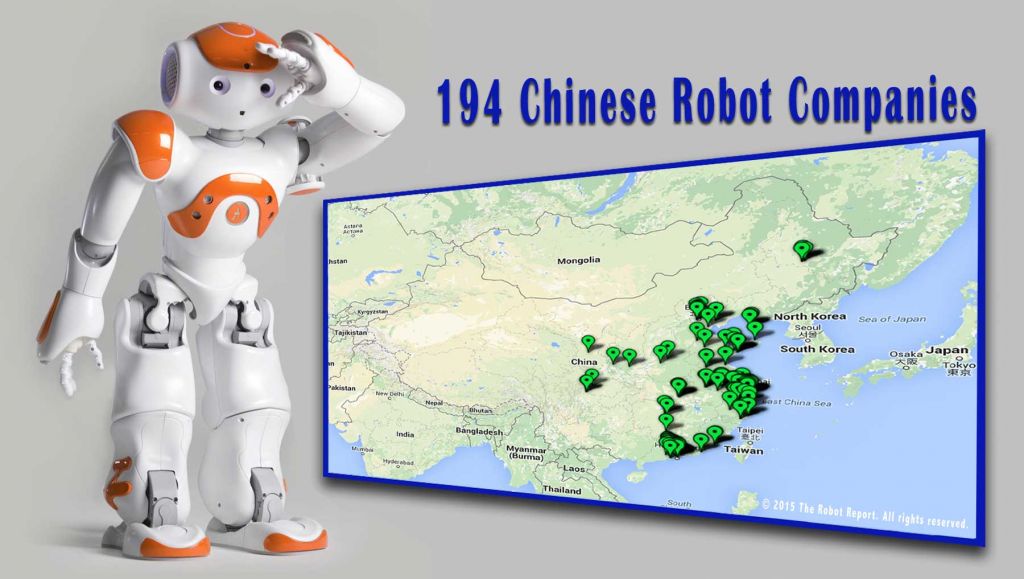 In China, the robotics industry is booming. Companies are deploying thousands of robots in all types of factories, particularly in the auto industry. Chinese companies that manufacture robots and their components are also growing. This article focuses on the robot makers.
China is the world’s largest consumer market of industrial robots for the second consecutive year, according to statistics released by the China Robot Industry Alliance (CRIA). Sales in China increased by 54.6% in 2014 to around 57,000 units, 25% of the global total. Data shows that nearly 17,000 units were made in China with a value of $474m, an increase of 60% from 2013.
Various research reports are predicting that more than 250,000 industrial pick and place, painting and welding robots will be purchased and deployed in China by 2019. That figure represents more than the total global sales of all types of industrial robots in 2014! The Chinese government is encouraging the development of an in-country robotics industry because, currently, three-quarters of all robots purchased are from off-shore companies (albeit some with manufacturing and assembly facilities in China).
We have been able to identify 47 Chinese companies and five startups that call themselves industrial robot makers, and another 26 which offer to provide integration services and speciality equipment. 34 more provide ancillary services, sensors and components to the robot makers. Overall, 107 Chinese companies are involved in industrial robotics. Many of these new industrial robot makers are producing products that, because of quality, safety and design regulations, will only be acceptable to the Chinese market.
In addition to growth in Chinese industrial robotics, progress in the service sector is also healthy. A shining example of the 48 mostly new service robotic companies on the map is Shenzhen DJI Innovations, of quadcopter fame. DJI is projected to sell devices worth $1bn in 2015.
Two other notable growth areas in the service sector are materials handling and the production of unmanned air, sea and ground devices for China’s developing space, military and defense industries.
The consumer sector is also growing: robotic vacuums and personal/social robots are examples. Last “Singles Day,” a brand new shopping holiday in China, Alibaba sold over 70,000 Ecovacs robotic vacuum cleaners!
The drivers propelling this boom are many and varied:
- Government mandates and political encouragement to develop the industry domestically and, ultimately, to export products
- Low-cost loans and factory incentives
- Tax credits for robot users and also to robot makers that employ local workers
- Engineering talent spewing out from Chinese technical universities and research facilities
- Rising wages
- A diminishing factory-age work force
- A rapidly aging work force, hampered by the one-child policy of past regimes
- The high cost of training and housing for a short-term transient work force
- Ramping up of auto makers to satisfy domestic demand and to improve quality and produce Chinese cars for export — for China to have competitive cars in the international marketplace (not just price-competitive), they have to improve quality, consistency and technology — and robotics is enabling them to do so
- Serious investment in automation and robotics from companies, such as Foxconn and Apple, that manufacture their goods in China
- A growing middle and upper class with disposible income for high-tech devices
The Robot Report and the research team at Robo-STOX™ have been able to identify 194 companies that make or are directly involved in making robots in China. The CRIA and other sources, believe the number to be closer to 400.
The Robot Report’s Global Map is limited by our own research capabilities, language translation limitations, and scarcity of information about robotics companies and their websites and contact people. We could use your help in adding to the map. Please send companies that we have missed (or are new) to info@therobotreport.com.
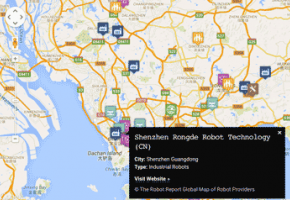 You can explore the map online and filter it in a variety of ways. Use Google’s directional and +/- markers on the left of the map to navigate, enlarge, and hone in on an area of interest (or double click near where you want to enlarge). Click on one of the colored markers to get a pop-up window with the name, type, focus, location and a link to the company’s website.
[Note: the map shows a single entry for the company headquarters regardless how many branches, subsidiaries and factory locations that company might have.]
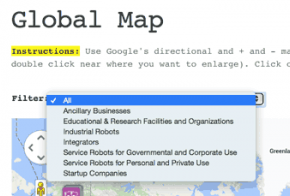 The Filter pull-down menu lets you choose any one of the seven major categories: (1) Industrial robot makers; (2) Service robots used by corporations and governments; (3) Service robots for personal and private use; (4) Integrators; (5) Robotic start-up companies; (6) Universities and research labs with special emphasis on robotics; and (7) Ancillary businesses providing engineering, software, components, sensors and other services to the industry.
As can be seen from the map at the top of the page, most all of the companies and educational facilities are located on the East Coast or in Central China; very few are located in the Northeast or in Western China.
The research firms forecasting dramatic growth for the domestic Chinese robotics industry are also predicting very low-cost devices. Their reports are contradicted by academics, roboticists and others who point out that there are so many new robot manufacturing companies in China that none will be able to manufacture thousands of robots per year and thus benefit from scale. Further, many of the components that comprise a robot are intricate and costly, e.g., reduction gears from Nabtesco, Harmonic Drive and Sumitomo (all Japanese companies). Although a few of the startups are attempting to make reduction gears and other similar devices, the lack of these component manufacturers in China may put a cap on how low costs can go and on how much can be done in-country for the time being. Another negative is that all but auto manufacturers have short product cycles requiring any robots on the line to be extremely flexible. Worker flexibility is still crucial in Chinese manufacturing.
In the chart below, the 194 Chinese companies are tabulated by their business type and area of focus.

Again, we request your help adding to the map and making it as accurate and up-to-date as possible. Please send robotics-related companies that we have missed (or new ones) to info@therobotreport.com.
tags: automotive, business, China, household, industrial, manufacturing, mapping & surveillance, space

AUAI is supported by:









